Mechanics & Motion
Interactive simulators for classical mechanics, forces, springs, and oscillations
8 tools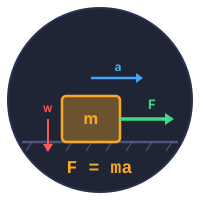
Understanding Classical Mechanics Through Interactive Simulation
Classical mechanics is the foundation of all engineering disciplines. It governs how objects move, how forces interact, and why structures stand or fall. For TVET and vocational students entering fields such as mechanical maintenance, automotive technology, manufacturing, and civil construction, a firm grasp of mechanics is not optional — it is essential. Yet the subject can feel abstract when taught only through textbooks and equations. These eight interactive simulators bridge that gap by letting you see forces, adjust parameters, and observe outcomes in real time, turning dry formulas into hands-on understanding.
Newton’s Laws — The Rules That Govern Every Motion
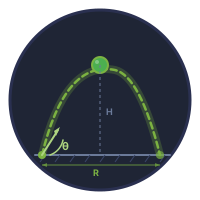
Isaac Newton’s three laws of motion form the bedrock of classical mechanics. The First Law (the law of inertia) tells us that objects resist changes to their state of motion. The Second Law, F = ma, quantifies how force produces acceleration proportional to mass. The Third Law ensures that forces always come in equal-and-opposite pairs. In our Newton’s Laws simulator, you can apply forces to objects of different masses, watch free body diagrams update live, and develop an intuitive feel for how F = ma plays out before ever plugging numbers into a calculator. The Projectile Motion simulator extends these principles into two dimensions, letting you launch objects at various angles and velocities under Earth, Moon, or Mars gravity while observing parabolic trajectories, velocity vectors, and the effect of air resistance.
Friction, Simple Machines, and Mechanical Advantage
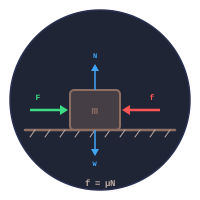
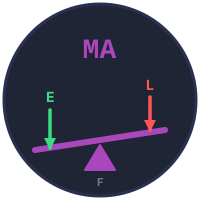
No real-world system is frictionless. The Friction & Contact Forces simulator models static and kinetic friction on flat surfaces and inclined planes, showing exactly when an object begins to slide and how the coefficient of friction changes the outcome. Understanding friction leads naturally to simple machines — the lever, pulley, inclined plane, wheel and axle, screw, and wedge — which humanity has used for millennia to multiply force. The Simple Machines simulator lets you calculate mechanical advantage (MA), velocity ratio (VR), and efficiency interactively, reinforcing the principle that while machines can multiply force, they can never multiply energy.
Springs, Oscillation, and Vibration Analysis
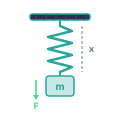
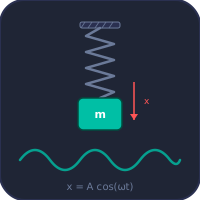
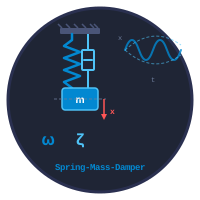
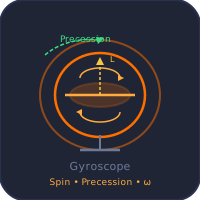
Robert Hooke discovered that the restoring force of an elastic material is proportional to its deformation: F = kx. This linear relationship, explored in our Hooke’s Law simulator, underpins the behaviour of springs in series and parallel, suspension systems, and load cells. When a mass on a spring is released, it oscillates — this is simple harmonic motion (SHM). The SHM simulator shows displacement, velocity, and acceleration sinusoids together with energy graphs, making it clear how kinetic and potential energy trade places continuously. Real systems, however, always include damping and sometimes external driving forces. The Vibrations simulator covers free, damped, forced, and resonance modes for a spring-mass-damper system, a model central to machine diagnostics, vehicle suspension design, and earthquake engineering. Finally, the Gyroscope simulator demonstrates angular momentum, precession, and nutation — phenomena critical to navigation systems, satellites, and rotating machinery.
Why Interactive Simulation Helps TVET Students
Traditional lectures present mechanics as a chain of equations on a whiteboard. Interactive simulators flip this approach: students can change a variable — add more mass, increase the angle, raise the damping ratio — and immediately see how the system responds. This trial-and-error exploration builds physical intuition that textbooks alone rarely achieve. Research consistently shows that interactive simulations improve conceptual understanding, particularly in physics, by making abstract force diagrams and energy curves tangible. For TVET students who will work with real machines, this intuition is invaluable — they learn to predict how a system will behave before they ever touch a wrench.
Explore Other Categories
Looking for more simulators? Explore our Mechanisms & Linkages category for cams, gears, and governors, Strength & Materials for beam bending and stress analysis, or Basic Electrical for circuit and motor simulators.