Thermal & Fluid Engineering
Thermodynamics Cycles • Heat Transfer • Heat Exchangers • Fluid Flow • Bernoulli • Pascal • Wind Tunnel • Refrigeration
8 tools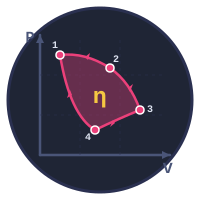

Thermal & Fluid Engineering — Interactive Simulators for Engineering Education
Thermal and fluid engineering form the backbone of countless real-world systems, from power plants and HVAC systems to hydraulic presses and jet engines. These disciplines study how energy transfers as heat, how fluids behave under different conditions, and how thermodynamic cycles convert thermal energy into useful work. Our collection of 8 interactive simulators brings these abstract concepts to life, enabling TVET and engineering students to experiment with parameters and observe results in real time.
Thermodynamics & Power Cycles
The study of thermodynamics revolves around energy conversion. Our Thermodynamics Cycles simulator lets you explore the four fundamental power cycles: the ideal Carnot cycle, the Otto cycle used in petrol engines, the Diesel cycle used in compression-ignition engines, and the Brayton cycle powering gas turbines. Each cycle is displayed on an interactive PV diagram with animated piston motion, allowing you to adjust compression ratio and heat input to see how efficiency changes. Understanding these cycles is essential for anyone working with engines, turbines, or power generation systems.
Heat Transfer: Conduction, Convection & Radiation
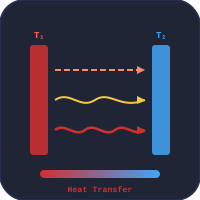
Heat always flows from hot to cold, but the mechanism varies. Our Heat Transfer simulator demonstrates all three modes with animated visualisations. Conduction transfers heat through direct molecular contact (Fourier’s law: q = −kA·dT/dx), convection involves bulk fluid motion (Newton’s law of cooling: q = hAΔT), and radiation transmits energy via electromagnetic waves (Stefan-Boltzmann law: q = εσAT&sup4;). Adjusting material properties and temperatures reveals how insulation, fin design, and surface emissivity affect heat flow rates.
Fluid Mechanics & Flow Analysis
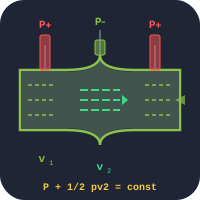
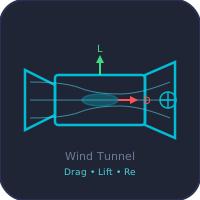
Understanding fluid behaviour is critical in piping systems, aerodynamics, and hydraulic machinery. Our Fluid Flow simulator visualises laminar and turbulent flow with animated particles, calculating the Reynolds number that determines the flow regime. The Bernoulli’s Principle simulator demonstrates how velocity and pressure relate in moving fluids — the foundation of Venturi meters, carburettors, and aircraft lift. The Wind Tunnel simulator lets you test 6 different shapes in a virtual wind tunnel, observing streamlines, pressure distributions, and drag/lift coefficients.
Heat Exchangers
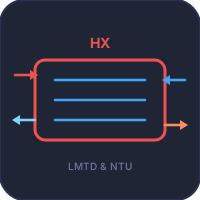
Heat exchangers are vital components in power plants, chemical processing, HVAC systems, and automotive cooling. Our Heat Exchanger simulator models a shell-and-tube heat exchanger using both the LMTD (Log Mean Temperature Difference) and NTU-effectiveness methods. You can switch between parallel-flow and counter-flow configurations, adjust inlet temperatures and flow rates, and observe how the temperature profiles and overall effectiveness change. Understanding heat exchanger design is essential for any thermal systems engineer.
Hydraulics & Refrigeration
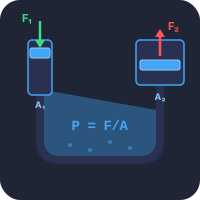
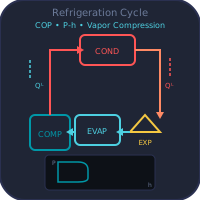
Pascal’s law — pressure applied to a confined fluid is transmitted equally in all directions — is the principle behind every hydraulic press, brake system, and lifting platform. Our Pascal’s Law simulator lets you experiment with piston sizes to understand force multiplication and mechanical advantage. The Refrigeration Cycle simulator models the vapour compression cycle used in refrigerators and air conditioners, with a P-h diagram, COP calculations, and four different refrigerants to compare environmental and performance trade-offs.
Who Uses These Simulators?
These tools serve TVET students studying mechanical and electrical engineering, university undergraduates in thermodynamics and fluid mechanics courses, instructors preparing demonstrations, and working engineers who need quick reference calculations. The interactive approach — adjusting parameters and seeing immediate visual feedback — bridges the gap between textbook theory and practical understanding, all without requiring expensive laboratory equipment or professional simulation software.
Explore Other Categories
Beyond thermal and fluid engineering, explore our Mechanics & Motion simulators for force and motion fundamentals, Strength of Materials simulators for stress analysis and structural design, and Basic Electrical simulators for circuit analysis and motor characteristics.