Interactive Mechanics & Motion Simulators
Forces that balance, bodies that move, things that spin and things that swing. These tools cover statics, kinematics and dynamics from Newton’s laws to orbits, gyroscopes and resonance — and each one draws the forces or the motion it is solving.
- 18 tools
- 4 topics
Statics & Friction
Bodies that do not move: forces in balance, the reactions supports provide, and the friction that holds or resists.
Free Body Diagram & Support Reactions
Build a particle or rigid body with pin, roller, fixed and cable supports and solve ΣF = 0, ΣM = 0 — in newtons or kip.
Simple Machines
Lever, pulley, inclined plane, wheel and axle, screw and wedge: mechanical advantage, velocity ratio and efficiency.
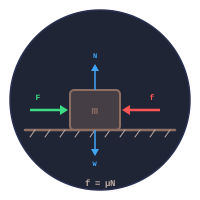
Friction
Static and kinetic friction on flat surfaces and inclined planes, with the free body diagram drawn live.
Motion & Newton’s Laws
Why and how things move in a line or a curve: force and acceleration, falling, launching, orbiting and colliding.
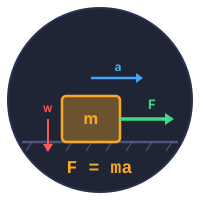
Newton’s Laws of Motion
F = ma, inertia and action–reaction, with an Atwood machine and a rocket.
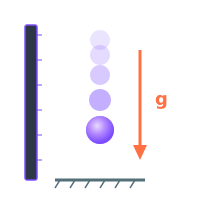
Free Fall & Terminal Velocity
Drop a ball with real air resistance and compare Earth, the Moon, Mars and Jupiter.
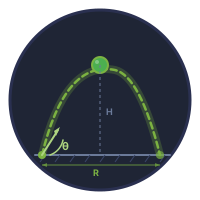
Projectile Motion
Range, maximum height, time of flight and impact velocity for any launch angle, speed and height.

Gravity Simulator
Real N-body orbits: Kepler’s laws, the Solar System, binary stars, Lagrange points and three-body chaos.

Escape Velocity & Orbits
Newton’s cannonball under inverse-square gravity: fall back, orbit or escape.
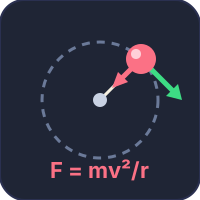
Centripetal Force & Circular Motion
F = mv²/r calculator plus 11 set-ups: banked curves, vertical loops, conical pendulum, orbits, and the rotating frame.

Collisions & Momentum
Air-track gliders, 2D pucks, a ballistic pendulum and a crash-test rig: momentum, energy, impulse and restitution.
Rotation & Angular Momentum
The rotational twin of every linear law: torque for force, moment of inertia for mass, angular momentum for momentum.
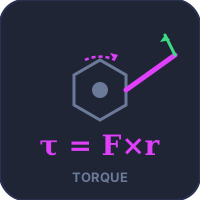
Torque & Rotation
Wrenches, seesaws, spinning discs and shapes racing down an incline: torque and rotational inertia.
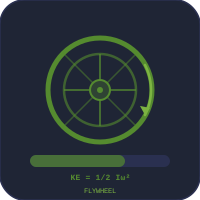
Flywheel Energy
Rotational kinetic energy, mass moment of inertia and rim stress of disc, ring and spoked flywheels.
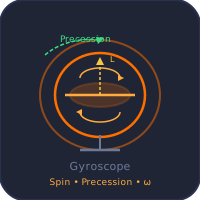
Gyroscope
Precession, nutation and angular momentum as spin speed, mass and tilt change.
Oscillations & Vibrations
Motion that repeats: springs and pendulums, damping and resonance, and the sound a vibrating body makes.
Hooke’s Law Experiment
Hang slotted masses, read the extension and take the spring constant from the gradient.
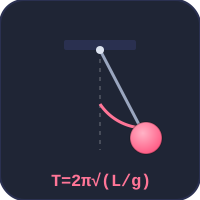
Simple Pendulum
Period, frequency and the kinetic–potential energy exchange on Earth, the Moon, Mars and more.
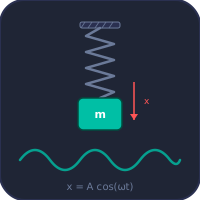
Simple Harmonic Motion
Spring-mass and pendulum oscillation with live displacement, velocity and energy graphs.
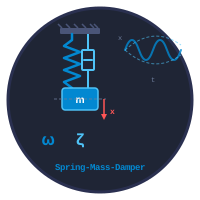
Damped & Forced Vibration
Spring-mass-damper systems: natural frequency, damping ratio and resonance.

Tuning Fork & Resonance
Pitch from prong geometry and material, beats, and the speed of sound in a resonance tube.
Statics, Kinematics and Dynamics
Mechanics splits into three questions. Statics asks what forces hold a body still — the support reactions under a beam, the effort a lever needs, the friction that stops a block sliding. Kinematics describes motion without asking why: position, velocity and acceleration against time, as in a falling ball or a projectile’s arc. Dynamics connects the two through Newton’s laws, then extends them to energy and momentum, to rotation, and to motion that repeats. The four groups on this page follow that path, and every tool in them draws the forces or the motion it is computing.
Which Principle, Which Tool
Most problems in a mechanics course are an application of one of a dozen relations. The table pairs each with the simulator that shows it.
| Principle | Relation | Where it appears |
|---|---|---|
| Equilibrium | ΣF = 0 · ΣM = 0 | Free body diagram, simple machines |
| Dry friction | F ≤ μsN · F = μkN | Friction |
| Second law | ΣF = ma | Newton’s laws |
| Constant acceleration | s = ut + ½at² · v² = u² + 2as | Free fall, projectiles |
| Gravitation | F = GMm/r² · vesc = √(2GM/r) | Gravity simulator, escape velocity |
| Impulse and momentum | FΔt = Δ(mv) | Collisions |
| Rotation | τ = Iα · KE = ½Iω² | Torque, flywheel |
| Angular momentum | L = Iω | Gyroscope |
| Elasticity | F = kx | Hooke’s law |
| Simple harmonic motion | ω = √(k/m) · T = 2π√(L/g) | SHM, pendulum |
| Damping | ζ = c / 2√(km) | Vibration |
A Sensible Order to Work Through
- Forces and equilibrium — free body diagrams first; every later topic depends on drawing them correctly.
- Friction and simple machines — equilibrium applied to real contact and to mechanical advantage.
- Kinematics — free fall and projectiles with constant acceleration, then what air resistance changes.
- Newton’s laws, then momentum and collisions, then gravitation and orbits.
- Rotation — torque, moment of inertia, rotational energy and angular momentum.
- Oscillation — springs and pendulums, then damping, forced vibration and resonance.
From Physics Class to Engineering Mechanics
The same principles carry straight into engineering. Equilibrium and free body diagrams are the first step of every strength of materials problem. Rotation, flywheels and vibration become the dynamics of machines in the mechanisms collection, where the concern is a governor holding an engine’s speed or a flywheel smoothing its torque. And the idealisations a school course makes — no air resistance, a frictionless pulley, an undamped spring — are exactly what several of these tools let you switch back on, so you can see how much each one changes the answer.
Frequently Asked Questions
What is the difference between statics, kinematics and dynamics?
Statics studies bodies in equilibrium, where the forces and moments balance. Kinematics describes motion - position, velocity and acceleration - without asking what causes it. Dynamics explains motion from its causes, using Newton's laws, energy and momentum.
Are these for physics or for engineering mechanics?
Both. The content matches school and first-year university physics, and the same principles open an engineering mechanics course. Tools such as the free body diagram solver, which works in newtons or kip and flags indeterminate supports, go beyond a typical school syllabus.
Why do some of the simulators include air resistance?
Textbook problems usually ignore it, and for a heavy ball dropped a few metres that is a good approximation. For a light object, a long fall or a fast projectile it is not: the object approaches a terminal velocity and falls short of the ideal range. Being able to switch drag on shows when the simple equations hold and when they do not.
Where are the machine design and mechanism simulators?
Linkages, cams, gears, governors and flywheels in engines are in Mechanisms & Machines. Bearing life, gear strength and hydraulic cylinder sizing are machine-design calculations and are in Strength of Materials and Engineering Calculators.
Explore Related Simulators
Updated