Buoyancy & Archimedes’ Principle Simulator
Fb = ρfluid · Vdisp · g — Drop, Float, Sink • Simulate • Explore • Practice • Quiz

Display Controls
Σ Live equations — values substituted from current state
⚖ Material comparison — floats vs sinks at current fluid
💡 What-if coach — insights from current values
1 Overview
This is a virtual lab for Archimedes’ principle, and it runs two pieces of apparatus over one physics engine.
- Tank — a glass tank of real inside dimensions, 40 × 30 × 35 cm (a base of 1200 cm², holding 42 L). You pour in a measured volume of fluid and lower a body into it. The level rises by the volume the body pushes aside — one litre displaced lifts it by 0.83 cm — and once the tank is full the surplus goes over the rim.
- Archimedes Rig — the same tank fitted with an overflow spout and filled to it. The body hangs from a spring balance and you lower it by a measured depth; everything it displaces runs out of the spout into a catch beaker standing on a second balance. The weight lost by the spring balance and the weight gained by the beaker are the same number, and that equality is Archimedes’ principle.
Ten solids (cork 250 through lead 11 340 kg/m³) and six fluids (ethanol 789 through mercury 13 534 kg/m³) cover the whole density range, including the result that lead floats on mercury. Four modes — Simulate, Explore, Practice, Quiz — and both SI and Imperial units.
2 Choosing the Apparatus and the Body

The Apparatus pills switch between Tank and Archimedes Rig. The Shape pills choose a cube, a sphere or an upright cylinder (height = diameter) — and the shape is real, not a picture: the buoyant force is the same for equal volumes, but the draft (how deep the lowest point sits) is solved from that shape’s own geometry. A floating cube sits with 91.7 % of its height under water when it displaces 91.7 % of its volume; an equal-volume sphere sits with only 82.3 % of its diameter under, because a sphere’s cross-section is not constant.
Object Volume runs from 0.1 to 12 L — the largest body that still fits inside the tank for every shape. Fluid Poured In (Tank) sets how many litres go into the tank, in litres rather than a percentage, because that is the quantity you would actually measure out. Immersion Depth (Rig) lowers the body by a measured depth in centimetres.
Ten presets set up classic scenarios in one click. The first two are rig experiments — Eureka Can (the opening state) and Find a Density — and the rest are tank scenarios: Ice in Water, Iceberg Tip, Lead on Mercury, Steel Sinks, Salt vs Fresh, Cork Bobber, Too Little Water (a body that would float, stranded in a shallow tank) and Spill Over. Use + Object or + Fluid to add a material of your own.
3 Running the Tank Experiment
Switch Apparatus to Tank (or click the Ice in Water preset), then click and drag the parked body down into the fluid — let go partway and gravity and buoyancy finish the job. The body falls, splashes and settles at its equilibrium depth. (The action button follows the body: it reads ▼ Drop It In while the body waits on the rim and ↥ Pull It Out once it is in the fluid. Space does the same thing.) Watch three things at once:
- the waterline climbing — the dashed gold line marks where it was before, and the callout gives Δh;
- the force vectors — red weight down, blue buoyant force up, and a green N for whatever the tank floor is carrying;
- the Displacement panel, which compares the body’s whole volume against the part of it under the surface.
Reduce Fluid Poured In until a floating body grounds: the buoyant force falls, the floor starts to carry load, and the readout says Aground. Increase the volume of a sinker until the tank overflows: the level stops rising, the surplus is reported as spilled, and the buoyant force stops growing too.
4 Running the Archimedes Rig
This is the standard practical, and it is where the simulator opens: an aluminium cube already fully immersed in the overflow can, with the fluid it displaced sitting in the catch beaker. Drag Immersion Depth back to zero to lift it out and start the experiment yourself, then raise it again (or press ↧ Lower Fully / Space). Read the Weight (W) card first — that is the weight in air.
- The spring balance reading falls as more of the body goes under.
- The catch beaker fills with exactly the volume displaced, and its balance reads the mass caught.
- Weight in air − balance reading = weight of the fluid caught. Check it against the Buoyant Force card — they are the same number.
- Once the body is completely immersed, keep lowering it. Nothing changes. Buoyancy depends on the displaced volume, never on depth.
- With the body fully immersed, the ρ from Weighings card appears: ρobj = ρfluid × Wair / (Wair − Wimmersed). Copper reads 8960 kg/m³ from 43.95 N and 39.04 N — the volume never had to be measured.
Try a body lighter than the fluid and the line goes slack: a string can pull but it cannot push, so a floating body cannot be forced deeper than its natural draft. The tool says so rather than pretending otherwise.
5 The Underlying Theory
Switch to Explore for concept cards in four categories: Basics (the principle, density, why things float, displacement and the level rise), Formulas (Fb = ρVg, the submerged fraction, the draft of a cube versus a sphere, density from two weighings, buoyancy as a pressure difference), Applications (ships, submarines, balloons, hydrometers, the eureka can) and Common Errors — including the two that cost the most marks: “buoyancy increases with depth” and “submerged % of volume = submerged % of height”.
Turn on the Pressure display toggle to see where buoyancy actually comes from: the fluid presses inward everywhere and harder the deeper it is, and for a prism the net of that is exactly (pbot − ptop) × A = ρgV.
6 Practice & Quiz
Practice generates ten kinds of problem: buoyant force on a floating and on a submerged body, submerged fraction, apparent weight, mass from density, density from two weighings, level rise in a tank of known base area, volume from the mass of fluid collected, the draft of a floating cube, and the extra load a floating block can carry. Every problem is stated in the unit system you are working in, and the answer follows from the numbers the prompt prints. Show Solution walks the full working.
Quiz draws six questions from a bank of sixteen and shuffles both the questions and the options, so the answer is never in the same place twice.
7 SI vs Imperial
Click the SI / Imperial pill to convert every readout, badge, slider label, canvas annotation and calculation line. SI uses kg/m³, N, kg, L, cm; Imperial uses lb/ft³, lbf, lb, US gal, in.
One thing does not change: the substitutions in Live equations and Show Calculations stay in SI base units, and the Imperial figure is shown as a conversion of the result. That is deliberate. ρVg is a force only in SI — lb/ft³ is a weight density, so “62.4 × 0.264 × 32.17” is not a number of pounds-force, and printing it as though it were would teach an equation that does not balance.
Useful conversions: 1 kg/m³ ≈ 0.0624 lb/ft³; 1 N ≈ 0.2248 lbf; 1 L ≈ 0.2642 US gal; 1 cm ≈ 0.3937 in.
8 Power Tools
Action bar: a single drop/lift button that reads ▼ Drop It In or ↥ Pull It Out depending on where the body is (Tank), Lower Fully (Rig), Reset, and Undo / Redo.
Keyboard shortcuts: Space drops the body in, or lifts it back out if it is already in the fluid (Tank), and lowers it fully (Rig); Ctrl+Z undoes and Ctrl+Shift+Z redoes.
Custom materials: + Object and + Fluid open the custom-material dialog, where you can name a material and give it any density from 50 to 25 000 kg/m³ (fluids 500–14 000). The dialog shows its ranges in whichever unit system you are working in, and converts your entry back to SI.
Display Controls: Forces, Particles, Equation, Grid, Waterline, Pressure (the hydrostatic overlay) and Depth scale (the centimetre rule up the tank wall and the Δh callout). Your choices are remembered for your next visit.
Show Calculations opens the full derivation for the current state: geometry → mass → weight → displaced volume → buoyant force → the two balance readings (or the floor reaction and the level rise).
Export: CSV saves the whole state including the tank dimensions and the pressures; PNG saves a labelled snapshot. Right-click the canvas for those plus Copy Result and Show Calculations. Share your setup copies a link that reproduces your exact configuration.
Sound feedback: the tool makes a small sound on each control, a soft note when you pick the body up and set it down, a splash as it enters the fluid — louder the faster you push it in — running water while the overflow channel is flowing, and success / error chimes in Practice and Quiz. Nothing is downloaded — every sound is generated by the Web Audio API.
9 Tips & Best Practices
- A uniform solid floats when ρobject < ρfluid. Volume and shape do not change that — only how deep it rides.
- For a floating body, Vsub/V = ρobject/ρfluid. Convert that to a depth only through the body’s own geometry.
- Buoyancy does not increase with depth once a body is fully immersed. Prove it on the rig in ten seconds.
- The level rise is Δh = Vdisplaced / Atank — it depends on the tank, not just the body.
- Sea water (1025 kg/m³) is denser than fresh water, so the same hull sits slightly higher at sea than in a river.
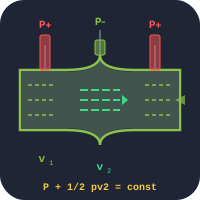
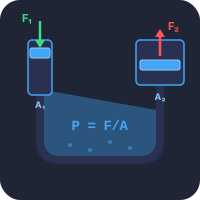
- Pair this lab with the Pascal’s Law and Fluid Flow simulators to cover statics and dynamics together.
Understanding Buoyancy and Archimedes’ Principle

Buoyancy is the upward force a fluid exerts on any object placed in it, and by Archimedes’ principle it equals the weight of the fluid the object displaces: Fb = ρfluid · Vdisplaced · g. A body floats when its average density is below the fluid’s, submerging the fraction ρobject/ρfluid of its volume; a body that sinks still loses that same weight, and the level in the tank rises by Vdisplaced/Atank. This one equation predicts a steel ship, a hot-air balloon and a submarine.
Densities of Common Materials & Fluids
| Material / Fluid | ρ (kg/m³) | ρ (lb/ft³) | Behaviour in Water |
|---|---|---|---|
| Cork | 250 | 15.6 | Floats — 25% submerged |
| Pine wood | 450 | 28.1 | Floats — 45% submerged |
| Ice | 917 | 57.2 | Floats — 91.7% submerged |
| Fresh Water | 1000 | 62.4 | Reference fluid |
| Salt Water (sea) | 1025 | 63.99 | Reference fluid |
| Aluminium | 2700 | 168.6 | Sinks (Wapp ≈ 63% of W) |
| Iron / Steel | 7870 | 491.4 | Sinks (Wapp ≈ 87% of W) |
| Lead | 11 340 | 708.0 | Sinks — but floats on Mercury |
| Mercury (fluid) | 13 534 | 845.0 | Densest common liquid |
The Float-or-Sink Rule
The behaviour of a uniform solid in a fluid is determined entirely by the density ratio ρobject / ρfluid. If the ratio is less than 1, the object floats and the submerged fraction equals the ratio itself. If it is greater than 1, the object sinks but still receives an upward buoyant force equal to its full weight in displaced fluid. This is why a 1 kg steel cube placed on a kitchen scale submerged in water reads only about 0.873 kg — the buoyant force of 1.247 N supports a portion of its weight.
How Much Does the Water Level Rise?
Displacement is the part of Archimedes’ principle that students most often meet only as a word. It has a formula, and it needs the tank as well as the body: the level rises by the displaced volume divided by the tank’s base area.
Δh = Vdisplaced / Atank
A body that sinks displaces its whole volume. A body that floats displaces only ρobject/ρfluid of it — which is why a block of ice raises the level less than an identical block of steel, even though they are the same size. The simulator’s tank is 40 × 30 cm at the base, so:
| Body (1 L) in fresh water | Displaced volume | Δh in a 1200 cm² tank | Δh in a 500 cm² tank |
|---|---|---|---|
| Cork (250 kg/m³, floats) | 0.250 L | 0.21 cm | 0.50 cm |
| Ice (917 kg/m³, floats) | 0.917 L | 0.76 cm | 1.83 cm |
| Steel (7870 kg/m³, sinks) | 1.000 L | 0.83 cm | 2.00 cm |
| Lead (11 340 kg/m³, sinks) | 1.000 L | 0.83 cm | 2.00 cm |
Note the last two rows: once a body sinks, its density stops mattering for the level rise. Lead and steel displace the same litre. The weight they lose differs not at all either — both lose 9.81 N in water, because both displace one litre.
Does Buoyant Force Increase with Depth?
No — not once the body is completely submerged. This is the single most common misconception in hydrostatics, and it survives because the premise is true: pressure really does increase with depth, at ρgh. But the buoyant force is not the pressure on the bottom face; it is the difference between the pressure pushing up on the bottom face and the pressure pushing down on the top face. Lower the body by 1 m and both pressures rise by exactly ρg(1 m). The difference does not change.
For a prism of height H and cross-section A, that difference is ρgH, so the net upward force is ρgHA = ρgV — Archimedes’ principle, derived rather than asserted. The formula Fb = ρfluidVdisplacedg contains no depth term at all. Turn on the Pressure overlay in the simulator and lower a fully immersed body on the Archimedes rig: the arrows on both faces grow, and the spring balance does not move.
Buoyancy does change with depth while a body is still entering the fluid, because Vdisplaced is still growing. That is a different statement, and it stops the moment the body is under.
Draft: Why a Sphere and a Cube Float Differently
The submerged volume fraction of any floating body is ρobject/ρfluid. The submerged height fraction — the draft — is only the same number when the body’s cross-section is constant. For a cube or an upright cylinder it is; for a sphere, a cone or a ship’s hull it is not.
Take ice (917 kg/m³) in fresh water. Both a cube and a sphere displace 91.7 % of their volume. The cube floats with 91.7 % of its height below the surface. The sphere does not: its submerged part is a spherical cap of volume πh²(3R − h)/3, and setting that equal to 0.917 of (4/3)πR³ gives h = 1.6458R, which is 82.3 % of the diameter. A sphere rides visibly higher than a cube of the same material, because its widest part is at the middle.
| Submerged volume fraction | Cube / cylinder draft (of height) | Sphere draft (of diameter) |
|---|---|---|
| 25 % (cork in water) | 25.0 % | 32.6 % |
| 45 % (pine in water) | 45.0 % | 46.7 % |
| 50 % | 50.0 % | 50.0 % |
| 89.5 % (ice in sea water) | 89.5 % | 79.9 % |
| 91.7 % (ice in fresh water) | 91.7 % | 82.3 % |
The two only coincide at 50 %, where the sphere is exactly half under by symmetry. Everywhere else, using the density ratio as a depth is an error — and a drawing that does it is teaching the wrong thing.
The Overflow-Can Experiment, Step by Step
The classical laboratory verification of Archimedes’ principle needs three pieces of apparatus: an overflow (eureka) can, a spring balance, and a catch beaker on a second balance. The Archimedes Rig in this simulator is exactly that rig.
- Weigh in air. Hang the body from the spring balance and record Wair.
- Fill the can to the spout until fluid just stops dripping, and place the empty catch beaker under it.
- Lower the body until it is completely immersed and clear of the bottom. Displaced fluid runs out of the spout.
- Read the balance again. Wimmersed is smaller. The difference is the buoyant force.
- Weigh the fluid collected. Its weight equals Wair − Wimmersed. That equality is the principle.
- Calculate the density without ever measuring the body’s volume:
ρobject = ρfluid × Wair / (Wair − Wimmersed)
A 0.5 L copper cylinder weighs 43.95 N in air and 39.04 N in water. The loss is 4.91 N, and 1000 × 43.95 / 4.91 = 8960 kg/m³ — copper, to three figures. Because the method needs no volume measurement, it works on castings, crowns and any other awkward shape; that is precisely the problem Archimedes is said to have been given.
The Iceberg Ratio — A Worked Example
Ice has a density of 917 kg/m³ and floats on sea water (ρ = 1025 kg/m³). The submerged fraction is 917 / 1025 ≈ 0.895, meaning about 89.5% of an iceberg is hidden below the waterline — only the famous “tip” is visible. For a 1 000 m³ iceberg, that is 895 m³ submerged, exerting a buoyant force Fb = 1025 × 895 × 9.81 ≈ 9.0 MN, exactly equal to the iceberg’s weight.
Why Steel Ships Float
Steel has a density 7.87 times greater than water, so a solid steel block sinks. A ship floats not because steel becomes lighter but because its average density — including the air-filled hull — is less than 1000 kg/m³. Naval architects design hulls to displace many times the boat’s actual mass in water, generating enough buoyant force to support the entire vessel plus cargo. The same logic explains how a hot-air balloon (warm low-density air inside a balloon) floats in the surrounding cooler atmosphere.
Apparent Weight and Submarines
For an object that sinks, its apparent weight in the fluid is Wapp = (ρobject − ρfluid) · V · g. Submarines exploit this by adjusting their average density: pumping water into ballast tanks increases density and the submarine sinks, while pushing the water out with compressed air decreases density and it rises. At neutral buoyancy, the submarine’s density exactly equals the surrounding water’s, and it can hover at any depth.
Why Icebergs Float with Nine Tenths Under Water
The textbook iceberg figure is “one-ninth above water.” That number drops out of the densities directly. Sea ice has a density of about 917 kg/m³; sea water is about 1025 kg/m³. For a floating object in equilibrium, the submerged-fraction equals the ratio of densities:
fsubmerged = ρobject/ρfluid = 917/1025 = 0.895
So 89.5 % submerged, 10.5 % visible. Not exactly one-ninth (which would be 89 % submerged), but the lazy approximation is close enough. The same calculation in fresh water (where icebergs almost never live, but for the exercise) would give 917/1000 = 91.7 % submerged. Salt water buoys things slightly more because it is denser; this is also why swimming pools at the seaside feel easier to float in than freshwater lakes.
A Worked Ship-Displacement Calculation
A ship has 10,000 tonnes of mass. What volume of water does it displace, and how does its draft change when it loads cargo?
| Quantity | Working | Result |
|---|---|---|
| Displaced volume in sea water | V = m/ρ = 10,000,000/1025 | 9756 m³ |
| If hull cross-section at waterline = 1500 m² | Draft = V/A = 9756/1500 | 6.50 m |
| Load 500 tonnes of cargo | ΔV = 500,000/1025 | +488 m³ |
| New draft | (9756 + 488)/1500 | 6.83 m (+0.33 m) |
| Pass from sea water (1025) to fresh river (1000) | New V = 10,500,000/1000 | 10,500 m³ (+256 m³) |
| Draft in fresh water | 10,500/1500 | 7.00 m (+0.17 m) |
Sailors call that last effect the “fresh water allowance” — ships sit deeper when they enter rivers. The Plimsoll line painted on every cargo ship’s hull has different marks for tropical, summer, winter, and fresh-water loading lines to account for this and for seasonal density variation.
Why Helium Balloons Rise (Same Equation, Different Fluid)
Archimedes’ principle is not about water specifically — it is about any fluid. Atmospheric air has density about 1.2 kg/m³ at sea level. Helium has a density of 0.18 kg/m³. A balloon containing helium experiences an upward buoyant force equal to the air displaced, which exceeds the balloon’s own weight, so it rises.
A standard party balloon has about 0.01 m³ of helium. Buoyant force = 1.2 × 0.01 × 9.81 = 0.118 N. Weight of the helium inside = 0.18 × 0.01 × 9.81 = 0.018 N. Net upward force = 0.10 N. That lifts about 10 g, which is roughly the mass of the balloon skin plus its string. A hot-air balloon scales the same calculation up: 2000 m³ of 100 °C air gives a density of about 0.95 kg/m³ vs ambient 1.2 kg/m³; net upward force around 5000 N, enough for a basket and a few people.
How Submarines Hover at Depth
A submarine cannot just be denser than water (it would sink to the bottom) or less dense (it would surface). It needs to be at exactly the water’s density to hover. Submarines achieve this with ballast tanks — large compartments that can be flooded with sea water or emptied with compressed air to fine-tune average density.
The subtle problem: as a submarine descends, the surrounding water density increases slightly (compressibility) and the submarine’s hull is squeezed inward slightly. Both effects make the sub harder to keep at depth without active trim adjustment. Modern nuclear submarines use depth-control hydroplanes and continuous variable-ballast trim to maintain hover precision of a few metres. The simpler ballast-tank approach is sufficient for slower-moving submersibles like research subs.
References
- Cengel, Y. A. & Cimbala, J. M. — Fluid Mechanics: Fundamentals and Applications, 4th ed., Chapter 3 (Pressure and Fluid Statics).
- Lewis, E. V. (ed.) — Principles of Naval Architecture, vol. 1, SNAME. The graduate ship-hydrodynamics reference.
- IMO International Convention on Load Lines (1966) — defines the Plimsoll line for cargo-ship loading.
Explore Related Simulators
If you found this buoyancy simulator helpful, explore our Viscosity Experiment Virtual Lab, Pascal’s Law Simulator, Fluid Flow in Pipes, Bernoulli’s Principle, Specific Heat Capacity, and Thermal Expansion for more hands-on practice.
Updated
Enter a positive value. Range: 50–25 000 kg/m³.