Diode & Rectifier Circuits
PN Junction • Forward/Reverse Bias • Half-Wave • Full-Wave • Bridge — Simulate • Explore • Practice • Quiz
Display Controls
Σ Live equations — values substituted from the current circuit
💡 What-if coach — what these numbers are telling you
1 Overview
The Diode & Rectifier Circuits Simulator lets you explore how semiconductor diodes convert alternating current (AC) into direct current (DC). You can visualise three rectifier topologies — half-wave, full-wave centre-tap, and bridge rectifier — with animated current flow, real-time input and output waveforms, and adjustable smoothing capacitors. The simulator measures DC output voltage, ripple voltage, ripple factor, Peak Inverse Voltage (PIV), rectification efficiency, form factor, crest factor, Transformer Utilisation Factor and voltage regulation off the simulated waveform.
This tool is designed for electronics and electrical engineering students, engineering trainees studying power supplies, and physics learners exploring PN junction diode behaviour, forward bias, and reverse bias characteristics.
2 Building the Circuit

The simulator opens in Simulate mode with a half-wave rectifier at Vpeak = 12 V, f = 50 Hz, Rload = 1000 Ω, Cfilter = 470 μF and Rsource = 2 Ω. To begin:
- Select the Rectifier Type: Half-Wave (single diode), Center-Tap (2 diodes on a centre-tapped secondary), or Bridge (4 diodes in a diamond).
- Set Vpeak (1–60 V) — the peak of the secondary, and for the centre-tap circuit the peak of each half-winding.
- Adjust Frequency (20–2000 Hz). The scope sweep speeds up with it, so you can see as well as calculate why high-frequency supplies are easier to smooth.
- Change Rload (10–20,000 Ω) and Cfilter (0–10,000 μF). Every slider has a number box beside it, so you can type 4700 μF instead of hunting for it.
- Set Rsource (0.1–50 Ω) — the transformer winding plus diode bulk resistance. This is the only thing limiting the charging pulse; with an ideal zero-ohm source the peak diode current would be infinite, which is why a real datasheet quotes a maximum source impedance.
- Toggle the Smoothing Capacitor off to compare filtered against raw pulsating DC.
- Use the six Presets to load a realistic supply — a 5 V USB brick, a 12 V audio rail, an LED driver, a phone charger, the bench supply worked through in the article below, or a centre-tap lab rig.
3 Energising the Circuit
Simulate mode is the main interactive workspace. The canvas is in two halves: the circuit schematic on the left with animated current flow, and a two-channel scope on the right. A yellow cursor sweeps the scope, and the schematic always shows the circuit state at that cursor — which diode is conducting, which is blocking, and what the instantaneous voltages and current are.
- Voltage scope: the AC input and the rectified output are drawn on one shared volts-per-division scale, so the comparison is real. The green dashed line is the measured average, and the amber band is the peak-to-peak ripple.
- Diode-current scope: the trace most textbooks leave out. With a reservoir capacitor the diode conducts for only a small part of the cycle, so all the load charge is delivered in short, tall pulses. Watch the peak climb as you increase C.
- Rectifier Type: half-wave passes one half-cycle; centre-tap uses two diodes and the whole secondary (PIV = 2Vp); bridge uses four diodes with PIV = Vp but two diode drops in the path.
- Display Controls (top-left of the canvas): show or hide the equation overlay, labels, either scope, the current animation and a background grid. Your choices are remembered for next visit.
- Show Calculations: opens an eight-step derivation for the exact circuit on screen, in proper mathematical notation, from the peak after diode drops through to the diode rating you should specify.
- Export CSV / PNG: the CSV carries every reading plus the full 720-sample waveform (time, v_in, v_out, diode current, load current) for plotting in a lab report.
Ten readout cards report Vdc, peak-to-peak ripple, Vpeak_out, Idc, ripple factor, efficiency, PIV, load power, peak diode current and conduction angle. All ten are measured from the simulated waveform, not from a formula, so they always agree with what is drawn.
4 Circuit Theory
Explore mode provides structured educational content in two categories:
- Basics: Covers the PN junction diode, forward bias (conduction above ~0.7 V for silicon), reverse bias (blocking), the V-I characteristic curve, and breakdown voltage.
- Circuits: Explains half-wave, centre-tap full-wave, and bridge rectifier topologies. Covers ripple voltage calculation (Vripple ≈ Idc/(fC) for half-wave, Idc/(2fC) for full-wave), PIV ratings, and how smoothing capacitors fill in the valleys between pulses.
Select any concept card to view detailed explanations with formulas and interactive canvas illustrations.
5 Try a Problem
Practice mode generates problems such as: “A half-wave rectifier has Vp = 15 V. Calculate the average DC output voltage”, “Find the ripple voltage for a bridge rectifier with Idc = 50 mA, f = 50 Hz, C = 470 μF”, or “What is the PIV for a centre-tap rectifier with Vp = 20 V?” Enter your answer and get instant step-by-step feedback.
Quiz mode tests your knowledge with 15 multiple-choice questions covering diode behaviour, rectifier types, ripple calculation, PIV ratings, and capacitor filtering. Review your results and detailed explanations at the end.
6 What the Model Assumes
Every reading comes from a time-domain solve of one settled mains period, sampled 720 times, with the capacitor’s periodic steady state found by bisection rather than by running the transient out. Within that, the deliberate simplifications are:
- Constant-voltage-drop diode. The diode conducts the moment it is forward biased by more than Vf and drops exactly Vf thereafter — the standard piecewise-linear model (Sedra & Smith §4.3). The real exponential knee is softer, so a measured circuit conducts for slightly longer than this predicts.
- No reverse recovery. Real silicon rectifiers keep conducting for a reverse-recovery time trr after the current reverses, which costs efficiency and generates switching noise. That matters above a few kHz and is why fast-recovery and Schottky parts exist; it is not modelled here.
- No temperature coefficient. Vf is fixed. A real diode’s drop falls about 2 mV/°C, so a hot rectifier delivers a little more than this shows.
- One lumped Rsource. Transformer winding resistance, leakage reactance and diode bulk resistance are combined into a single resistance. Real transformers also have leakage inductance, which softens the current pulse further than a pure resistance does.
- Ideal capacitor. No equivalent series resistance (ESR). Real electrolytics have milliohms of ESR that add a step to the ripple waveform and heat the capacitor.
The consequence worth remembering: this tool is accurate for the shape of the waveform and for every quantity derived from it at mains frequencies, and progressively optimistic as you push the frequency slider into the kilohertz, where recovery and leakage inductance start to dominate.
7 Field Tips
- Start with the capacitor switched off to see the basic pulsating DC, then switch it on and watch Vdc jump from 0.318Vp towards Vp. That jump is the whole point of a reservoir capacitor.
- Switch between half-wave and bridge at the same settings: the bridge doubles the ripple frequency and roughly halves the ripple voltage.
- Watch the PIV card while you switch the capacitor on in half-wave mode. It nearly doubles. With the cathode held near +Vp by the capacitor and the anode swinging to −Vp, the diode sees about 2Vp — a trap that has destroyed a great many 1N4001s specified from the unfiltered textbook figure.
- Compare Ipeak with Idc. A ratio of 10–20× is normal for a capacitor-input supply, and it is why rectifier diodes are rated far above the output current and why large supplies need inrush limiting.
- Turn C up and Rsource down together and watch the conduction angle collapse while the peak current explodes — the classic capacitor-input trade-off.
- Efficiency: with no capacitor the reading lands on the textbook 40.6% (half-wave) or 81.2% (full-wave). With a capacitor it reads much higher, because Pdc/Pac is then measuring something different — near-DC output against near-DC input, so only the diode and winding losses count. Both figures are correct; they are answers to different questions.
- Increase frequency and watch ripple fall — this is exactly why switched-mode supplies run at tens of kilohertz and get away with tiny capacitors.
- Centre-tap versus bridge: the centre-tap needs half the diodes and loses half the diode drop, but demands double the PIV and a more expensive transformer. At mains voltages the bridge wins, which is why you rarely see a centre-tap rectifier built after about 1970.
Understanding Diode Rectifier Circuits — Free Interactive Simulator
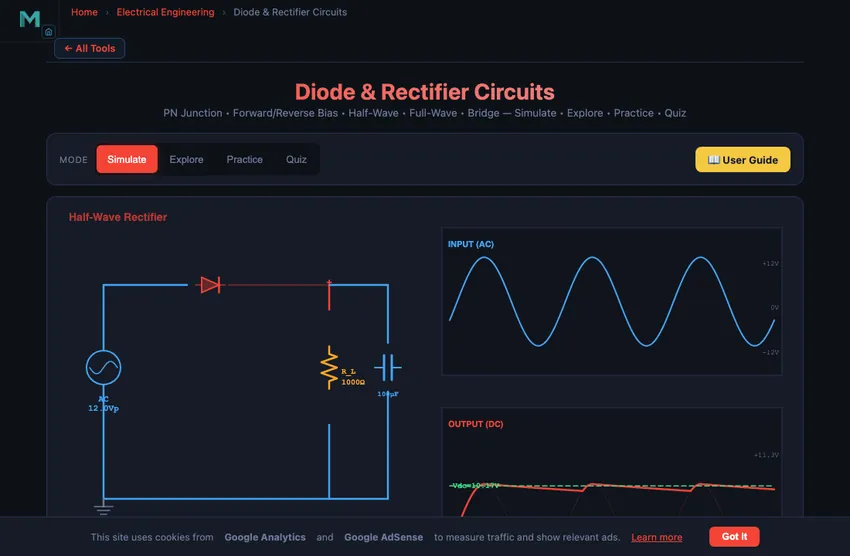
Rectification is the process of converting alternating current (AC) into direct current (DC) using one or more semiconductor diodes. Diode rectifiers are fundamental building blocks in every power supply, from simple battery chargers to the regulated supplies inside computers and industrial equipment. This interactive simulator lets you visualise half-wave, full-wave centre-tap, and bridge rectifier circuits with animated current flow, real-time waveform display, and adjustable smoothing capacitors.
The PN Junction Diode
A diode is a two-terminal semiconductor device that permits current flow in one direction only. When forward biased (anode positive with respect to cathode), the diode conducts with a small voltage drop of approximately 0.7 V for silicon diodes. When reverse biased, the diode blocks current flow (ideally). The voltage-current (V-I) characteristic curve shows an exponential increase in forward current beyond the threshold voltage and near-zero reverse current until breakdown.
Half-Wave vs. Full-Wave Rectification
A half-wave rectifier uses a single diode to pass only the positive half-cycles of the input AC signal, blocking the negative half-cycles entirely. The average DC output voltage is V_dc = V_p / π and the theoretical maximum efficiency is 40.6%. A full-wave rectifier uses either a centre-tapped transformer with two diodes or a four-diode bridge configuration to rectify both half-cycles. This doubles the ripple frequency, producing a smoother output with V_dc = 2V_p / π and efficiency up to 81.2%.
Ripple Voltage and Smoothing Capacitors
The pulsating DC output of a rectifier contains an AC component called ripple voltage. A smoothing capacitor connected in parallel with the load stores charge during voltage peaks and releases it during the valleys between pulses. The ripple voltage is approximately V_ripple = I_dc / (fC) for half-wave and V_ripple = I_dc / (2fC) for full-wave circuits. Larger capacitance and higher load resistance both reduce ripple.
Peak Inverse Voltage (PIV) — and the Half-Wave Trap
The Peak Inverse Voltage is the maximum reverse voltage a diode experiences in the circuit. Without a filter capacitor: half-wave PIV = Vp, centre-tap PIV = 2Vp, bridge PIV = Vp.
Add a reservoir capacitor and the half-wave figure roughly doubles. The capacitor holds the cathode near +Vp while the anode swings down to −Vp, so the diode stands off close to 2Vp. The simulator measures this directly — switch to half-wave, watch the PIV card, then toggle the smoothing capacitor. Size a diode for a 35 V peak supply from the unfiltered figure and 35 V sits comfortably inside a 1N4001’s 50 V rating — but with a reservoir capacitor fitted that part actually stands off about 70 V, well past its rating, and fails in reverse. Standard practice is to derate against the ideal-diode figure — Vp for a bridge, 2Vp for a centre-tap, and about 2Vp for a filtered half-wave — and to specify a part rated at least 1.5× that. The simulator’s PIV card reports what the blocking diode actually stands off, which on a bridge or centre-tap is one forward drop lower; the textbook figure is the safer number to buy against.
Why the Diode Current Comes in Pulses
The trace most textbooks omit is the diode current. In a capacitor-input supply the diode only conducts while the incoming sine is above the voltage already on the capacitor — for a well-filtered supply often under 15% of the cycle, and below 5% with a large reservoir. All the charge the load draws over the whole cycle has to be delivered in that short window, so the peak repetitive current is often 10–20× the DC output current.
This is why a 1 A supply uses diodes rated for several amps, why the transformer runs hotter than its VA rating suggests, and why large supplies need an inrush limiter (an NTC thermistor or a relay-bypassed resistor) — at switch-on the capacitor is empty and the only thing between the mains peak and a dead short is the winding resistance. The simulator makes the trade-off visible: raise the capacitance and the ripple falls while the current pulse gets shorter and taller, and the conduction angle readout collapses.
Two Different Efficiencies
Textbooks quote a maximum rectification efficiency of 40.6% for half-wave and 81.2% for full-wave. Those figures are derived for a purely resistive load with no filter, where the ripple content of the output is counted as wasted power. Run this simulator with the capacitor switched off and those are the numbers you get.
Switch the capacitor on and the measured Pdc/Pac jumps to around 90%. That is not a contradiction: with the output smoothed to near-DC, the only real losses are the diode forward drops and the winding resistance. The two numbers answer different questions: a datasheet quoting a supply’s “efficiency” means the second, while an exam asking for “rectification efficiency” wants the first.
Sizing a Smoothing Capacitor — A 5 V 1 A Bench Supply
Design a bench supply: 12 V RMS secondary from a transformer (16.9 V peak), full-wave bridge rectifier, 5 V regulated output, 1 A load. What smoothing capacitor do you need?
| Step | Working | Result |
|---|---|---|
| Rectified peak (with 2 diode drops, ≈1.4 V) | Vpeak = 16.9 − 1.4 | 15.5 V |
| Ripple frequency (full wave) | fr = 2 × 50 | 100 Hz |
| Required regulator headroom (LM7805 needs ~2 V) | Vmin = 5 + 2 = 7 V at load | Allow Vripple ≤ 15.5 − 7 = 8.5 V |
| Practically aim for Vripple ≈ 1 V (well within margin) | — | — |
| Capacitor sizing | C = I/(fr·Vripple) = 1/(100×1) | 10,000 µF |
Load the Bench 5 V 1 A preset to see this exact design running: 17 V peak into a bridge, 10,000 µF, and the ripple lands close to the 1 V the calculation asked for. A 10,000 µF at 25 V electrolytic capacitor is a reasonable, off-the-shelf part. The size of a small can. That capacitor stores the energy that flows out between rectifier pulses, smoothing the ripple from a sawtooth shape down to a small wiggle the regulator can handle. Bench-supply designs from the 1960s through today all follow this same recipe.
Choosing a Topology — Why the Bridge Usually Wins, and When It Does Not
Three full-wave rectifier topologies exist, with very different parts counts:
- Half-wave (1 diode). Simplest. Wastes half the cycle. Ripple at 50 Hz. Use only for small signal applications where ripple matters less than parts count.
- Centre-tap full-wave (2 diodes). Needs a centre-tapped transformer secondary. Two diodes only, but the transformer is more expensive and its secondary is poorly utilised (TUF 0.693 against the bridge’s 0.812). PIV = 2Vp, so the diodes must be higher rated. Only one drop sits in the conduction path, which is why it remains the standard choice wherever that drop dominates — low-voltage high-current supplies, and the ±rail supplies in audio power amplifiers.
- Bridge full-wave (4 diodes). Standard secondary, no centre tap. Four diodes, each rated for Vp. The 1.4 V drop (two silicon diodes in series, rising towards 2 V at high current) is the only real downside. Modern silicon diodes cost a few cents each, so at mains voltages the extra drop is cheaper than the extra copper: this is the default choice for line-voltage supplies.
“Bridge by default” is a mains-voltage rule, not a universal one. Turn the ratio around — a 5 V, 50 A secondary — and 1.4 V of bridge drop burns 70 W and costs 28% of the output; there the centre-tap, or a synchronous rectifier that replaces the diodes with MOSFETs to cut the drop further still, is the only sensible answer. The topology follows the ratio of diode drop to output voltage, not the calendar.
For 3-phase rectification, the same logic produces the 6-pulse rectifier (three pairs of diodes) which gives 300 Hz ripple from 50 Hz input — much easier to smooth. Industrial DC drives, electric vehicle chargers, and grid-tied solar inverters all run 3-phase 6-pulse or 12-pulse rectification.
Rectifier Design Formulas — Quick Reference
Every figure below is the ideal-diode textbook result; the simulator’s readouts add the real diode drop and source resistance on top. Vp is the peak of the secondary (per half-winding for centre-tap); f is the supply frequency; R and C are the load resistance and filter capacitance.
| Topology | Vdc | PIV | Max efficiency | Ripple factor | TUF |
|---|---|---|---|---|---|
| Half-wave | Vp / π ≈ 0.318 Vp | Vp (≈2Vp filtered) | 40.6% | 1.21 | 0.287 |
| Centre-tap full-wave | 2Vp / π ≈ 0.637 Vp | 2Vp | 81.2% | 0.482 | 0.693* |
| Bridge full-wave | 2Vp / π ≈ 0.637 Vp | Vp | 81.2% | 0.482 | 0.812 |
*Centre-tap Transformer Utilisation Factor is the mean of two different figures — the secondary alone rates only 0.573 (each half-winding is sized for the full half-voltage but conducts for only half the cycle), while the primary carries continuous current and rates 0.811.
Ripple voltage in a filtered supply is approximately Vripple ≈ Vp,out / (fRC) for half-wave and Vp,out / (2fRC) for full-wave, where Vp,out is the peak after the diode drop(s). Voltage regulation is (Vno-load − Vfull-load) / Vfull-load × 100%, driven by the source resistance rather than the rectifier itself. The simulator’s Show Calculations panel derives every one of these from the live circuit, including the two that differ from the table above by design — measured PIV and measured efficiency — and states why.
References
- Sedra, A. S. & Smith, K. C. — Microelectronic Circuits, 8th ed., Chapter 4 (Diodes).
- Rashid, M. H. — Power Electronics, 4th ed. The industrial reference for rectifier and inverter design.
- IEC 60146 — Semiconductor converters — General requirements and line commutated converters.
Explore Related Simulators
If you found this Diode & Rectifier simulator helpful, explore our Ohm’s Law simulator, RC Circuit simulator, RLC Circuit simulator, Wheatstone Bridge simulator, and the House Wiring Simulator for more hands-on electrical engineering practice.
Updated