
Galvanic & Electrolytic Cell Virtual Lab
Build a voltaic cell with a salt bridge and voltmeter — Nernst equation, cell potential, ΔG and K


Ready.
⚡ Cell diagram, half-reactions & overall reaction IUPAC notation: anode on the left, || is the salt bridge
ƒ Live Equations values substituted from the current cell
⚖ Which reaction wins? the lowest-energy reaction at each electrode takes the current
| Reaction | E / V | η / V | E − η / V | Share |
|---|
| Reaction | E / V | η / V | E + η / V | Share |
|---|
⚡ Cell diagram & half-reactions
ƒ Live Equations Faraday's laws with the numbers from the run
📝 Lab notebook record readings, graph them, fit a line
🏆 Challenges build the activity series · identify a mystery metal
1. The activity series
Each button dips a strip of the metal in the row into a 0.1 M solution of the metal in the column. Press them, note which ones react, and put the seven metals in order from most to least reactive.
Press a button to test a pair.
2. Mystery electrode
The left beaker holds a metal X in 1.0 M X²⁺. Choose a known half-cell for the right beaker, read the voltmeter, and work out the standard potential of X. Then name the metal.
Click “New Problem” to begin.
Click “Start Quiz” to begin an 8-question round.
1 Overview
This is a virtual electrochemistry bench with two cell types on one page. A galvanic (voltaic) cell turns a spontaneous redox reaction into electrical energy: you choose two half-cells, join them with a salt bridge and read the voltage on a voltmeter. An electrolytic cell does the opposite: a power supply forces a reaction that would not happen by itself, so you can electroplate, refine copper, split water or electrolyse brine.
Nothing is stored as a result. Cell voltages come from the Nernst equation, electrode products from standard potentials plus overpotentials, and masses and gas volumes from Faraday’s laws. The four modes along the top are Simulate, Explore, Practice and Quiz; the lab notebook and challenges sit under the bench.
2 Getting Started
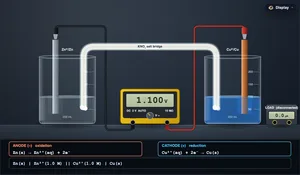
- The page opens on a galvanic zinc–copper cell on a realistic bench: two beakers, a salt bridge, a digital voltmeter reading 1.100 V.
- Press Run in the dock under the bench. Run closes the switch to the load, so current flows: electrons travel through the wire, ions through the bridge, the zinc strip thins, copper builds up on the cathode and the blue copper(II) solution fades. With the time-lapse on Auto the whole discharge takes about a minute, ending when the copper ions run out.
- Use the pills above the bench to switch between Galvanic and Electrolytic.
- Click the bridge, the load box or the voltmeter on the picture itself, or use the dock buttons; both do the same thing.
3 Galvanic Cells (Simulate)
- Presets — one click sets up a classic cell: the Daniell cell (Zn | Cu), Mg | Cu (the most active pair, 2.71 V), Zn | Ag, Cu | Ag, Fe | Cu, zinc against the standard hydrogen electrode, and a copper concentration cell.
- Half-cells — pick any two of 34 half-reactions from the left and right selectors, including gas electrodes (H₂, O₂, Cl₂) and redox pairs such as Fe³⁺/Fe²⁺ and MnO₄⁻/Mn²⁺ on inert platinum. The cell works out for itself which side is the anode.
- Concentrations — each species has a slider and a numeric box (0.001–2 M, gases in atm). Drag them and watch the voltage follow the Nernst equation.
- Salt bridge — remove it and the circuit is open: the voltmeter drops to zero although the EMF is unchanged.
- Load — connect the load resistor and the cell delivers current, so the terminal voltage sits below the EMF by the internal-resistance drop. Choose the resistance and read the current on the ammeter.
- Other sliders — solution volume, temperature (which changes the Nernst slope), electrode area and strip mass (which set how long the cell lasts), the load resistance, and the time-lapse (Auto sets it so a full discharge takes about a minute; the other steps are fixed factors of ten).
- Swap leads reverses the voltmeter and its sign; Swap beakers exchanges the two sides.
- Notation and equations — the cell is written in line notation, with the half-reactions and the overall equation, E°cell, E, ΔG°, K and Q updating live.
- Display chips — labels, electron flow, ion flow, sound and the pH indicator can be switched on or off; your choices are remembered.
4 Electrolytic Cells
- Choose an electrolyte (NaCl, CuSO₄, Na₂SO₄, H₂SO₄, KI, AgNO₃, NiSO₄, ZnSO₄, CuCl₂, HCl, NaOH, or molten NaCl) and the anode and cathode materials (platinum, graphite, copper, silver, nickel, iron, zinc, lead).
- Presets set up a well-known process in one click: copper plating (the default: a copper anode plates an iron object), copper refining, silver plating, nickel plating, copper sulfate between graphite electrodes, splitting water in the Hofmann voltameter, brine, and molten sodium chloride.
- While current flows, the metal ions can be seen crossing the solution from the dissolving anode (or from the solution itself, with an inert anode) to the cathode. The coating on the cathode starts thin, so the base metal shows through, and thickens with the charge passed while the anode thins.
- The supply’s output stays off until you press Run; the readout shows the current it will deliver. Run switches it on, and Pause switches it off again.
- Set the supply voltage and its current limit, the electrolyte concentration, and the electrode gap, area, solution volume, temperature and run speed with the sliders.
- The simulator ranks every possible reaction at each electrode by its potential plus the overpotential for that material, and the winner is what you see: gas bubbles, a plated coating, or the anode dissolving. Competing reactions are listed below the bench with the numbers.
- Switch the apparatus to the Hofmann voltameter to collect gases over water: hydrogen and oxygen come off in a 2 : 1 volume ratio. The universal-indicator option shows the pH changing near each electrode.
- Reverse polarity swaps which material is the anode, which is what reversing the supply does.
- The readouts give charge passed, mass deposited, gas volumes at 25 °C and 1 atm, coating thickness and the pH of the solution.
5 Lab Notebook and Challenges
- Record reading writes the present reading into the lab notebook table. The graph tabs plot a Nernst plot (E against log Q, slope −0.0592/n, intercept E°), a Faraday plot (mass against charge), a current–voltage sweep and the discharge curve. Each fits a line and reports the slope and R²; the data export as CSV.
- Report (dock) or Export Lab Report (notebook) opens a printable A4 report of the apparatus, readings, results, calculation and graph, ready for your browser’s Save-as-PDF. It stays greyed out until the cell has run.
- Activity series challenge — rank seven metals from the most to the least reactive by testing which one displaces which from solution.
- Mystery electrode — an unknown metal is hidden as X. Measure it against reference half-cells, work out its E° and name it.
6 Explore, Practice and Quiz
- Explore — 28 concept cards in five groups: basics, cell potential, batteries and corrosion, electrolysis, and lab technique and errors. Most cards have a See it button that sets the bench up for that idea.
- Practice — 17 problem types (E°cell, ΔG°, log K, the Nernst equation, concentration cells, unknown concentrations, Faraday’s laws, terminal voltage, line notation and electrolysis products). The numbers are random each time; Show Solution gives the worked answer.
- Quiz — 8 questions drawn at random from a pool of 26, with the answer order shuffled, an explanation after each answer and a star rating at the end.
7 Key Equations
- E°cell = E°cathode − E°anode (the E° values are never multiplied by coefficients).
- E = E° − (RT/nF) ln Q, which at 25 °C is E = E° − (0.0592/n) log Q.
- ΔG° = −nFE° and K = exp(nFE°/RT); at equilibrium E = 0 and Q = K.
- Faraday: m = (It/zF)·M. One mole of electrons is 96,485 C.
- Terminal voltage = E − Ir.
Worked example: Zn|Cu with [Zn²⁺] = 0.010 M and [Cu²⁺] = 1.0 M gives E = 1.10 − (0.0592/2) log(0.010) = 1.16 V.
8 Tips and Common Mistakes
- Anode is where oxidation happens in both cell types; the sign of the anode flips (galvanic −, electrolytic +).
- Do not double E° because two electrons move.
- A zero voltage can mean the bridge is out, the reading is on a dead battery (Q = K), or the leads are open; the bench shows which.
- Water often wins at the electrodes: sodium never plates from brine and Cl₂ beats O₂ on graphite only because of overpotential.
- Right-click the bench to save it as an image, copy the cell data or reset.
Galvanic and Electrolytic Cells: Cell Potential, the Nernst Equation and Faraday’s Laws
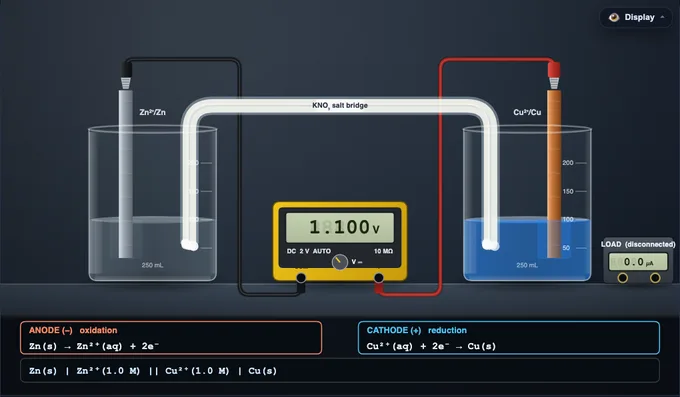
An electrochemical cell is a redox reaction split into two half-reactions so that the electrons have to travel through a wire. In a galvanic (voltaic) cell the reaction is spontaneous and the cell delivers electrical energy; in an electrolytic cell an external supply drives a reaction that would not otherwise occur. This virtual lab lets you build both, read the voltage, vary the conditions and compare what you measure with the equations used in general chemistry and AP Chemistry courses.
Which electrode is the anode and which is the cathode in a galvanic cell?
Oxidation always happens at the anode and reduction always happens at the cathode. In a galvanic (voltaic) cell the anode is the negative electrode and the cathode is the positive one, because the spontaneous reaction pushes electrons out of the anode and into the cathode. In an electrolytic cell the signs flip: the anode is positive and the cathode is negative, but oxidation is still at the anode.
Standard reduction potentials
Each half-reaction has a standard reduction potential E° measured against the standard hydrogen electrode at 25 °C, 1 M and 1 atm. The more positive the value, the stronger the oxidising agent. The values below are the textbook two-decimal figures the simulator uses.
| Half-reaction (reduction) | E° (V) |
|---|---|
| Li⁺(aq) + e⁻ → Li(s) | −3.04 |
| Na⁺(aq) + e⁻ → Na(s) | −2.71 |
| Mg²⁺(aq) + 2e⁻ → Mg(s) | −2.37 |
| Al³⁺(aq) + 3e⁻ → Al(s) | −1.66 |
| Zn²⁺(aq) + 2e⁻ → Zn(s) | −0.76 |
| Fe²⁺(aq) + 2e⁻ → Fe(s) | −0.44 |
| Ni²⁺(aq) + 2e⁻ → Ni(s) | −0.26 |
| Pb²⁺(aq) + 2e⁻ → Pb(s) | −0.13 |
| 2H⁺(aq) + 2e⁻ → H₂(g) | 0.00 |
| Cu²⁺(aq) + 2e⁻ → Cu(s) | +0.34 |
| Ag⁺(aq) + e⁻ → Ag(s) | +0.80 |
| O₂(g) + 4H⁺(aq) + 4e⁻ → 2H₂O(l) | +1.23 |
| Cl₂(g) + 2e⁻ → 2Cl⁻(aq) | +1.36 |
| MnO₄⁻(aq) + 8H⁺(aq) + 5e⁻ → Mn²⁺(aq) + 4H₂O(l) | +1.51 |
| F₂(g) + 2e⁻ → 2F⁻(aq) | +2.87 |
Cell potential, free energy and equilibrium constant
E°cell = E°cathode − E°anode. A positive value means the cell reaction is spontaneous, with ΔG° = −nFE° and log K = nE°/0.0592 at 25 °C. The table gives common cells (1.0 M, 25 °C) with n the number of electrons in the balanced equation.
| Cell (anode left) | E°cell (V) | n | ΔG° (kJ/mol) | K |
|---|---|---|---|---|
| Zn(s) | Zn²⁺ || Cu²⁺ | Cu(s) | 1.10 | 2 | −212 | 1037.2 |
| Zn(s) | Zn²⁺ || Ag⁺ | Ag(s) | 1.56 | 2 | −301 | 1052.7 |
| Cu(s) | Cu²⁺ || Ag⁺ | Ag(s) | 0.46 | 2 | −89 | 1015.5 |
| Fe(s) | Fe²⁺ || Cu²⁺ | Cu(s) | 0.78 | 2 | −151 | 1026.4 |
| Mg(s) | Mg²⁺ || Cu²⁺ | Cu(s) | 2.71 | 2 | −523 | 1091.6 |
| Al(s) | Al³⁺ || Cu²⁺ | Cu(s) | 2.00 | 6 | −1158 | 10202.7 |
| Zn(s) | Zn²⁺ || Ni²⁺ | Ni(s) | 0.50 | 2 | −96 | 1016.9 |
What does the salt bridge do in a galvanic cell?
The salt bridge completes the circuit and keeps each half-cell electrically neutral. As the anode dissolves, the solution around it gains positive charge; as the cathode plates out metal, its solution loses positive charge. Anions migrate through the bridge towards the anode and cations towards the cathode to cancel these changes. Take the bridge out and the circuit is open, so no current flows and the voltmeter in this lab drops to zero even though the cell’s EMF has not changed.
How do you calculate cell potential under non-standard conditions?
Use the Nernst equation, E = E° − (RT/nF) ln Q, which at 25 °C is E = E° − (0.0592/n) log Q. Q is the reaction quotient built from the concentrations (or pressures) in the cell reaction, with solids and liquids left out. For the zinc–copper cell E° = 1.10 V, so lowering the Zn²⁺ concentration or raising the Cu²⁺ concentration raises the voltage, and when Q reaches the equilibrium constant K the cell voltage falls to zero.
What is made at each electrode in electrolysis?
At each electrode the reaction needing the least voltage wins, after adding the overpotential of the electrode material (gas evolution on platinum or graphite is slow, so extra voltage is needed). The simulator ranks the candidates and shows which one wins; the table is its output for 1 M solutions with inert electrodes unless stated.
| Electrolyte and electrodes | Cathode (reduction) | Anode (oxidation) | Decomposition voltage (V) |
|---|---|---|---|
| Concentrated NaCl, graphite | H₂ | Cl₂ | 2.47 |
| Na₂SO₄, platinum | H₂ | O₂ | 1.88 |
| CuSO₄, platinum | Cu | O₂ | 1.25 |
| CuSO₄, copper electrodes | Cu | Cu dissolves | 0.00 |
| KI, graphite | H₂ | I₂ | 1.60 |
| AgNO₃, platinum | Ag | O₂ | 0.70 |
| H₂SO₄, platinum | H₂ | O₂ | 1.88 |
| Molten NaCl, graphite | Na | Cl₂ | — |
How much metal is deposited? Faraday’s laws
The mass deposited is m = (I t / z F) × M, where I is the current in amperes, t the time in seconds, z the electrons per ion and F = 96,485 C/mol. A current of 2.00 A passing through copper(II) sulfate for 30.0 minutes deposits 3600 C of charge, which is 0.0373 mol of electrons and 1.19 g of copper. The table gives the mass per ampere-hour.
| Metal | z | M (g/mol) | Mass per A·h (g) |
|---|---|---|---|
| Ag | 1 | 107.868 | 4.025 |
| Cu | 2 | 63.546 | 1.185 |
| Ni | 2 | 58.693 | 1.095 |
| Zn | 2 | 65.38 | 1.220 |
| Al | 3 | 26.982 | 0.336 |
Who uses a galvanic cell simulator?
High-school and AP Chemistry students use it to rehearse the free-response questions on cell potential, concentration cells and electrolysis; first-year university students use it to check Nernst plots; teachers use the lab notebook, the activity-series challenge and the mystery electrode as a class activity when no equipment is available.
Explore Related Simulators
If you found this galvanic cell lab helpful, explore our Titration Simulator, Faraday’s Law of Induction, Chemical Bonds Simulator, Chemical Equation Balancer, and the Build Your Atom Simulator for more hands-on chemistry and electricity.
Updated