Faraday's Law Simulator
Magnetic Flux • Induced EMF • Lenz's Law • Galvanometer — Simulate • Explore • Practice • Quiz

Display Controls
Σ Live equations — values substituted from current state
💡 Why did the EMF change? — insights from current values
1 Overview
The Faraday's Law Simulator shows how a moving magnet induces a voltage in a coil through electromagnetic induction. As the bar magnet moves, the magnetic flux (Φ = B A cosθ) through the coil changes, and by Faraday's law the induced EMF is e = −N dΦ/dt. The negative sign is Lenz's law: the induced current always opposes the change that created it. Drag the magnet by hand or press Play to oscillate it, and watch the flux, EMF, current direction, galvanometer needle and live graphs respond instantly.
This tool is built for high-school physics students meeting induction for the first time, as well as engineering trainees and instructors who want a fast, visual way to explore how each variable changes the induced EMF.
2 Getting Started
The simulator opens in Simulate mode with B = 0.80 T, N = 120 turns, A = 50 cm², speed = 40 cm/s and θ = 0°. To begin:
- Drag the magnet left and right across the coil. The galvanometer needle kicks one way as the magnet enters and the other way as it leaves.
- Press Play to make the magnet oscillate back and forth automatically — this produces a repeating EMF, just like a simple generator.
- Use the Speed slider to move the magnet faster: a faster magnet means a faster change in flux and a larger EMF.
- Press Flip Poles to swap the magnet's N and S poles and see the induced current reverse.
- Try the preset chips (e.g. Strong magnet, Many turns, Fast movement) to jump to a ready-made demonstration.
3 Simulate Mode

Simulate mode is the main workspace. The canvas shows the bar magnet, its field lines, the coil, a centre-zero galvanometer, a voltmeter and a live graph. Each control changes the physics:
- Magnet B (T): a stronger magnet creates denser field lines and more flux, so the induced EMF rises in proportion to B.
- Turns N: EMF is directly proportional to the number of turns. Doubling N doubles the EMF.
- Coil A (cm²): a larger coil captures more flux, raising the EMF.
- Speed (cm/s): EMF depends on how fast the flux changes (dΦ/dt). A faster magnet gives a bigger EMF; a stationary magnet gives zero.
- Angle θ (°): flux scales with cosθ. At θ = 90° the coil is edge-on to the field, the flux is zero and so is the EMF.
The readout cards show position, velocity, flux Φ, the rate of change dΦ/dt, the induced EMF and the induced current. The colour-coded status strip tells you whether flux is increasing or decreasing and which way the current flows (Lenz's law).
4 Explore Mode
Explore mode organises induction theory into three categories:
- Fundamentals: magnetic flux (Φ = BA cosθ), Faraday's law (e = −N dΦ/dt), Lenz's law, and flux linkage (NΦ).
- Factors: how magnet strength, speed, number of turns, coil area and angle each affect the induced EMF, with worked numbers.
- Applications: generators, transformers, bicycle dynamos, induction cooktops, microphones and wireless phone charging.
Each concept card includes a definition, the formula with units, and a worked example you can follow step by step.
5 Practice & Quiz
Practice mode generates randomised problems such as “A coil of 200 turns has its flux change by 0.04 Wb in 0.2 s — find the EMF” or “Find the flux when B = 0.6 T, A = 0.02 m², θ = 60°”. Type your answer, press Check, and read the step-by-step solution. Your score is tracked.
Quiz mode presents 5 questions — a mix of multiple-choice and numeric — covering Faraday's law, Lenz's law, flux and the factors that change EMF. At the end you get a score, a star rating, and a per-question breakdown.
6 Key Equations & Worked Example
The three equations behind every reading:
- Magnetic flux: Φ = B A cosθ (weber, Wb).
- Faraday's law: e = −N dΦ/dt (volt, V).
- Average EMF: eavg = −N ΔΦ/Δt.
Worked example: a coil of N = 200 turns sits in a field where the flux changes from 0.05 Wb to 0.01 Wb in 0.1 s. The average EMF is e = −200 × (0.01 − 0.05) / 0.1 = −200 × (−0.4) = 80 V. The positive result tells you the induced current opposes the falling flux.
7 Tips, Export & Keyboard
- Zero EMF: hold the magnet still, or set θ = 90° — with no change in flux there is no induced EMF, no matter how strong the magnet is.
- Graphs: switch the graph between EMF, Flux and Position vs time to see how they relate. EMF is largest where the flux curve is steepest, and zero where the flux is at its peak.
- Show Calculations: the calculator button on the canvas opens a modal with the full step-by-step working for the current instant.
- Export CSV: downloads the recorded time, position, flux, dΦ/dt and EMF samples for plotting in a spreadsheet.
- Export PNG: saves the current canvas frame with a MechSimulator watermark.
- Right-click the canvas for quick Export PNG, Export CSV and Reset actions.
- Keyboard: Space toggles Play/Pause; R resets; Enter submits practice and quiz answers.
Understanding Faraday's Law of Electromagnetic Induction
Faraday's law states that the EMF induced in a coil equals the rate of change of magnetic flux linkage: e = −N dΦ/dt, where the flux is Φ = B A cosθ. Move a magnet faster, use a stronger magnet, add more turns, or use a larger coil and the induced EMF grows. Hold the magnet still and the EMF is zero.
The Variables That Control Induced EMF
| Quantity | Symbol | Formula / Role | Effect on EMF |
|---|---|---|---|
| Magnetic flux | Φ | B A cosθ | Source quantity (Wb) |
| Turns | N | Flux linkage = NΦ | e ∝ N |
| Flux density | B | Magnet strength | e ∝ B |
| Coil area | A | Cross-section | e ∝ A |
| Speed | v | Sets dΦ/dt | e ∝ rate of change |
| Angle | θ | cosθ factor | e = 0 at 90° |
Drag the bar magnet through the coil, or press Play to oscillate it, and watch the flux, induced EMF, current direction, galvanometer deflection and live graphs respond in real time. Switch the graph between EMF, flux and position versus time, open Show Calculations for the full working, and export your data as CSV or the canvas as PNG.
Faraday's Law and Flux Linkage
The magnetic flux through a coil is Φ = B A cosθ, measured in webers (Wb). When the coil has N turns, the total flux linkage is NΦ. Faraday's law says the induced EMF is the negative rate of change of this flux linkage: e = −N dΦ/dt. In the simulator the flux rises as the magnet approaches, peaks when the magnet sits inside the coil, and falls as it leaves — so the EMF is largest on the way in and on the way out, and momentarily zero when the magnet is centred and the flux stops changing.
Lenz's Law and the Direction of the Induced Current
Lenz's law is the negative sign in Faraday's equation. It states that the induced current always flows in the direction that opposes the change in flux producing it. As the magnet's north pole approaches, the coil induces a current that makes the near face of the coil a north pole too, repelling the magnet. As the magnet leaves, the induced current reverses to attract it back. This opposition is required by the conservation of energy: the work you do pushing the magnet against this force is exactly the electrical energy that appears in the circuit.
Why Does the EMF Increase?
Students often ask which change matters most. Because e = −N dΦ/dt and Φ = BA cosθ, the induced EMF is proportional to N, B and A, and to how quickly the flux changes. Doubling the magnet speed doubles dΦ/dt and so doubles the EMF; doubling the turns doubles the EMF; a stronger magnet or a bigger coil does the same. Tilting the coil reduces the EMF by cosθ until, at 90°, the field skims past the coil, no flux threads through it, and the EMF vanishes. The what-if coach panel highlights exactly which variable drove the latest change.
Who Uses This Simulator?
This Faraday's law simulator is used by high-school and college physics students learning electromagnetic induction, engineering trainees studying generators and transformers, and teachers who want a clear classroom demonstration of how a moving magnet creates a voltage. It pairs naturally with hands-on lab work using a coil, a bar magnet and a galvanometer.
Real-World Applications
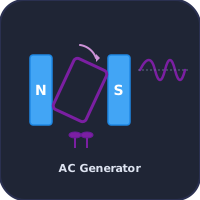
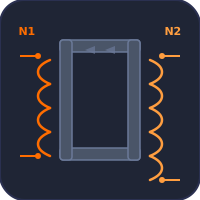
Electromagnetic induction is everywhere: generators and alternators spin coils in magnetic fields to power the grid, transformers change AC voltages using mutual induction, a bicycle dynamo lights your lamp, an induction cooktop heats a pan with changing flux, a microphone turns sound into a tiny induced voltage, and a wireless charger sends energy to your phone across an air gap — all governed by the same equation e = −N dΦ/dt.
Explore Related Simulators
If you found this Faraday's Law simulator helpful, explore our AC Generator Simulator, Transformer Simulator, DC Motor Simulator, Induction Motor Simulator, and RLC Circuit Simulator, and the Galvanic & Electrolytic Cell Lab (Faraday's laws of electrolysis) for more hands-on electrical engineering practice.
Updated