
Rankine Cycle Simulator
Steam Power Cycle • T-s & P-v Diagrams • Thermal Efficiency • Carnot Comparison — Simulate • Explore • Practice • Quiz

Display Controls
| # | Description | P (bar) | T (°C) | h (kJ/kg) | s (kJ/kg·K) | Quality |
|---|
| # | Question | Result |
|---|
1 Overview
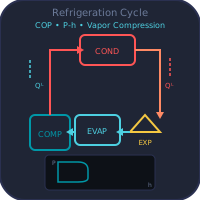
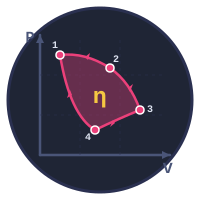
This simulator models the Rankine cycle — the steam power cycle behind most of the world's electricity — and the ideal Carnot cycle for comparison. The left canvas is an animated power-plant schematic (boiler → turbine & generator → condenser → pump). The right canvas plots the cycle on a T-s (temperature–entropy) or P-v (pressure–volume) diagram with the saturation dome and four numbered state points.
All properties are taken from standard saturated and superheated steam tables and interpolated, so the thermal efficiency, turbine-exit quality, and state enthalpies match textbook worked examples to about 1%. It is built for mechanical, power, and marine engineering students, vocational trainees, and instructors teaching steam power plants.
2 Simulate Mode
Choose a cycle type (Rankine or Carnot) and adjust the sliders: boiler pressure (2–150 bar), condenser pressure (5–100 kPa), turbine inlet temperature (superheat), turbine and pump isentropic efficiency, and target net power (for mass-flow rate). Each slider has a number box for exact entry. Use the Preset menu to load classic textbook cases instantly.
Press Run (bottom-right of the plant canvas) to build the cycle one process at a time — the diagram draws stage by stage (pump → boiler → turbine → condenser) while the matching component lights up in the schematic. The build starts slow; use the Speed slider to speed it up, Reset to clear, or Replay to watch it again. Toggle between T-s and P-v diagrams, show or hide the saturation dome and state labels, and switch SI / Imperial readout units. Export the diagram as PNG or the state points as CSV, or right-click the diagram for the same options. The readout grid and state-point table update live.
3 Reading the Diagrams
On the T-s diagram, the bell-shaped dome separates liquid (left), the two-phase mixture (inside), and superheated vapour (right). The Rankine path runs 1→2 (pump, near-vertical at low entropy), 2→3 (boiler — liquid heating up the saturation line, boiling across the dome, then superheat), 3→4 (turbine expansion, down to the condenser), and 4→1 (condensation, horizontal). The area enclosed equals the net work; the area under 2→3 equals the heat added.
On the P-v diagram (log–log), boiling and condensation are the two horizontal constant-pressure lines, and the huge volume change from liquid (~0.001 m³/kg) to vapour (tens of m³/kg) is why a turbine, not a piston, extracts the work.
4 Explore Mode
Explore mode has five categories — Basics, Formulas, Improving η, Applications, and Reference — each with concept cards covering the four processes, efficiency and quality formulas, the levers that raise efficiency (pressure, superheat, vacuum, reheat & regeneration), real plants (thermal stations, ORC, combined-cycle), and the property data behind the tool. A live T-s preview mirrors your current cycle.
5 Practice & Quiz
Practice generates randomised numerical problems — thermal efficiency, net work, heat added, Carnot limit, and turbine-exit quality — with instant feedback, a step-by-step solution, and a running score. Quiz gives five multiple-choice conceptual questions with a star rating and a review table at the end.
6 Engineering Notes
- Set Turbine η and Pump η to 100% for the ideal Rankine cycle; lower them (or load the “Actual” preset) for a realistic plant.
- Watch turbine-exit quality x4 — keep it above ~0.88 to avoid blade erosion. Raising superheat increases it.
- The back-work ratio (pump/turbine work) is tiny — usually under 2% — because pumping a liquid costs far less than compressing a gas.
- Compare with the Carnot limit shown in every result: the gap is the “cost” of adding heat over a temperature range instead of all at Tmax.
- Pair this with the Refrigeration Cycle simulator (the reversed cycle) and the Thermodynamics simulator for Otto, Diesel, and Brayton cycles.
What is the Rankine Cycle?
The Rankine cycle is the ideal thermodynamic cycle for a steam power plant. Water is pumped to high pressure, boiled into steam, expanded through a turbine to generate work, and condensed back to liquid — then the loop repeats. Coal, nuclear, biomass, geothermal, and concentrated-solar plants all run a Rankine cycle, which is why it underpins the majority of the world's electricity generation. This simulator builds the cycle from real steam-table data and draws it live on T-s and P-v diagrams as you change the operating conditions.
What are the four processes of the Rankine cycle?
The cycle has four components, each handling one process:
- Pump (1→2) — isentropic compression of saturated liquid from condenser pressure to boiler pressure. The work input is small: wpump = v1(P2−P1).
- Boiler (2→3) — constant-pressure heat addition. Liquid is heated to saturation, boiled, and (usually) superheated to the turbine inlet temperature. This is qin = h3−h2.
- Turbine (3→4) — isentropic expansion to condenser pressure, producing the work output wturbine = h3−h4. The exit is normally a wet mixture.
- Condenser (4→1) — constant-pressure heat rejection qout = h4−h1 to cooling water, returning the working fluid to saturated liquid.
How do you calculate Rankine cycle efficiency?
Thermal efficiency is the net work divided by the heat added in the boiler:
ηth = wnet / qin = ((h3−h4) − (h2−h1)) / (h3−h2)
The enthalpies come straight from steam tables: h1 is saturated liquid at condenser pressure, h2 = h1 + v1(P2−P1), h3 is read from the superheated table at the boiler pressure and turbine inlet temperature, and h4 follows from an isentropic expansion (s4 = s3) to condenser pressure. Typical simple-cycle efficiencies are 35–42%; modern supercritical plants reach 45–48%.
What raises the efficiency of a Rankine cycle?
| Change | Effect on efficiency | Side effect |
|---|---|---|
| Increase boiler pressure | Higher (raises mean heat-addition T) | Lower exit quality (more moisture) |
| Superheat the steam | Higher | Improves exit quality — the best lever |
| Lower condenser pressure | Higher (lowers heat-rejection T) | Limited by cooling-water temperature |
| Add reheat | Higher | Keeps quality high; needs second turbine stage |
| Add regeneration | Higher | Uses bled steam to preheat feedwater |
Why is the Rankine cycle less efficient than the Carnot cycle?
The Carnot efficiency, η = 1 − TL/TH (in kelvin), is the theoretical maximum for any cycle between two temperatures. The Rankine cycle cannot reach it because heat is added over a range of temperatures — warming liquid water from condenser temperature up to boiling, then boiling, then superheating — so the average temperature of heat addition is well below the peak. The simulator shows the Carnot limit alongside every result so you can see the gap, and how superheat and pressure narrow it.
Worked example — a simple ideal Rankine cycle
Boiler 3 MPa, turbine inlet 350 °C, condenser 75 kPa, ideal (isentropic) turbine and pump:
| Quantity | Working | Result |
|---|---|---|
| Pump work | v1(P2−P1) = 0.001037 × (3000−75) | 3.03 kJ/kg |
| Heat added | h3 − h2 = 3116 − 387.5 | 2729 kJ/kg |
| Turbine work | h3 − h4 = 3116 − 2403 | 713 kJ/kg |
| Net work | 713 − 3.03 | 710 kJ/kg |
| Thermal efficiency | 710 / 2729 | 26.0% |
Enter these values in the simulator (3 MPa = 30 bar, 75 kPa, 350 °C) and you will get the same result — then raise the boiler pressure and superheat to watch the efficiency climb toward the Carnot limit.
Who uses this simulator?
Mechanical, power, marine, and aerospace engineering students use it to learn steam power cycles; vocational and technical trainees use it for plant-operation fundamentals; and instructors use it to demonstrate how pressure, superheat, and vacuum drive efficiency without setting up a real boiler. The state-point table and CSV export make it easy to check homework or build lab worksheets.
Explore Related Simulators
If you found this Rankine Cycle simulator helpful, explore our Refrigeration Cycle simulator (the reversed cycle), the Thermodynamics simulator for Otto, Diesel and Brayton cycles, the Heat Exchanger simulator, and the Ideal Gas Law simulator for more hands-on thermal engineering practice.
Updated