Centrifugal Governor Simulator
Watt • Porter • Proell • Hartnell — Height • Controlling Force • Sensitivity • Effort — Simulate • Explore • Practice • Quiz

Display Controls
Machine
Geometry
Masses
Operating
Σ Live equations — values substituted from the current state
📈 Height & speed — this governor against the alternatives
💡 What-if coach — insights from the current values
1 Overview
The Centrifugal Governor Simulator lets you visualise and analyse the behaviour of centrifugal speed-regulating mechanisms. These governors use centrifugal force from rotating masses (flyballs) to control engine speed by adjusting the fuel or steam supply. This simulator covers four classic governor types: Watt, Porter, Proell, and the spring-loaded Hartnell.
You can observe how sleeve lift responds to speed changes, calculate controlling force, monitor sensitivity, and study the relationships between angular velocity, ball radius, and governor height. The tool helps build intuition about speed regulation mechanisms that are fundamental to mechanical engineering.
2 Loading the Mechanism

- Pick a Governor in the Machine row (Watt, Porter, Proell, or Hartnell) — each has different characteristics and governing equations. The panel below regroups itself into Geometry, Masses, Spring and Operating, and only shows the groups that governor actually uses.
- Switch the Units toggle between SI and Imperial to show the steppers and readout cards in metres/kilograms/newtons or inches/pounds/pound-force — the underlying calculation always stays in SI, and your choice is remembered on your next visit.
- Adjust Ball Mass, Arm Length, Speed, and Sleeve Mass (for Porter, Proell and Hartnell) by dragging the slider, tapping − / + (hold to repeat), or typing an exact value into the box. Choosing Proell adds a Ball Extension (BF) slider — the length of the upward extension of the lower link that carries the ball. Set it to 0 and the readouts reproduce a Porter governor exactly; lengthen it and the height, radius and speed all move.
- Choosing Hartnell swaps the pendulum arms for bell crank levers and reveals three extra controls: Spring Stiffness (k), Ball Arm (a), and Sleeve Arm (b). The Arm Length slider is hidden, because a Hartnell governor has no pendulum arm.
- Use the Preset dropdown for Low Speed, Medium Speed, High Speed, Heavy Ball, or a Spring (Hartnell) configuration.
- Watch the animated governor mechanism on the canvas respond to your parameter changes in real time — the spindle marker spins continuously at the current angular velocity.
- Open the Display Controls panel (the gear icon on the canvas) to toggle the grid, labels, Fc vectors, dimension lines, throttle linkage and orbit path on or off — your choices are remembered on your next visit.
- Use the Diagram tabs beside the canvas to switch the side chart between Controlling Force vs radius, Sensitivity vs speed, and Lift vs Speed.
- Right-click (or long-press on touch) the canvas for a quick menu to copy readout values, export a PNG or CSV, or reset to default.
3 Watching the Motion
The canvas shows an animated governor with rotating spindle, swinging arms, and flyballs. As speed increases, the balls swing outward and the sleeve rises. Readout cards display governor height (h), controlling force (Fc), sleeve lift, angular velocity (ω), rotation radius (r), arm angle (θ), sensitivity percentage, and effort.
For the Watt governor, height h = g/ω² depends only on speed. The Porter governor adds a dead weight (sleeve mass M), giving h = (m + M)g/(mω²), which extends the useful speed range. The Proell governor is that same Porter machine with the balls moved onto upward extensions of the lower links, a length e above the junction; its height is h = gL[m(L − e) + ML]/[mω²(L + e)²], which equals Porter's exactly when e = 0 and is strictly less whenever e > 0 — so the same governor runs at a lower speed once the balls are moved out onto the extensions. The Hartnell governor has no pendulum height at all — its balls sit on bell crank levers and its restoring force comes from a spring, so the Height card is relabelled Spring Force (S) and the Arm Angle card becomes the bell-crank Lever Angle (φ). Nothing fudged is shown in a card that does not apply.
Sensitivity and Effort are evaluated around the current operating point (a small +/-10 mm sleeve-height window), so changing any Simulate control — Ball Mass, Arm Length, Sleeve Mass, Speed, or Governor Type — moves both readouts, not just the sliders that obviously touch them. Only a perfectly isochronous governor would show the same sensitivity at every speed; the Watt/Porter/Proell models here do not.
Below the canvas, the collapsible Learning panels section substitutes your current values into the live equations, plots this governor’s height against the alternatives at the same speed, and offers a What-if coach with plain-language insights for the state you have set up.
4 Geometry & Theory
Study 15 governor concepts across Governor Basics, Governor Types, and Analysis categories. Topics include controlling force diagrams, sensitivity analysis, isochronism, hunting, governor effort and power, friction and the dead band it creates, and Hartnell spring design with the bell crank lever.
5 Try a Problem
Practice generates problems on governor height, controlling force, sleeve lift, angular velocity, sensitivity, effort and power, friction dead band, and Hartnell spring stiffness — 14 generators in all. Quiz presents 5 randomised questions from a pool of 26.
6 Design Notes
- Start with the Watt governor to understand the basic h = g/ω² relationship before adding sleeve mass complexity.
- Compare Porter and Watt at the same speed to see how the dead weight extends the useful operating range.
- Higher sensitivity means the governor responds to smaller speed changes — but excessively high sensitivity can cause hunting.
- An isochronous governor has the same equilibrium speed at all heights — theoretically ideal but prone to continuous oscillation.
- Use the speed slider dynamically to watch the balls swing out and the sleeve rise, building intuitive understanding of the feedback mechanism.
- On Hartnell, raise the spring stiffness k and watch the sleeve lift fall: the spring, not gravity, is what the centrifugal force works against. Drop k far enough at high speed and the canvas warns SPRING OVERRUN — the balls run to their outer stop because 2mω²a²/b has exceeded kb.
- Increasing the ball arm a relative to the sleeve arm b gives the balls more leverage over the spring, so the same speed produces more sleeve lift. That lever ratio a/b is the main design knob in a Hartnell governor.
Centrifugal Governor — Speed Regulation in Machines
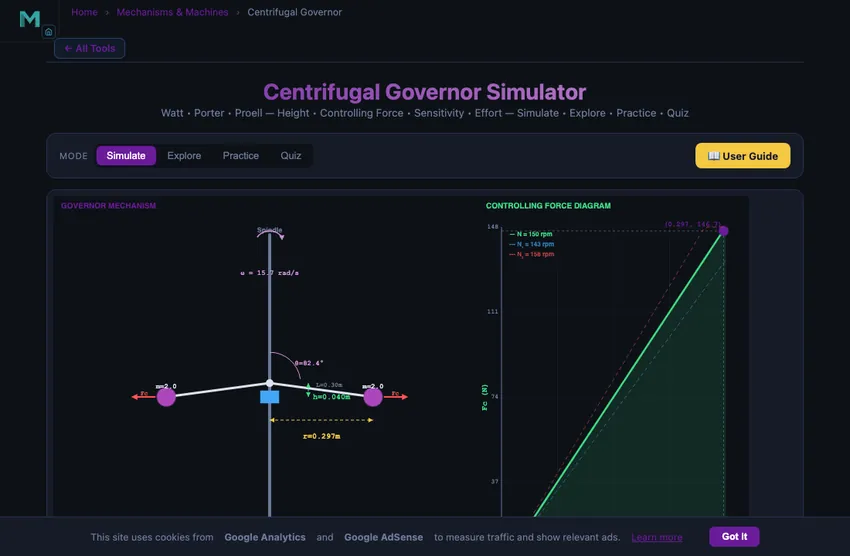
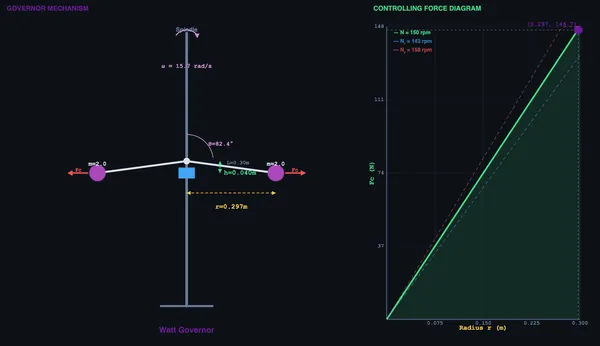
A centrifugal governor is a mechanical device that automatically regulates engine speed by controlling fuel supply. As speed increases, spinning balls fly outward under centrifugal force, raising a sleeve linked to the throttle valve and closing it. This feedback loop — first used on James Watt’s steam engines — keeps engine speed constant despite changing load.
Governors are classified by their operating principle. Centrifugal governors (Watt, Porter, Proell, Hartnell) use the centrifugal effect of rotating masses, while inertia governors respond to changes in angular acceleration. Centrifugal governors are further divided into pendulum type (Watt), dead-weight loaded type (Porter, Proell), where extra mass on the sleeve improves sensitivity and control range, and spring-loaded type (Hartnell), where a compression spring replaces the dead weight entirely. All four types are simulated here.
How Centrifugal Governors Work
The governor consists of a spindle driven by the engine through bevel gears, arms attached to the spindle, balls at the ends of the arms, and a sleeve that slides on the spindle. When the engine speed increases, the balls fly outward, the arms rotate, and the sleeve rises. This sleeve movement is linked to the throttle valve to reduce fuel supply, thereby reducing engine speed. When speed decreases, gravity pulls the balls inward, the sleeve descends, and more fuel is supplied.
Key Formulas and Analysis
For a Watt governor, the height is given by h = g/ω², where ω = 2πN/60. The controlling force is Fc = mω²r, where m is the ball mass and r is the radius of rotation. For a Porter governor, the sleeve mass M adds to the effective loading: h = (m + M)g / (mω²). Sensitivity is defined as (N₂ − N₁) / N_mean × 100%, where N₁ and N₂ are the minimum and maximum operating speeds. An isochronous governor has equal equilibrium speeds at all radii (zero sensitivity range).
Governor Types Compared
| Governor | Loading Type | Height / Key Equation | Speed Range | Sensitivity |
|---|---|---|---|---|
| Watt | Pendulum (gravity only) | h = g/ω² | Low speed only | Lowest — unusable at high N |
| Porter | Dead-weight loaded | h = (m + M)g/(mω²) | Medium–high | Better than Watt |
| Proell | Dead-weight, extended arms | h = gL[m(L−e)+ML]/[mω²(L+e)²] | Slightly below Porter’s at same design | Highest of the three gravity types |
| Hartnell | Spring loaded | 2Fc·a = (S + Mg)·b | High speed, compact | Tunable via lever ratio a/b |
How to Use This Simulator
In Simulate mode, select a governor type (Watt, Porter, Proell, or Hartnell), adjust ball mass, arm length, RPM, and sleeve mass using the sliders; choosing Hartnell replaces the pendulum arms with bell crank levers and adds spring stiffness and bell-crank arm controls, while choosing Proell adds a Ball Extension (BF) slider for the upward extension of the lower link. The canvas displays an animated governor mechanism that responds in real time, showing the balls swinging outward as speed increases. Readout cards show height, controlling force, sleeve lift, angular velocity, radius, arm angle, sensitivity, and effort. Switch to Explore mode to study 15 governor concepts across basics, types, and analysis. Practice generates random governor problems, and Quiz tests your knowledge with 5 randomised questions.
James Watt’s 1788 Invention — Engineering’s First Feedback System
The centrifugal governor predates control theory by 150 years. Watt added it to steam engines in 1788 as a purely mechanical feedback system: if the engine sped up (load lighter than expected), the spinning balls flew outward, raised the sleeve, closed the throttle, slowed the engine. If the engine slowed (load heavier), balls fell inward, sleeve dropped, throttle opened, engine sped back up. No electronics, no computers, no sensors — just the laws of mechanics implementing a proportional controller.
Maxwell wrote the first stability analysis of governors in 1868, founding control theory. Modern PID controllers and state-space methods all descend from his paper. The fact that you can still see Watt governors spinning on steam locomotives in museums is a kind of accidental monument to one of engineering’s most consequential innovations.
Watt vs Porter vs Hartnell — Why Sensitivity Matters
The basic Watt governor has limitations: it’s only sensitive at low speeds (h = g/ω² means height drops as 1/ω²) and the controlling force is weak. Three improvements followed in the 19th century:
- Porter governor. Adds a dead weight on the sleeve, increasing controlling force and pushing usable speed range higher. Standard for steam-engine governors after about 1860.
- Proell governor. A Porter governor with the balls moved onto upward extensions of the lower links, a length e above the arm/link junction. Its height h = gL[m(L − e) + ML]/[mω²(L + e)²] equals Porter's when e = 0 and is strictly less otherwise, so the same machine runs slower and governs over a narrower speed band.
- Hartnell governor. Uses a stiff spring against the sleeve instead of gravity loading. Tunable sensitivity, suitable for portable engines and IC engines. Most modern governors descend from this design.
Where Centrifugal Governors Still Live Today
Despite electronic engine management, centrifugal governors persist in:
- Marine diesel engines and industrial generators. Mechanical governors still serve as backup or primary speed control, particularly on stationary engines for grid backup.
- Small engines (lawn mowers, chainsaws). Throttle is controlled by a centrifugal mechanism inside the carburettor. Cheap, no electronics needed, fail-safe.
- Helicopter rotor speed governors. Mechanical governors regulate engine power to maintain constant rotor RPM. Failure of electronic systems falls back to the mechanical governor.
- Music boxes and clockwork. Friction governors regulate the speed of mainspring-driven movements; same physical principle.
The Hartnell Governor — Bell Crank Levers and a Spring
The Hartnell governor is the one type here that does not hang its balls from pendulum arms. Each ball is bolted to the ball arm (length a) of a bell crank lever whose fulcrum is carried on a frame that rotates with the spindle. The sleeve arm (length b) of the same lever reaches inward and bears on a sleeve that is held down by a compression spring of stiffness k, assisted by the sleeve dead weight M. Taking moments about the fulcrum, and sharing the sleeve load between the two levers, equilibrium is:
2 · Fc · a = (S + Mg) · b where S = k x
Because the lever turns through the same angle at both ends, a sleeve lift x moves each ball outward by x (a/b). That single ratio is the whole design: a long ball arm against a short sleeve arm gives the balls a large mechanical advantage over the spring, so the same speed change produces more sleeve travel. To size the spring from two design speeds, compute Fc₁ = mω₁²r₁ and Fc₂ = mω₂²r₂, note that the sleeve travels (r₂ − r₁) b/a between those positions, and divide:
k = 2(Fc₂ − Fc₁) · (a/b) / sleeve lift = 2(Fc₂ − Fc₁)/(r₂ − r₁) × (a/b)²
A Hartnell governor has no height h. The familiar h = g/ω² is a property of a pendulum hanging in gravity, and there is no such pendulum here — so this simulator does not print a height for Hartnell. It relabels that readout Spring Force (S) and reports the ball radius, sleeve lift and bell-crank angle instead, all solved from the moment equation above rather than assumed. Because the spring is what resists the balls, the governor also has a genuine stability limit: once 2mω²a²/b exceeds k b the spring can no longer hold, and the balls run to their outer stop. The simulator says so on the canvas instead of quietly clamping.
This is why the Hartnell design outlived the others. It is compact, it does not need a tall gravity column, it works at high speed, and because the restoring force is a spring rather than a weight it works in any orientation — which is exactly what a portable or vehicle-mounted engine needs.
Frequently Asked Questions
What is the difference between a Watt governor and a Porter governor?
A Watt governor is the simplest centrifugal governor: rotating balls on arms, nothing else, and its height depends solely on speed (h = g/ω²). A Porter governor adds a dead weight — a sleeve mass M sliding on the spindle — so the height becomes h = (m + M)g/(mω²). The extra load means a much larger centrifugal force is needed to lift the sleeve, which keeps the governor usable at speeds where a Watt governor’s cone has collapsed to almost nothing.
What is the difference between a Porter governor and a Proell governor?
Both are loaded governors with the same sleeve mass; the difference is where the balls sit, and it changes the numbers. In a Porter governor each ball is pinned at the junction of the upper arm and the lower link. In a Proell governor each ball is carried on an upward extension of the lower link, a length e = BF above that junction. Taking moments about the instantaneous centre of the lower link gives h = gL[m(L − e) + ML] / [mω²(L + e)²]. Set e = 0 and that collapses exactly to the Porter result h = (m + M)g/(mω²) — the extension slider in this simulator lets you check that for yourself. Make e positive and h is strictly smaller, because the ball now orbits at the larger radius (L + e)sinθ while its own weight moment works over the shorter arm (L − e)sinθ. A shorter cone at a given speed is the same statement as a lower equilibrium speed at a given cone height, so a Proell governor runs slower than the Porter governor it was built from, and holds a given sleeve position over a narrower speed band — which is what makes it more sensitive.
What is a Hartnell governor and how is it different?
A Hartnell governor is a spring-loaded centrifugal governor. Its balls sit on the ball arms of bell crank levers, and the sleeve arms of those levers press on a spring-loaded sleeve, so the restoring force comes from a spring rather than from gravity. Its equilibrium is 2 Fc a = (S + Mg)b. It is compact, suits high speeds, and works in any orientation — and, unlike Watt, Porter and Proell, it has no pendulum height h at all.
How do you calculate the spring stiffness of a Hartnell governor?
Take the two limiting speeds. Compute Fc₁ = mω₁²r₁ and Fc₂ = mω₂²r₂. The sleeve lift between the two positions is (r₂ − r₁) b/a, and the spring force must change by 2(Fc₂ − Fc₁) a/b. Therefore k = 2(Fc₂ − Fc₁)(a/b) / sleeve lift. Worked example: Fc₁ = 200 N, Fc₂ = 350 N, a = 0.1 m, b = 0.08 m, lift = 0.02 m gives ΔS = 2 × 150 × 1.25 = 375 N and k = 375/0.02 = 18 750 N/m.
What is isochronism and hunting in a governor?
An isochronous governor has the same equilibrium speed at every radius, so its speed range is zero. That sounds ideal, but it means there is no unique equilibrium position: the smallest disturbance sends the sleeve to one extreme or the other, and the governor hunts — oscillating continuously about the mean speed instead of settling. Real governors are therefore designed to be slightly stable rather than isochronous, and friction or a dashpot is added to damp what oscillation remains.
What is governor sensitivity, and what makes a governor more sensitive?
Sensitivity is (N₂ − N₁)/N_mean, the fractional speed band needed for full sleeve travel — a smaller band means a more sensitive governor. Adding sleeve mass, increasing ball mass, moving the ball outward (Proell), or increasing the a/b lever ratio (Hartnell) all raise sensitivity. Sleeve friction lowers it, because the sleeve then needs extra speed change just to break loose.
References
- Maxwell, J. C. (1868) — On Governors. Proc. Royal Society. The original control-theory paper.
- Khurmi, R. S. — Theory of Machines, 14th ed., Chapter 18 (Governors).
- Hayward, J. (1958) — Theory and Practice of the Centrifugal Governor. Mechanical Engineering Publications.
Explore Related Simulators
If you found this Centrifugal Governor simulator helpful, explore our Flywheel simulator, Gear Trains simulator, Cam & Follower simulator, and the Centrifugal Pump Test Rig for more hands-on practice. The governor’s flyballs are a conical pendulum: explore the physics behind it in the Centripetal Force & Circular Motion simulator. The governor was born on the steam engine: see it trim the cut-off of a running engine in the Steam Engine Simulator.
Updated