Charles' Law Simulator
V₁/T₁ = V₂/T₂ — Isobaric Gas Expansion • Simulate • Explore • Practice • Quiz
Display Controls
Drag the piston, or type a temperature Switch the chart to °C and extend the line to V = 0 to find absolute zero Right-click the canvas for more
Σ Live equations — values substituted from the current state
❄ Finding absolute zero — the extrapolation Kelvin made in 1848
⚡ Isobaric work — W = PΔV
💡 What-if coach — what to try next
1 Overview
This tool covers V₁/T₁ = V₂/T₂ two ways. Simulate gives you a cylinder of gas under a constant load: heat it and the piston rises, cool it and it falls, with the volume, both temperature scales and the Charles constant read live. Calculate is a solver — type any three of V₁, T₁, V₂, T₂ and it returns the fourth with the full working.
The control that matters most is the Chart switch. In kelvin, V against T is a straight line through the origin. Switch to °C and the line no longer passes through the origin — and extending it back to zero volume lands on −273.15 °C. That extrapolation is how absolute zero was discovered, and it is the single most important thing this simulator can show you.
2 Driving the simulation

Use the Temperature slider or type an exact value into the box beside it — 273.15 K and 298 K both go in as written. Volume follows immediately, because V = kT with k fixed.
Pressure is now adjustable, and it does something specific: it selects which isobar you are on. Charles' law governs movement along one line, so changing the temperature never changes the pressure. Moving the pressure is a separate action that puts you on a different line with a different gradient (k = nR/P), and the line you came from stays behind as a dashed ghost.
Six presets load real situations: a laboratory cylinder, a party balloon taken outdoors, a hot-air balloon envelope at 120 °C, a sealed bag in a freezer, air trapped in an oven dish, and Kelvin's 1848 extrapolation. The SI / Imperial switch reads everything in psi, cubic feet, °R and °F — and in Imperial the absolute-zero intercept correctly reads −459.67 °F.
3 The three chart views
V – T (K) is the proportionality in its cleanest form: a straight line through the origin. Double the kelvin temperature and the volume doubles, which you can read straight off the graph.
V – T (°C) & absolute zero plots the same gas against the Celsius scale. The line is just as straight but it no longer goes through the origin, and a dashed extension carries it back to where the volume would vanish. The intercept is marked: −273.15 °C. This is the graph a school practical asks you to draw.
Isobars draws three pressures at once. Their gradients differ, because k = nR/P, but every one of them extrapolates to the same intercept. That convergence — the fact that the answer does not depend on the gas, the amount or the pressure — is exactly the argument Lord Kelvin used in 1848 to claim the point as a true absolute zero rather than an artefact of one experiment.
4 The Calculate tab
Choose which of V₁, T₁, V₂, T₂ to solve for and type the other three; the chosen field becomes a read-only output so you cannot type into the answer.
The Enter T in switch lets you work in kelvin or in degrees. If you choose degrees, the tool converts to kelvin before applying the law and shows that conversion as its own step in the working — because skipping it is the commonest mistake in the whole topic. A gas at 27 °C heated to 177 °C expands by a factor of 450/300 = 1.5, not 177/27 = 6.6.
The result panel also reports the constant k and the ratio V₂/V₁ = T₂/T₁. Press Show Calculation in the ribbon for the full derivation.
5 Exports and shortcuts
- Export CSV writes a 30-point sweep of the current isobar with T in kelvin, T in Celsius, V and V/T in separate columns — paste it into a spreadsheet, plot V against °C and fit a trendline to recover −273.15 yourself.
- Save PNG exports the diagram watermarked. Right-click the canvas for Copy state values, Export CSV, Export PNG, Toggle grid and Reset.
- Display Controls, top-left of the canvas, switch the grid, the Charles line, the extrapolation, the trail, the molecules, the thermometer and the equation strip independently.
- Molecular speed in the animation follows √T, and the vertical component is corrected for the fact that the gas column itself grows with T — so what you see on screen is the real speed, not an artefact of the box getting taller.
6 Explore, Practice and Quiz
Explore holds sixteen concept cards in four groups — gas law basics, Charles' law itself, absolute zero, and applications — each with a formula, an explanation and a worked example.
Practice generates randomised problems from twelve templates, including the four rearrangements, Celsius-to-Kelvin conversions, hot-air balloons, and extrapolation towards absolute zero. Show Solution reveals the steps and is not counted against your score.
Quiz is five multiple-choice questions from a pool covering the statement of the law, why Kelvin is compulsory, the shape of the graph, absolute zero and the applications.
7 Engineering notes
- Watch the k = V/T readout while you change temperature. It should not move. That invariance is Charles' law.
- k is not universal: k = nR/P, so it belongs to one sample at one pressure. It is also the gradient of the V–T line.
- An isobaric change does work on the surroundings: W = PΔV, and since 1 kPa·L = 1 J that comes out in joules directly. Unlike an isothermal change, ΔU is not zero here — the heat supplied both warms the gas and does the pushing, which is exactly why cp exceeds cv.
- Real gases stop obeying the law as they approach liquefaction. The straight line is the ideal-gas limit; every real gas turns away from it and condenses long before absolute zero.
- Compare with the Boyle's Law Simulator (constant T) and the Ideal Gas Law Calculator, which combines all of them.
Charles' Law — Understanding Volume-Temperature Relationships in Gases

Charles' Law is one of the fundamental gas laws in thermodynamics, describing the direct relationship between the volume and absolute temperature of a gas at constant pressure. First observed by Jacques Charles in 1787 and later published by Joseph Louis Gay-Lussac in 1802, it states that for a fixed mass of an ideal gas at constant pressure (isobaric conditions), the volume is directly proportional to the absolute temperature: V/T = constant. This means that when you heat a gas, it expands proportionally, and when you cool it, it contracts. The mathematical expression V₁/T₁ = V₂/T₂ allows engineers and scientists to predict how gas volumes change with temperature.
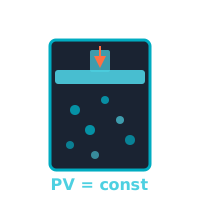
The relationship produces a characteristic straight line on a V-T diagram when plotted in Kelvin. If extended backward, every such line (called an isobar) passes through the origin at 0 K (−273.15°C), the theoretical point known as absolute zero where gas volume would become zero. This extrapolation was historically significant because it helped establish the Kelvin temperature scale and the concept of absolute zero. This simulator lets you visualise this behavior with animated gas particles inside a piston-cylinder assembly, showing how particle speed and gas volume change with temperature.
How Does Charles' Law Work?
At the molecular level, temperature is a measure of the average kinetic energy of gas molecules. When temperature increases, molecules move faster and collide more forcefully with the container walls. If the pressure is held constant (as in a piston-cylinder with a freely moving piston), the container must expand to accommodate the more energetic molecules. The faster-moving molecules push the piston outward until the internal pressure again equals the external (constant) pressure. Conversely, cooling the gas slows the molecules, and the piston moves inward as the gas contracts. The key requirement is that the pressure remains constant — meaning the gas is free to expand or contract against a constant external force.
Using the Charles’ law calculator
The Calculate tab solves V₁/T₁ = V₂/T₂ for whichever quantity is missing. Pick the unknown, type the other three, and the answer arrives with the constant k and the ratio.
| To find | Rearrangement | Typical question |
|---|---|---|
| V2 | V2 = V1 × T2/T1 | A balloon is carried outside into the cold — how much does it shrink? |
| T2 | T2 = T1 × V2/V1 | How hot must the envelope get for this much lift? |
| V1 | V1 = V2 × T1/T2 | Working back from a measured final volume. |
| T1 | T1 = T2 × V1/V2 | What was the starting temperature? |
How to find T₂ specifically, since it is the one people search for most: rearrange to T₂ = T₁ × V₂/V₁, make sure T₁ is in kelvin, compute, and convert back at the end if the answer is wanted in degrees. A gas occupying 2 L at 300 K that expands to 3 L must have reached T₂ = 300 × 3/2 = 450 K, or 176.85 °C.
Why the temperature must be in kelvin
This is the error that costs more marks than anything else in the topic, and it is worth seeing why it is fatal rather than just being told to convert. Charles’ law claims a direct proportion, and a proportion is only meaningful on a scale whose zero is a real zero.
Take 2 L of gas at 27 °C, heated to 177 °C. Done properly: 300.15 K to 450.15 K, a ratio of 1.4995, so the volume becomes about 3 L. Done in Celsius: 177/27 = 6.56, predicting 13 L. The Celsius answer is more than four times too large. Worse, the Celsius version predicts that a gas at 0 °C has no volume at all, and that a gas below freezing has a negative volume — which is the clearest possible sign that the scale, not the law, is at fault.
The tool’s calculator lets you type degrees if that is how the question is worded, but it converts to kelvin before doing anything else and shows that conversion as a numbered step, so the habit is visible rather than hidden.
Finding absolute zero by extrapolation
Charles’ law is the reason we know where absolute zero is. The experiment is simple enough for a school laboratory: hold a fixed mass of gas at constant pressure, measure its volume at several temperatures, and plot volume against temperature in degrees Celsius.
The points fall on a straight line. Extend that line backwards — beyond any temperature you actually measured — to the place where the volume would fall to zero. It crosses the axis at −273.15 °C.
| Temperature | Volume of 1 mol at 101.325 kPa |
|---|---|
| 100 °C (373.15 K) | 30.62 L |
| 25 °C (298.15 K) | 24.47 L |
| 0 °C (273.15 K) | 22.41 L |
| −100 °C (173.15 K) | 14.21 L |
| −273.15 °C (0 K) | 0 L — extrapolated, never observed |
The decisive detail is not the number itself but its universality. Lord Kelvin’s argument in 1848 was that the intercept comes out the same for every gas, at every pressure, for any amount of substance. Change the pressure and the gradient of the line changes — k = nR/P — yet the line still points at the same place. Switch this simulator’s chart to Isobars and you can watch three different lines converge on one temperature. A point that every experiment agrees on, independent of what you put in the apparatus, is not a property of the gas; it is a property of temperature itself. That is what earned it the name absolute zero and the zero of the scale that carries Kelvin’s name.
One honest caveat, which the Explore cards make too: no gas ever gets there. Every real gas liquefies and then freezes long before 0 K, so the final stretch of that line is a mathematical extension, not a measurement. The Third Law of Thermodynamics puts absolute zero permanently out of reach in any finite number of steps.
What is the constant in V/T = k?
k is the volume divided by the absolute temperature for the sample in front of you, and it holds steady while you heat or cool that sample at constant pressure — which is exactly what the k = V/T readout in the simulator lets you check. Move the temperature through its whole range and the number should not budge.
Comparing Charles’ law with the ideal gas law identifies it: k = nR/P. So k depends on how much gas there is and on the pressure, but not on temperature — and on a V–T graph it is simply the gradient of the line. Raise the pressure and the line lies flatter, because the same warming buys you less expansion.
Real-World Applications of Charles' Law
Hot air balloons are the most iconic application of Charles' Law. By heating the air inside the balloon envelope, the air expands and becomes less dense than the surrounding cooler air, generating buoyant lift. Pilots control altitude by adjusting the burner. Automobile tires experience pressure changes with temperature — on a hot summer day, the air inside tires expands, increasing pressure, which is why tire pressure should be checked when tires are cold. Baking relies on Charles' Law when CO₂ gas produced by yeast or baking powder expands in the oven, causing bread and cakes to rise. Weather balloons launched into the atmosphere expand as they ascend because temperature and pressure both decrease, causing the gas inside to occupy a larger volume.
The Hot-Air Balloon Calculation
A hot-air balloon envelope holds 2000 m³ of air. Ambient temperature is 20 °C (293 K). To lift the balloon and a basket totalling 1500 kg, how much do you need to heat the air?
| Step | Working | Result |
|---|---|---|
| Ambient air density (at 20 °C) | ρcold = 1.20 kg/m³ | — |
| Mass of cold air in 2000 m³ | 2000 × 1.20 | 2400 kg |
| Required balloon-air mass (to lift envelope + basket + 1500 kg) | 2400 − 1500 | 900 kg |
| Required hot-air density | 900/2000 | 0.45 kg/m³ |
| From P·M = ρ·R·T at constant P | Thot = Tcold·(ρcold/ρhot) = 293 × (1.20/0.45) | 781 K (~508 °C) |
508 °C of air is too hot for a fabric balloon envelope — modern hot-air balloons heat to only about 100 °C above ambient, so they can lift less than this calculation suggests. The fabric of a real envelope tolerates about 120−130 °C. To lift 1500 kg in practice you would need a much larger envelope, around 7000 m³ for a 100 °C temperature rise. Charles’s law gives you the theoretical limit; material limits restrict what is actually possible.
Three Cases With The Numbers Worked
- Car tyre pressure rises in summer. Mostly Gay-Lussac (constant volume) rather than Charles (constant pressure), but the underlying physics is the same. A 6−8 psi rise from 15 °C morning to 50 °C hot road is routine.
- Bread rising in the oven. CO2 bubbles produced by yeast double or triple in volume between dough temperature (25 °C) and oven temperature (200 °C). Plus the gas evaporates from the dough faster at higher T. The combined effect is what makes bread rise.
- Weather balloons. A weather balloon launched at sea level (1.0 atm, 20 °C) might reach 30 km where pressure is 0.01 atm and temperature is −50 °C. Combined gas law: volume ratio is (1.0/0.01) × (223/293) = 76. The balloon bursts at altitude rather than continuing forever.
References for Gas Laws
- Cengel, Y. A. & Boles, M. A. — Thermodynamics: An Engineering Approach, 9th ed., Chapter 3.
- Charles, J. (unpublished, 1787) / Gay-Lussac, J. L. (1802) — Recherches sur la dilatation des gaz et des vapeurs.
- Kelvin, W. T. (1848) — On an Absolute Thermometric Scale. Phil. Mag.
Explore Related Simulators
If you found this Charles' Law simulator helpful, explore our Ideal Gas Law Simulator, Boyle's Law Simulator, Specific Heat Capacity Simulator, Thermal Expansion Simulator, and Thermodynamics Cycles Simulator for more hands-on practice.
Updated