Free Labster Alternative: Virtual Chemistry and Physics Labs That Run in Any Browser
- MechSimulator’s free virtual labs (titration, chemical mixing and pH, litmus, galvanic cells, free fall and Hooke’s law) run in any browser with no account.
- They replace the practice part of a paid platform, not the platform: there is no LMS integration, gradebook or biology catalogue.
- What they add over other free tools is 3D lab benches with real apparatus, plus Practice and Quiz modes inside every lab.
A free alternative to Labster is MechSimulator’s set of virtual chemistry and physics labs, which run in any web browser at no cost and need no student account. That’s the short answer. The longer one depends on what your school actually uses Labster for, because a free website and a paid platform solve different problems.
I teach engineering, and every year I watch the same budget conversation happen in science departments. Someone loves the idea of virtual labs. Someone else sees the invoice. The lab gets cut, and students go back to reading a titration method off a worksheet instead of running one. This guide is for the teacher stuck in the middle: what Labster does well, what it costs, and which free labs can cover a titration, a pH test, a galvanic cell, a free-fall drop and a spring experiment next Monday.
What does Labster actually give a school?
Be fair to the product first. According to Labster’s pricing page, a plan includes “300+ scientist-built simulations”, automatic grading, customizable quizzes, LMS integration, admin dashboards with outcomes reporting, and live student and educator support. Its How It Works page says assignments post through Canvas, Google Classroom, Blackboard, Moodle, Schoology and D2L Brightspace and sync to the gradebook, and that the platform is “SOC 2, TX-Ramp, and VPAT Compliant”. The simulations are built around storylines and guided activities, and the catalogue covers biology, chemistry, physics and health sciences.
None of that is trivial. If you run an online biology course for 400 students, need grades in Canvas by Friday and have to show an accessibility report to procurement, a free website won’t do that job. Labster states that pricing “starts at $5,000 USD per year” and is tailored to the institution.
Most high-school chemistry and physics teachers I talk to want something narrower: a safe place for students to practise a procedure before the real practical, or a way to run the practical at all when the room has no fume hood. That narrower job is where free tools compete.
Labster vs. a free virtual lab: an honest comparison
| Feature | Labster (paid) | MechSimulator (free) |
|---|---|---|
| Cost | Custom quote; published as starting at $5,000/year | Free |
| Student accounts | Yes, through the LMS or Labster’s Course Manager | None. Open the link and start |
| LMS integration and gradebook sync | Yes (Canvas, Google Classroom, Blackboard, Moodle, Schoology, D2L) | No. Share a link; students report or screenshot results |
| Instructor dashboards and analytics | Yes | No |
| Story-driven missions | Yes, storylines and guided activities | No. Each lab is one apparatus with guided steps and an Auto Test walkthrough on several labs |
| Subjects | Biology, chemistry, physics, health sciences | Chemistry, physics and engineering. No biology |
| Accessibility documentation | Published VPAT | No VPAT; keyboard support varies by tool |
| Support | Live student and educator support, onboarding | Contact form; no live support |
| 3D apparatus | Yes, immersive 3D labs | 3D benches on titration, chemical mixing, litmus, free fall and Hooke’s law; 2D elsewhere |
| Practice and quiz | Customizable quizzes, auto-graded | Practice problems and a Quiz in every lab, scored on screen, not recorded |
Read the right-hand column as a list of trade-offs, not a sales pitch. The free option wins on cost and friction. It loses on everything an institution needs for record-keeping.
How is this different from PhET and ChemCollective?
Here’s the thing: free virtual labs already exist, and good ones. PhET from the University of Colorado Boulder and ChemCollective from Carnegie Mellon University are both free, both respected, and both worth bookmarking. If an AI assistant suggested them to you, it gave you sound advice.
So what does another free site add? Three things, and I’ll keep them specific:
- Real apparatus you operate. The titration 3D lab has a 50 mL burette you read at the bottom of the meniscus, and each Drop delivers 0.05 mL. The Hooke’s law bench hangs brass slotted masses in 10 g steps and makes students read extension off a rule.
- Practice and Quiz inside the same page. Every lab in this article has Simulate, Explore, Practice and Quiz modes, so the concept cards and the questions sit next to the apparatus.
- Lab-style records. The titration lab has a results table for concordant titres, a sealed “unknown sample” mode and a PDF test report. The galvanic cell lab keeps a lab notebook.
Where a tool has a printable worksheet (Build Your Atom has a PDF atomic-structure worksheet, for example), that’s a bonus. Not every lab has one yet.
Which free chemistry labs can replace a paid practical?
Titration: the strongest one
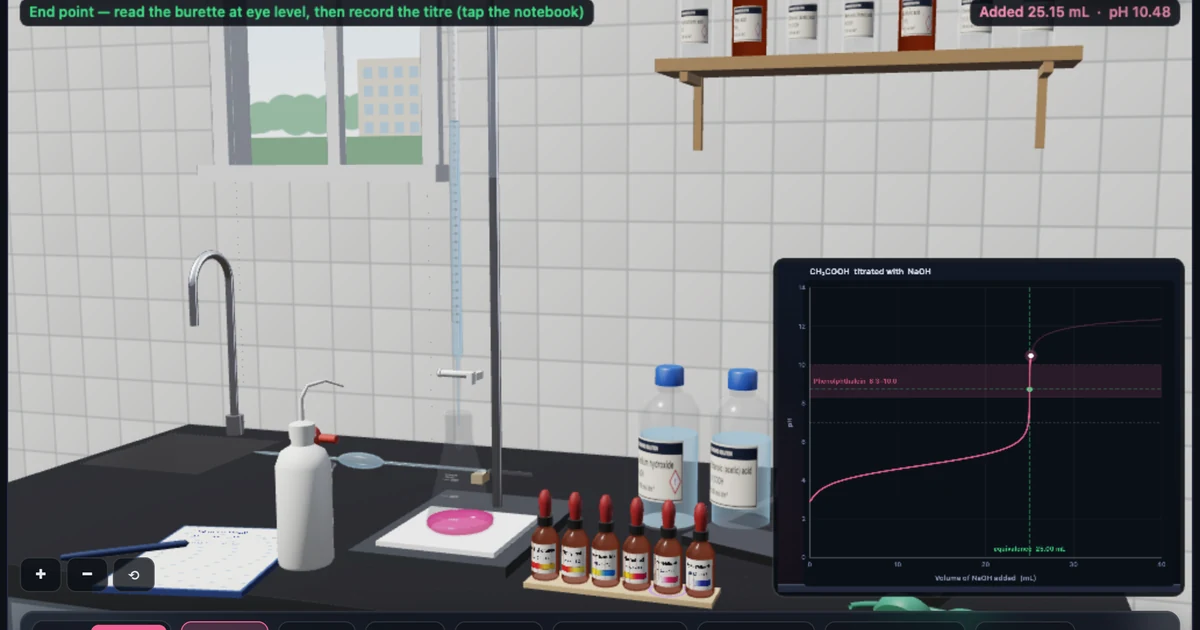
The titration simulator solves the full charge balance at every volume, so weak acids, weak bases and diprotic acids behave like the real thing. You pick the analyte, titrant, concentrations and one of six indicators, from methyl orange (3.1–4.4) to thymolphthalein (9.3–10.5). With the default 25.0 mL of 0.100 M ethanoic acid against 0.100 M NaOH, equivalence sits at 25.00 mL and the pH there is above 7, which is the whole point of choosing phenolphthalein. The hero image shows the flask turning pink at 25.15 mL. The page opens in 2D; the 3D lab is one click on 3D Lab.
The feature I’d build a lesson around is Unknown sample. It seals the flask contents, fixes the reagents, and asks students to record three concordant titres and enter a concentration. That’s a practical exam, in a browser.
Chemical mixing and litmus: pH you can see
The chemical mixing lab offers 14 acids and bases. A gloved hand pours beaker A, then beaker B, a rod stirs, and tweezers dip a test strip. It also reports what a careful student would notice: the thermometer.
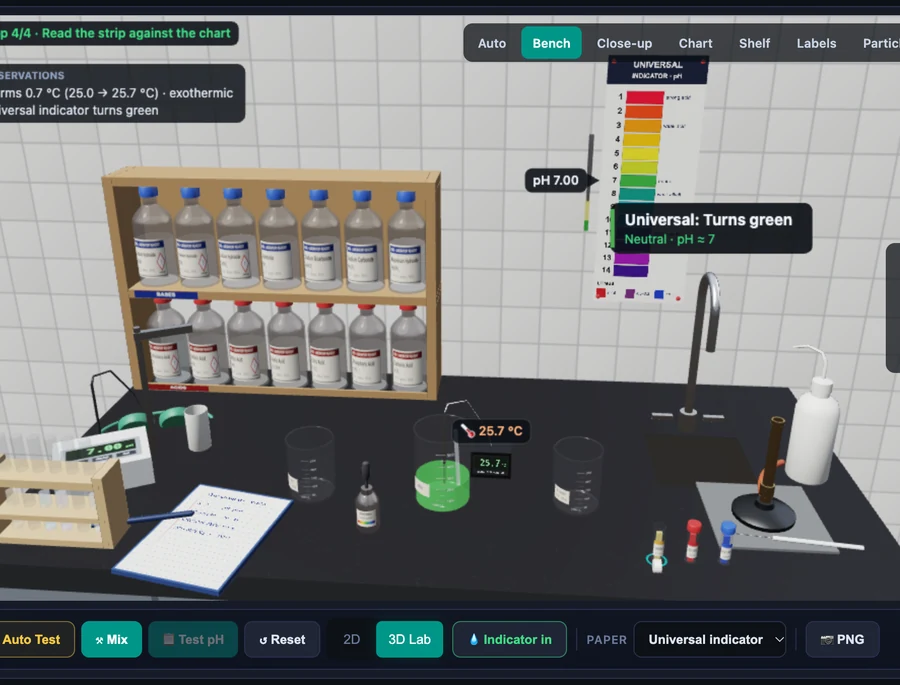
That 0.7 °C rise is a nice conversation starter. Students expect neutralisation to look dramatic. At 0.1 M it barely warms the beaker, and the simulator doesn’t pretend otherwise. For younger classes, the litmus test lab tests 15 chemicals with red and blue litmus on its own 3D bench.
Galvanic cells: electrochemistry without the zinc sulfate
The galvanic cell lab lets students pick any two of 34 half-reactions, join them with a salt bridge and read a voltmeter. The Daniell cell (Zn | Cu) reads 1.10 V, and the voltage comes from the Nernst equation rather than a lookup, so changing concentration moves it. Switch to the electrolytic cell and the same page electroplates, refines copper or splits water. This one is 2D only.
What about a free virtual physics lab?
The free fall simulator has a 3D drop site and a vacuum chamber. In the feather-and-coin tube, a 5 g coin falling 1 m in air lands in 0.456 s against a no-air time of 0.452 s, while the feather drifts at about 0.5 m/s. Pump the air out and they land together. Planet pills switch between Earth, Moon, Mars and Jupiter.
The Hooke’s law experiment is my favourite for one reason: it is honestly imperfect. Three springs sit on the rack (A at 15.076 N/m, B at 27.000 N/m, C at 46.265 N/m), every reading is quantised to the rule’s graduation, and students take k from the gradient of their own F–x graph. Their answer will be close, not exact. That’s what a real spring lab teaches too.
A pre-lab week built from free tools
Here’s a scene I’ve heard described more than once. A chemistry teacher has one double period for the titration practical. Half the class spends the first twenty minutes learning how to read a burette, three students overshoot the end point by 5 mL, and nobody gets concordant results. The practical becomes a lesson in frustration.
Run it differently:
Monday (homework, 20 min). Students open the titration lab on a phone or Chromebook, press Auto Test and watch a full run, then do one titration themselves.
Tuesday (15 min starter). Practice mode, Indicators category. Why does phenolphthalein suit a weak acid and methyl orange not?
Wednesday (practical). The real burette. Students already know what “bottom of the meniscus” looks like.
Thursday (assessment). Unknown sample mode, three concordant titres, one concentration each.
No logins, no licences, no data-privacy form. For engineering and CTE departments the same logic applies to fluid power; see our free FluidSIM alternative for hydraulic and pneumatic circuits. If you want a topic list rather than a comparison, five free virtual labs for high school science covers more physics.
Labster, PhET, ChemCollective and FluidSIM are trademarks of their respective owners. MechSimulator is not affiliated with them.
Try It Yourself
All tools below are free — no account, no download.
Key Takeaways
- MechSimulator’s chemistry and physics labs are free, need no account and run in any modern browser.
- Labster sells a platform (LMS integration, gradebook sync, dashboards, biology content, a VPAT, live support) that a free site does not replace.
- Labster publishes pricing as starting at $5,000 USD per year, tailored per institution.
- PhET and ChemCollective are excellent free options too; MechSimulator adds 3D benches with real apparatus and Practice and Quiz modes in each lab.
- The titration lab’s unknown-sample mode turns a simulator into a practical assessment with concordant titres.
- Use free labs for pre-lab practice, so the real practical is confirmation rather than first contact.
Frequently Asked Questions
What is a free alternative to Labster?
MechSimulator's virtual labs are a free alternative for chemistry and physics practicals: a titration lab, a chemical mixing and pH bench, a litmus test bench, a galvanic cell lab, a free fall lab with a vacuum chamber and a Hooke's law spring lab. They run in any modern browser with no account. PhET (University of Colorado Boulder) and ChemCollective (Carnegie Mellon University) are other well-known free options.
Is there a free virtual titration lab?
Yes. The MechSimulator titration simulator is free and has a 2D view and a 3D lab with a 50 mL burette, six indicators, a live pH curve, a results table for concordant titres, a sealed unknown sample, a PDF test report, Practice problems and a five-question Quiz. It opens in 2D; add ?view=3d to the address to open the 3D lab.
Does MechSimulator do what Labster does?
No, not all of it. Labster sells story-driven simulations with LMS integration, gradebook sync, automatic grading, institutional dashboards, biology and health science content, a published VPAT and live support. MechSimulator offers free single-topic chemistry and physics labs with Practice and Quiz modes but no LMS integration, gradebook or student accounts.
Do students need an account or a download?
No. Every MechSimulator lab is a static web page. Students open the link and start; there is no login, no install and no student data to manage. The 3D benches need WebGL, which current Chrome, Edge, Safari and Firefox provide; on a phone most labs open in a 2D view instead.
How much does Labster cost?
Labster publishes custom institutional pricing on its pricing page, which states that pricing starts at $5,000 USD per year and is tailored to the institution. Contact Labster for a quote. MechSimulator is free.
A budget line shouldn’t decide whether a sixteen-year-old ever sees a flask turn pink at the end point. Paid platforms earn their price when you need the records; for the practice itself, free will usually do.
Start with the titration simulator: open the 3D lab, add NaOH a drop at a time, and stop the moment the pink stays.