Two Stroke Engine Simulator
Port Timing & Crankcase Compression — Animate • Learn • Practice • Quiz
1 Overview
The Two Stroke Engine Simulator visualises the complete two-stroke cycle with animated port timing, piston motion, and a live PV diagram. Unlike four-stroke engines, the two-stroke completes a power cycle in just one crankshaft revolution (360°), using ports instead of valves and crankcase compression to manage gas exchange.
You will see how the intake port, transfer port, and exhaust port are uncovered and covered by the piston as it moves, and understand the scavenging process where fresh charge pushes out exhaust gases. The simulator clearly shows the simultaneous events happening above and below the piston.
2 Configuring the System
- Adjust the RPM slider to set the engine speed. Up to 120 rpm the animation runs in real time; above that it runs in slow motion and the canvas shows by how much (8000 rpm is 133 power strokes a second — far too fast to watch).
- Change the Compression Ratio (6:1 to 12:1) to see its effect on pressure and efficiency.
- The engine starts running when the page opens. Click Pause to freeze it, or Step to advance to the next port or reed event one at a time.
- The canvas shows a section through a real case-reed two-stroke — finned barrel and head, spark plug, exhaust port and header pipe, the transfer duct cast in the barrel wall, the reed valve and carburettor on the crankcase, the piston, connecting rod and flywheels — alongside a live P–V diagram and a port-timing circle. The two lanes under the engine show what is happening above and below the piston at every crank angle.
- Readout cards display current phase, crank angle, pressure, temperature, efficiency, and port status.
3 Running the Cycle
The exhaust and transfer ports are windows in the cylinder wall, opened and closed by the piston crown — so their timing is symmetric about BDC. The intake is a reed valve on the crankcase: its petals lift when the rising piston pulls the crankcase below atmospheric pressure, so its timing comes from pressure, not position. During the upstroke: the charge above the piston is compressed while fresh mixture is drawn into the crankcase through the reed valve. During the downstroke (power stroke): combustion drives the piston down, the exhaust port opens first for blowdown, then the transfer port opens for scavenging as crankcase-compressed charge enters the cylinder.
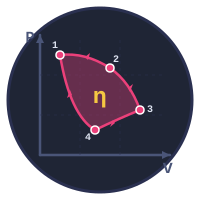
The Port Status readout shows which ports are currently open or closed. The P–V diagram traces the cycle with the enclosed area representing net work per cycle. Compression starts at point 1, when the exhaust port closes — not at BDC — so the trapped compression ratio is smaller than the geometric one shown on the slider.
4 Draw the Port Timing Diagram (Virtual Lab)
This is the port-timing experiment from the engines lab, done on the simulated engine.
- Press Pause, then press Step until the Crank Angle reads 0°. The piston is at TDC.
- Press Step again. The engine turns and stops exactly where the next event happens. The label on the canvas tells you which port has just opened or closed. Note the crank angle: 110° is exhaust open.
- Keep stepping and write down every event: exhaust opens 110°, transfer opens 125°, transfer closes 235°, exhaust closes 250°, reed opens about 258°, reed closes 20° after TDC.
- Convert each angle to “before or after the nearest dead centre”: 110° after TDC is 70° before BDC.
- Draw a circle with TDC at the top and one arc for each port. Then compare it with the Port timing circle on the canvas.
What to notice: the exhaust and transfer arcs are symmetric about BDC because the piston is their valve, and the exhaust opens 15° before the transfer (the blowdown).
5 The 3D Engine
The Engine view switch above the canvas shows the same engine in 3D: a 50 cc case-reed single on a training stand, drawn true to scale from the simulator itself. The crown follows the same slider-crank, every port’s roof sits exactly where the crown is at that port’s timing angle (so the crown uncovers the exhaust at 110° and the transfers at 125°), the reed petals lift by the same pressure model, and the dome in the head holds exactly the clearance volume your compression ratio sets. The page opens on the 2D section; press 3D to switch, and 2D section to come back. On a phone the 3D engine works but is easier to explore on a larger screen.
- Drag to turn the engine (arrow keys work too), pinch or hold Ctrl and scroll to zoom, and click any part — piston, rings, connecting rod, flywheels, the exhaust, transfer and boost ports, the reed valve, carburettor, spark plug, expansion chamber — for a card saying what it does, with live numbers.
- Cutaway mills a quarter off the castings and paints the cut faces red; Section removes the whole front half, which is exactly the 2D drawing; X-ray turns the castings to glass; Exterior shows the engine as it looks from outside.
- Gas shows the charge: fresh mixture blue, burnt gas brown, hot gas orange. Watch the fresh charge loop up the far wall from the two main transfer ports and the boost port (loop scavenging), the exhaust stream turn blue as some charge escapes, and the mixture pass the reed petals into the crankcase.
- The card at the top left says what is happening above and below the piston; the dial at the top right is the port-timing circle with the crank angle on it. Play, Step and both sliders drive the 3D engine exactly as they drive the section, and the P–V diagram and timing circle stay under it.
6 The Underlying Theory
Study concepts across four categories: Fundamentals (two-stroke cycle, crankcase compression, scavenging), Ports & Timing (port geometry, timing diagram, port opening angles), 2-Stroke vs 4-Stroke (power output, efficiency, emissions, applications), and Performance (trapping efficiency, delivery ratio, scavenging efficiency).
7 Try a Problem
Practice generates problems on port timing, scavenging efficiency, power output comparisons, and thermodynamic calculations. Quiz provides 5 randomised questions from a pool of 15.
8 Engineering Notes
- Use Step mode to freeze at the moment when transfer and exhaust ports are simultaneously open — this is where short-circuiting occurs.
- Two-stroke engines produce a power stroke every revolution (vs every two revolutions for four-stroke), giving them higher power-to-weight ratio.
- The exhaust port opens before the transfer port — this blowdown period is essential for reducing cylinder pressure before scavenging begins.
- Lower compression ratios (6-10) are typical for two-stroke petrol engines compared to four-stroke engines.
- Watch how the crankcase acts as a pump — it draws in fresh charge on the upstroke and compresses it on the downstroke.
How a Two-Stroke Engine Works — Interactive Port-Timing Simulator
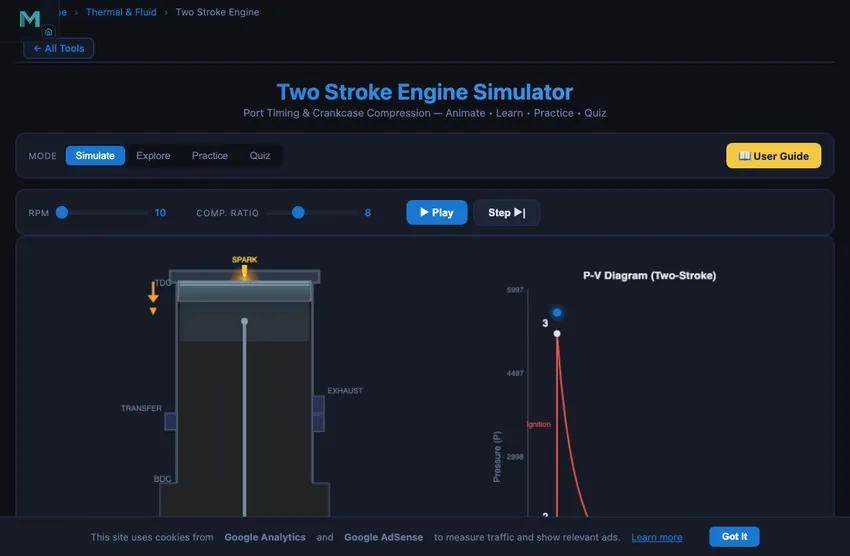
The two-stroke engine completes an entire power cycle in just one revolution of the crankshaft (360°), producing one power stroke per revolution compared to the four-stroke engine’s one power stroke every two revolutions. This gives two-stroke engines a higher power-to-weight ratio, making them popular in chainsaws, outboard motors, motorcycles, and small power tools. However, this comes at the cost of lower fuel efficiency and higher emissions due to the overlap between intake and exhaust processes.
Two-Stroke Engine Diagram — Parts Labelled
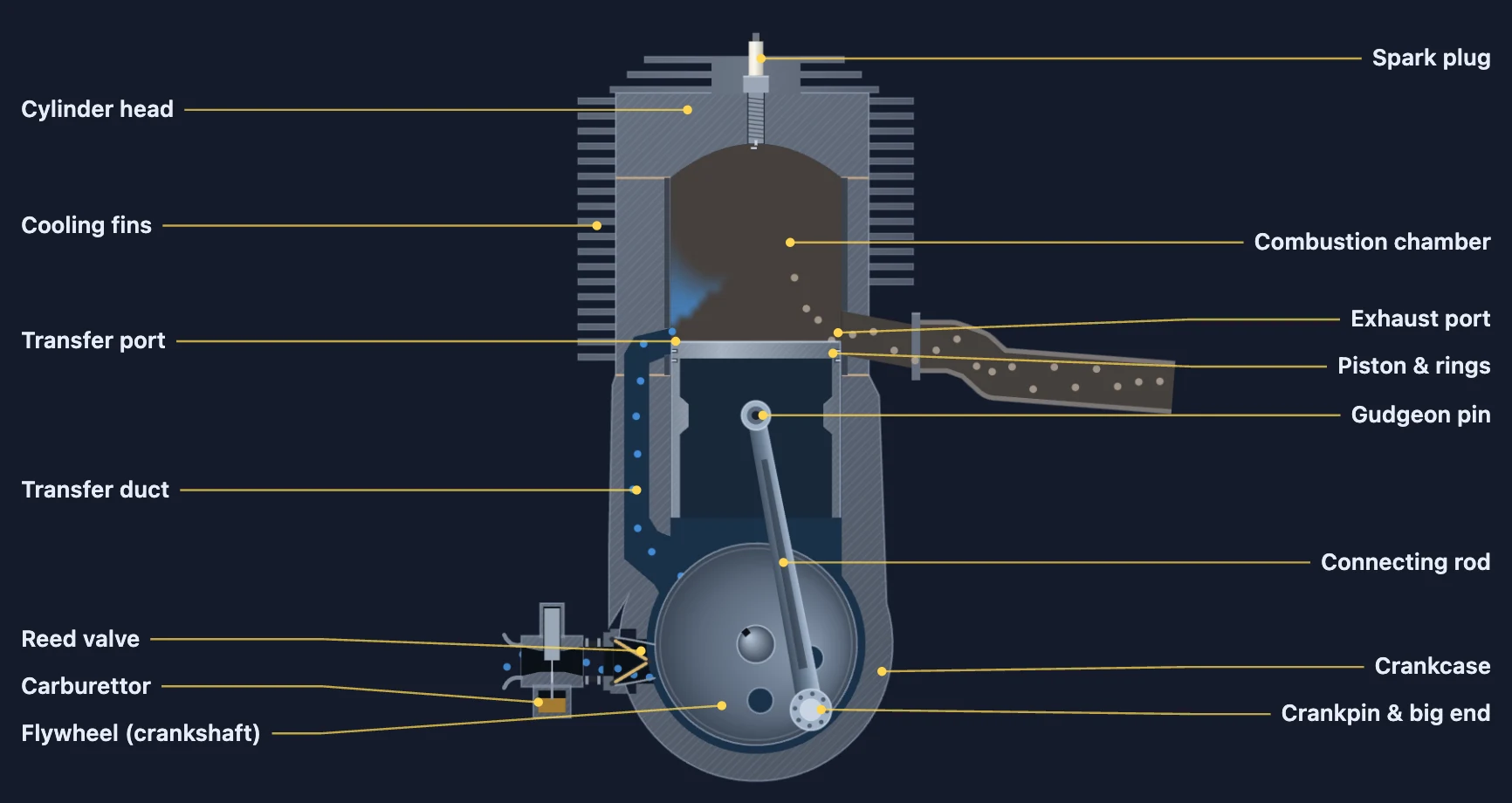
This is the layout of a typical small petrol two-stroke — the engine in a 50 cc scooter, a moped or a chainsaw. The table says what each labelled part does.
| Part | What it does |
|---|---|
| Cylinder head | Closes the top of the cylinder, holds the spark plug and forms the dome of the combustion chamber. |
| Spark plug | Ignites the compressed charge just before top dead centre (TDC). |
| Combustion chamber | The clearance volume above the piston at TDC. Its size sets the compression ratio. |
| Cylinder and cooling fins | Guides the piston. The fins carry heat to the air — this engine has no water jacket. |
| Exhaust port | The highest window in the cylinder wall, so the piston uncovers it first on the way down. Burnt gas leaves to the exhaust pipe. |
| Transfer port and duct | A passage cast into the cylinder wall from the crankcase to a port just below the exhaust. It carries the compressed fresh charge up into the cylinder. |
| Piston and rings | Takes the gas force, and is also the valve: its crown opens and closes the exhaust and transfer ports. Its skirt still covers the exhaust port at TDC. |
| Gudgeon pin | Pins the connecting rod’s small end to the piston. |
| Connecting rod | Links the piston to the crankpin and turns the piston’s straight-line motion into rotation. |
| Crankpin and big end | The offset pin the rod turns on, running in a roller bearing. Its offset is half the stroke. |
| Flywheel (crankshaft) | Two full-circle flywheels with the crankpin pressed between them. They smooth the single power stroke and fill the crankcase so it pumps well. |
| Crankcase | Sealed. As the piston moves, its volume changes and it works as a pump — drawing charge in on the upstroke and pushing it up the transfer duct on the downstroke. |
| Reed valve | One-way petals on the crankcase intake. They open when the crankcase falls below atmospheric pressure and close when it rises again. |
| Carburettor | Meters petrol into the incoming air. Two-stroke oil is mixed into the fuel or injected, because the charge passes through the crankcase and lubricates it. |
Two-Stroke Engine Working Animation — the Four Stages
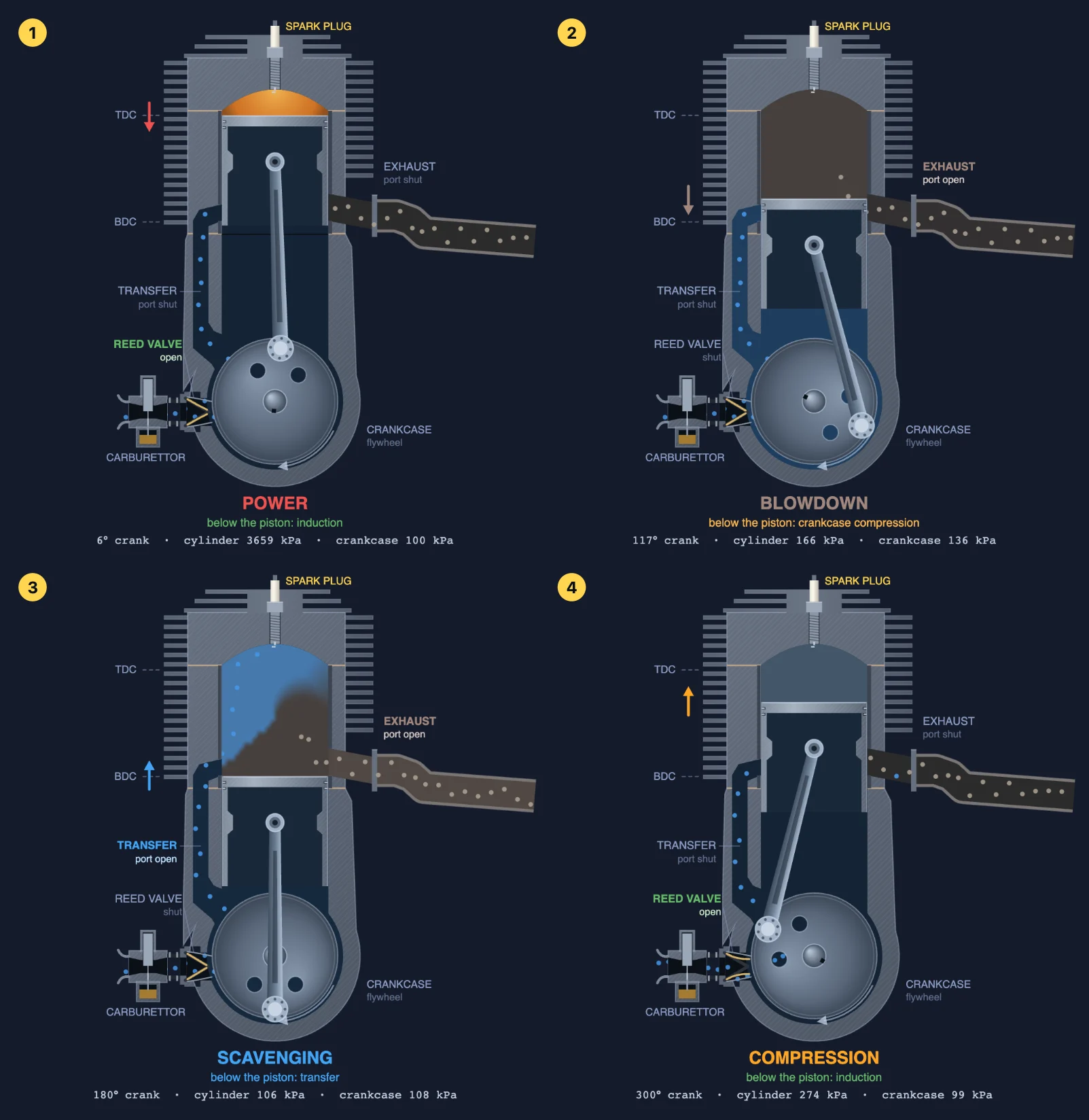
Everything happens in one turn of the crank: two strokes of the piston, with something going on above the piston and below it at the same time.
- Power (downward stroke, 0–110° after TDC). The charge was fired at TDC and the hot gas drives the piston down. Below the piston, the reed valve has just closed and the shrinking crankcase starts compressing the fresh charge.
- Exhaust blowdown (110–125°). The crown uncovers the exhaust port first. Cylinder pressure falls from about 298 kPa to 122 kPa before the transfer port opens.
- Transfer and scavenging (125–235°, around BDC). The transfer port opens and the crankcase charge — now at about 139 kPa — flows up the far wall, over the dome and down towards the exhaust, pushing the burnt gas out ahead of it. Some fresh charge escapes with it: the short-circuit loss.
- Compression and induction (upward stroke, 250–360°). Once the exhaust port closes at 250°, the trapped charge is compressed for the next firing. Below the piston the crankcase grows, its pressure falls below atmospheric, and at about 258° the reed valve opens to draw in fresh mixture.
Understanding Port Timing in Two-Stroke Engines
Unlike four-stroke engines that use mechanically operated valves, two-stroke engines use ports—openings in the cylinder wall that are covered and uncovered by the piston as it moves. The exhaust port releases burnt gas and the transfer port connects the crankcase to the cylinder. The intake is either a third, piston-controlled port low in the cylinder wall, or — as in the engine simulated here — a reed valve on the crankcase. A port opens exactly when the piston crown passes its upper edge, so the height of each port is its timing.
Port Timing Diagram of a Two-Stroke Petrol Engine
A port timing diagram is a circle of crank angle with TDC at the top, turning in the running direction. It has one arc for each port. Because the piston is the valve, the exhaust and transfer arcs are symmetric about bottom dead centre (BDC): a port closes as far after BDC as it opened before it. The reed valve’s arc is not symmetric, because pressure opens it, not the piston. These are the events of the engine in this simulator; the Port timing circle beside the P–V diagram draws them live.
| Event | Crank angle after TDC | From the nearest dead centre | What happens |
|---|---|---|---|
| Reed valve closes | 20° | 20° after TDC | The charge’s momentum keeps it flowing briefly after TDC. Then the descending piston raises crankcase pressure. |
| Exhaust port opens (EO) | 110° | 70° before BDC | Blowdown begins — crown 73.5 % of the way down the stroke |
| Transfer port opens (TO) | 125° | 55° before BDC | Scavenging begins — crown 83.5 % of the way down |
| Bottom dead centre | 180° | — | Both ports fully open |
| Transfer port closes (TC) | 235° | 55° after BDC | Fresh charge stops entering |
| Exhaust port closes (EC) | 250° | 70° after BDC | The charge is trapped and compression starts |
| Reed valve opens | about 258° | about 102° before TDC | Crankcase 2 kPa below atmosphere — induction begins |
Durations: exhaust open 140°, transfer open 110°, blowdown (EO to TO) 15°, reed open about 122°. A real engine fires the plug some degrees before TDC. The simulator uses the air-standard cycle, which adds the heat at TDC.
Drawing the port timing diagram — the lab experiment
In the engines lab this is done on a cut-section model:
- Mark TDC and BDC on the flywheel rim.
- Turn the flywheel slowly in its running direction. Stop where the piston crown just begins to uncover the exhaust port, and mark the rim. Repeat for transfer opening, transfer closing and exhaust closing.
- Measure each mark’s arc from the nearest dead centre, and convert it: angle = arc ÷ flywheel circumference × 360°.
- Draw the circle with TDC at the top and one arc for each port.
The simulator does the same thing without the tape measure. Press Step and it stops exactly on each event; the Crank Angle readout gives the angle, and the port timing circle draws the arcs. Check the symmetry yourself: 110° and 250° are both 70° from BDC.
Crankcase Compression
A unique feature of the two-stroke petrol engine is crankcase compression. As the piston moves upward during compression, it creates a partial vacuum in the sealed crankcase, drawing fresh air-fuel mixture in through the reed valve (or, in simpler engines, a piston-controlled intake port). When the piston descends during the power stroke, this mixture is slightly compressed in the crankcase — to about 1.4 bar in the simulated engine — and then transferred to the cylinder through the transfer port, pushing out (scavenging) the exhaust gases.
Scavenging and Short-Circuiting
Scavenging is the process of replacing burnt gases with fresh charge. In a two-stroke engine, the exhaust and transfer ports are open simultaneously for a brief period, which can cause short-circuiting—fresh charge escaping directly through the exhaust port. Modern two-stroke engines use shaped piston crowns, tuned exhaust systems, and direct fuel injection to minimize this loss.
P–V Diagram of a Two-Stroke Engine
The two-stroke P–V diagram differs from the four-stroke one in two ways you can see in the simulator:
- Compression starts when the exhaust port closes (point 1), not at BDC. Until the port closes, the rising piston only pushes gas out. So the trapped compression ratio is smaller than the geometric one. With the slider at 8:1, the trapped ratio is 6.15.
- There is no separate pumping loop. A four-stroke draws a thin loop at the bottom of its diagram for its intake and exhaust strokes. A two-stroke does its gas exchange around BDC with both ports open, so the bottom of the loop is a short, nearly flat line near atmospheric pressure. The pumping work is done by the crankcase instead.
The sharp drop at point 4 is blowdown, when the exhaust port opens. The area inside the loop is the net work of one revolution. For the four-stroke Otto and Diesel cycles, with the pumping loop, see the Four Stroke Engine Simulator. To compare the two directly, run the same compression ratio in the four-stroke engine simulator and watch the extra pumping loop appear.
Two-Stroke vs Four-Stroke Engine — Key Differences
| Two-stroke | Four-stroke | |
|---|---|---|
| Power strokes | One every crankshaft revolution | One every two revolutions |
| Gas exchange | Ports uncovered by the piston near BDC; the crankcase pumps the charge | Separate intake and exhaust strokes through poppet valves |
| Valve gear | None, except the reed petals | Camshaft at half crank speed, valves, springs, timing belt or chain |
| Lubrication | Oil mixed into the fuel or injected | Oil sump and pump |
| Fresh charge lost | Some short-circuits straight out of the exhaust | Almost none |
| Thermal efficiency (small petrol engines) | About 20–25 % | About 30–35 % |
| Power for its weight | High | Lower |
| Typical uses | Chainsaws, scooters and mopeds, dirt bikes, small outboards, large ship diesels | Cars, most motorcycles, generators |
Why Two-Strokes Are More Powerful Per Litre — And Why That Doesn’t Win
Same displacement, twice the firing rate. A 250 cc two-stroke produces as many power strokes per second as a 500 cc four-stroke at the same RPM. So in principle, a two-stroke could be twice as powerful for the same engine size and mass. In practice it gets close to that on dirt bikes, racing kart engines, and chainsaws — the power-to-weight ratio is genuinely excellent.
The catch is everything else. Two-strokes lose 20−30 % of fresh charge straight out the exhaust port during the brief overlap when both ports are open. That fuel just goes out as unburnt hydrocarbon. They burn oil mixed into the fuel as a deliberate lubrication strategy, which means the exhaust always has some blue smoke. They have no separate intake stroke, so volumetric efficiency is poor. Net result: thermal efficiency around 20−25% versus 30−35% for a comparable four-stroke. The four-stroke wins on fuel economy and emissions easily, and as those mattered more, two-strokes lost market share.
The Scavenging Problem — The Single Biggest Engineering Challenge
In a four-stroke engine, the exhaust stroke pushes burnt gases out, then the intake stroke pulls fresh charge in — clean separation. In a two-stroke, both happen simultaneously while the piston is near bottom dead centre. Fresh charge enters through the transfer port; exhaust leaves through the exhaust port; some fresh charge inevitably follows the exhaust out (short-circuit loss).
Three design approaches try to fix it, each with trade-offs:
- Loop scavenging. Transfer ports angled upward so fresh charge sweeps up the cylinder before turning toward the exhaust. The Schnürle design (DKW, 1932) made this the standard for petrol two-strokes.
- Cross-flow scavenging. Piston has a deflector hump that directs fresh charge upward. Simple but inefficient; rarely used now.
- Uniflow scavenging. Fresh charge enters one end, exhaust exits the other. Used in large two-stroke marine diesels (Wartsila, MAN-B&W). Combined with direct injection, achieves 50%+ thermal efficiency — better than any four-stroke.
Where Two-Strokes Are Still the Right Choice
| Application | Why two-stroke wins |
|---|---|
| Chainsaw, leaf blower, brush cutter | Weight matters more than fuel economy; can run in any orientation |
| Outboard boat motor (small) | Power-to-weight, simpler construction |
| Motocross dirt bike (legacy) | Light weight, broad powerband, simple maintenance |
| Large marine diesel (container ships) | Uniflow scavenging + direct injection gives the highest thermal efficiency available |
| Model aircraft engines (glow plug, 0.5−10 cc) | Power-to-weight, simple lubrication via fuel mixture |
The engine in this simulator is the motorcycle layout. It has one air-cooled cylinder, a reed valve on the crankcase, and full-circle flywheels — the arrangement in most 50 cc scooters and mopeds. Motocross two-strokes use the same cycle with the reed moved to the cylinder, and chainsaws often use a piston-controlled intake port instead of a reed. So watching this engine is watching how a two-stroke motorcycle engine works.
What Killed Petrol Two-Strokes for Road Use
European emission standards (Euro 1 in 1992, Euro 2 in 1996) effectively banned petrol two-stroke road motorcycles. The unburnt hydrocarbon and lubricant smoke could not be cleaned up at any practical cost. By 2000 the petrol two-stroke had disappeared from car-class engines (the last was the Trabant 601), and by 2010 from road motorcycles in Europe. Tools and small off-road engines persist because their use is brief and well-ventilated, but even there four-stroke equivalents are increasingly common.
The marine diesel two-stroke is the survivor. With direct injection bypassing the scavenging-loss problem, and at hundreds-of-MW power scale where thermal efficiency drives fuel cost, the two-stroke uniflow diesel is unbeaten. The engine in a large container ship is two-stroke, low-speed (100 rpm), direct-coupled to the propeller, and runs on heavy fuel oil at 50%+ efficiency.
Two-Stroke Engine 3D Simulator — Ports, Reed Valve and Loop Scavenging
The page opens on the 2D section; press 3D in the Engine view switch above the canvas to see the same engine as a 3D model, free in the browser with no download (or open the 3D two-stroke engine directly). It is a 50 cc case-reed single, 40 mm bore and 40 mm stroke, on a training stand, drawn to scale from the simulator itself. Every port’s roof sits exactly where the piston crown is at that port’s timing angle, so the crown uncovers the exhaust at 110° and the transfers at 125°. The reed petals lift by the same crankcase-pressure model as the 2D view, and the dome in the head holds exactly the clearance volume your compression ratio sets.
There are four ways to look inside. Cutaway mills a quarter off the castings and paints the cut faces red, Section removes the front half (exactly the 2D drawing), X-ray turns the castings to glass and Exterior shows the engine from outside. Turn on Gas to watch the fresh charge loop up the far wall from the two main transfer ports and the boost port (loop, or Schnürle, scavenging) while the exhaust stream turns blue as some fresh charge escapes. That short-circuiting loss is why a simple two-stroke burns more fuel than a four-stroke. Click any part, such as the piston, rings, connecting rod, reed valve, expansion chamber or spark plug, for a card with live numbers.
The four-stroke cycle has the same kind of view in the 3D engine simulator, and the steam engine simulator and gas turbine simulator run in 3D too.
Two-Stroke Engine — Frequently Asked Questions
How does a two-stroke engine work?
A two-stroke engine completes one power cycle in a single crankshaft revolution (360°). On the upstroke the piston compresses the charge above it while the rising piston lowers the crankcase pressure and draws fresh mixture in through the reed valve below it. On the downstroke the burning charge drives the piston down while the crankcase charge underneath is compressed; near bottom dead centre the piston uncovers the exhaust port and then the transfer port, and the crankcase charge flows up into the cylinder and pushes the burnt gas out.
What are the main parts of a two-stroke engine?
The cylinder head with the spark plug and combustion chamber; the finned cylinder with the exhaust port, the transfer port and its duct cast into the wall; the piston with its rings and gudgeon pin; the connecting rod; the crankshaft, usually a pair of full-circle flywheels with the crankpin between them; the sealed crankcase; and the intake, which is either a reed valve on the crankcase or a piston-controlled intake port, fed by the carburettor.
What is a port timing diagram of a two-stroke engine?
A port timing diagram is a circle of crank angles, with top dead centre at the top, showing when each port opens and closes. Because the piston is the valve, the exhaust and transfer arcs are symmetric about bottom dead centre. In the engine simulated here the exhaust port is open from 110 to 250° after TDC (140°) and the transfer port from 125 to 235° (110°); the reed valve is open from about 258° to 20° after TDC.
Why does the exhaust port open before the transfer port?
So that the cylinder pressure falls below the crankcase pressure before the transfer port opens. If the transfer port opened first, the high-pressure burnt gas would blow back into the crankcase. In the simulated engine the exhaust opens 15° earlier; over that blowdown the cylinder pressure drops from about 298 kPa to 122 kPa, while the crankcase is at its peak of about 139 kPa, so fresh charge flows into the cylinder.
What does the reed valve do in a two-stroke engine?
The reed valve is a one-way valve between the carburettor and the crankcase. Its thin petals lift when the rising piston pulls the crankcase pressure below atmospheric pressure, letting fresh mixture in, and they close when the descending piston starts to compress the crankcase, so the charge cannot blow back out. Its timing therefore follows crankcase pressure rather than piston position.
What is the difference between a two-stroke and a four-stroke engine?
A two-stroke engine fires once every crankshaft revolution and exchanges its gas through ports while the piston is near bottom dead centre, using the crankcase as a pump; a four-stroke engine fires once every two revolutions and uses separate intake and exhaust strokes with camshaft-driven valves. The two-stroke is lighter and has more power for its size; the four-stroke uses less fuel and emits less, because a two-stroke loses some fresh charge straight out of the exhaust.
Why are two-stroke engines less fuel efficient than four-stroke?
Two-stroke engines suffer from short-circuiting: fresh charge escaping through the exhaust port while both ports are open during scavenging. This wastes fuel and increases emissions. The overlap between intake and exhaust also reduces trapping efficiency, typically to 60–80% compared with nearly 100% in four-stroke engines.
References
- Heywood, J. B. — Internal Combustion Engine Fundamentals, 2nd ed., Chapter 7 (Two-Stroke Engines).
- Blair, G. P. — Design and Simulation of Two-Stroke Engines, SAE. The reference for two-stroke designers.
- MAN Energy Solutions / Wartsila marine engine documentation — for the modern large-bore uniflow diesel.
Explore Related Simulators
If you found this two-stroke engine simulator helpful, explore our Four Stroke Engine Simulator, Thermodynamics Simulator, Heat Transfer Simulator, and Flywheel Energy Simulator for more hands-on practice.
Updated