Belt Drive Calculator — Velocity Ratio, Tension and Wrap Angle Explained
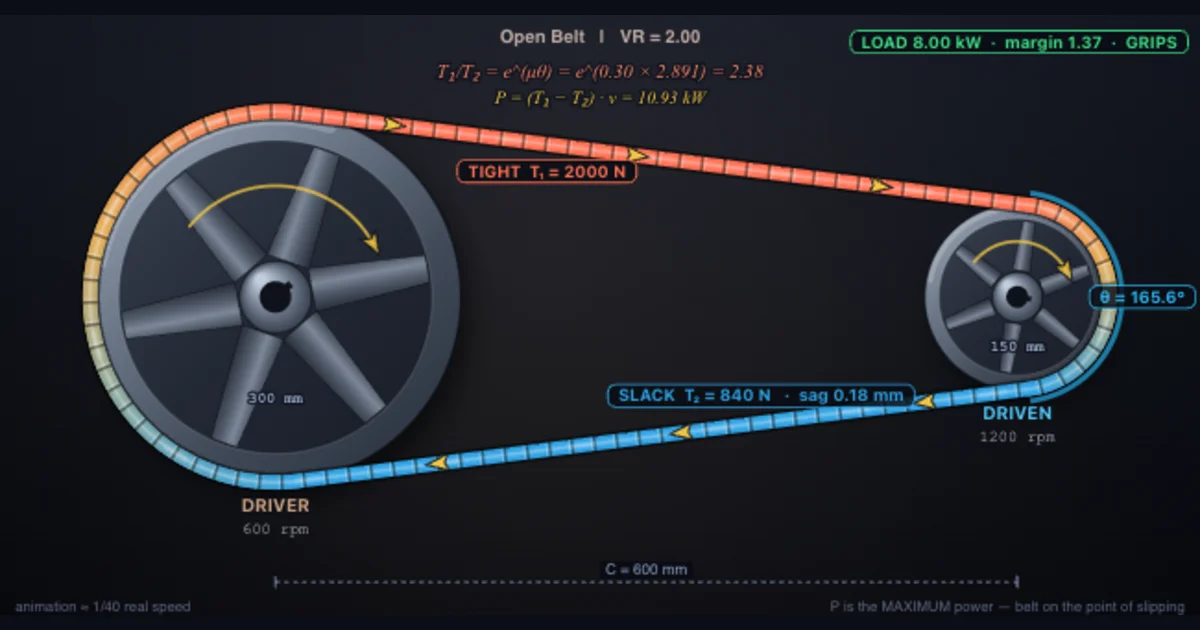
- Velocity ratio comes from the diameters: VR = D₁/D₂ = N₂/N₁. A 300 mm driver on a 150 mm driven pulley at 600 rpm gives 1200 rpm out.
- Grip comes from the capstan equation, T₁/T₂ = eμθ, and power from the difference: P = (T₁ − T₂)v. Because it is exponential in θ, wrap angle is the cheapest lever you have.
- A belt slips when the demanded power exceeds Pmax = T₁(1 − e−μθ)v — not simply because it is loose.
Belt drives look like the easy topic. Two pulleys, a loop, a ratio you can write down in one line. Then a student asks why the belt on the workshop pillar drill squeals under load when the ratio has not changed, and the one-line answer runs out. The ratio is kinematics. Whether the drive actually works is friction — and friction in a belt behaves in a way that is genuinely unintuitive until you see it.
Here is the whole chain of reasoning, with a worked example you can reproduce in the Belt Drive Calculator as you read.
Step 1 — The Ratio Is the Easy Part
Ignore slip for a moment and the belt is inextensible, so the rim speeds must match: πD₁N₁ = πD₂N₂. Rearranged, that is the velocity ratio:
VR = D₁/D₂ = N₂/N₁
A bigger driver means a faster driven shaft; a smaller driver means reduction and torque multiplication. Real belts lose a little to creep — the belt stretches on the tight side, relaxes on the slack side, and creeps backwards a few tenths of a percent as it passes round each pulley — so the driven speed is N₂ = N₁(D₁/D₂)(1 − s/100).
A chain does not do this. It engages tooth by tooth, so its ratio is z₁/z₂, a ratio of whole numbers, and it is exact.
Step 2 — Grip: the Capstan Equation
Wrap a rope round a bollard and you can hold a ship with one hand. The same relation governs a belt on a pulley:
T₁/T₂ = eμθ
T₁ is the tight side, T₂ the slack side, μ the coefficient of friction and θ the angle of wrap in radians. Three things follow, and all three surprise people.
The tight side is set by rotation, not by geometry. Friction from the driver adds tension in the direction the belt travels, so the span leaving the driver carries T₁ and the span returning to it carries T₂. Reverse the motor and the two swap. Drives are usually arranged with the slack side on top only because a sagging upper span drapes onto the pulleys and slightly increases the wrap.
The smaller pulley governs — whichever of the two it is. In an open drive the small pulley carries θ = π − 2 arcsin(|R₁−R₂|/C) and the large one π + 2 arcsin(|R₁−R₂|/C). The small one reaches its friction limit first, so it sets the capacity. Note this has nothing to do with which pulley is driving: in a speed-up drive the driver is the small pulley.
Tension does not jump — it climbs. Through the arc of contact the tension follows T = T₂eμφ, reaching T₁ after the full wrap. The simulator draws this directly by colour-mapping the belt, which is the fastest way I know to make the exponential feel real rather than algebraic.
Step 3 — Power, and a Worked Example
Only the difference in tension does work:
P = (T₁ − T₂) × v, v = πD₁N₁/60 000 m/s with D in mm
Take the simulator's default drive: D₁ = 300 mm, D₂ = 150 mm, centre distance C = 600 mm, N₁ = 600 rpm, μ = 0.30 and an allowable tight-side tension T₁ = 2000 N.
- VR = 300/150 = 2.00, so N₂ = 1200 rpm.
- v = π × 300 × 600 / 60 000 = 9.42 m/s.
- α = arcsin((150−75)/600) = 7.18°, so the small pulley wraps θ = 180° − 2(7.18°) = 165.6° = 2.891 rad.
- T₁/T₂ = e0.30 × 2.891 = 2.38, giving T₂ = 2000/2.38 = 840 N.
- P = (2000 − 840) × 9.42 = 10.93 kW.
That 10.93 kW is a ceiling, not a duty. It assumes the belt is exactly on the point of slipping, with T₂ as small as friction allows. No real drive is designed to sit there.
Step 4 — Will It Slip?
This is where the topic becomes engineering rather than arithmetic. Compare what the drive can pass with what the machine demands:
slip margin = Pmax / Pdemanded
Above 1 the belt grips and only creeps. Below 1 it slips bodily, heats, glazes and polishes the pulley. Ask our example drive for 12 kW and the margin is 10.93/12 = 0.91 — it slips, and no amount of retensioning within the belt's rating will change that by much, because tension enters linearly while wrap enters exponentially.
So buy wrap instead. Fit a back-side idler on the slack span — a wheel that carries no torque and simply pushes the slack belt inward — and the geometry changes for both pulleys at once. A 240 mm idler on this drive lifts the governing wrap from 165.6° to 199.5°. The tension ratio rises to 2.84, T₂ falls to 704 N, and the drive now passes 12.22 kW: margin 1.02, and it grips.
Two rules go with that idler, and both come from practice rather than theory. It must sit on the slack side — on the tight side it would have to react the full T₁, which gives tensioner-arm chatter, bearing failure and sometimes a snapped belt. And it must sit outside the belt loop to increase the arc; an idler inside the loop is a take-up device, useful for a stretched belt but adding no wrap.
Step 5 — Why a V-Belt Beats a Flat Belt
Swap the flat belt for a V-belt and the same drive passes 17.54 kW — a 60 % jump with no change of material, tension or geometry. The reason is a wedge.
A V-belt sits in a groove, so the normal force pressing it against the two flanks is amplified by 1/sin(β/2), where β is the included groove angle. The capstan equation then runs on an effective coefficient:
μ′ = μ / sin(β/2)
For a 38° groove that is a factor of 3.07, so a real μ of 0.30 behaves like 0.92. Classical V-belts are moulded with a 40° included angle while the pulley groove is cut to 32°, 34°, 36° or 38° per ISO 4183 — narrower on smaller pulleys, because a belt bent round a small pulley bulges and its flanks open up. That is also why V-belts cannot be crossed: the belt would have to run on its back, out of the groove.
Step 6 — Chains Count in Teeth and Pitches
Chain drives follow different arithmetic, and two of the differences catch people out because the belt formulas look like they should carry over.
Speed. A chain rides the polygon its own links form, not a circle. One turn of a sprocket feeds exactly z pitches, so v = z p N/60 000 — not πDpN/60 000. The circle overstates it by π/(z sin(π/z)): 0.2 % at 37 teeth, 1.7 % at 10.
Length. A chain is built from whole links, and an even number of them unless you accept a weaker cranked offset link, so the length is worked out in pitches and rounded up to the next even integer — then the centre distance is trimmed to suit.
The same polygon produces chordal action: the effective radius swings between Dpcos(π/z)/2 and Dp/2 as each link seats, so the output speed ripples by 1 − cos(π/z) once per tooth. That is 3.4 % on an 11-tooth sprocket, 1.7 % on 15 and 0.4 % on 31 — the reason fast chain drives avoid small sprockets.
Using the Simulator in Class
The sequence that works: set the drive, read the wrap angle, then predict what will happen before touching a control. Shorten the centre distance and ask whether the ratio changes (it does not) and whether the capacity changes (it does, because θ does). Turn on the demanded load and find the point where GRIPS becomes SLIPS. Then fix it three different ways — idler, V-belt, more tension — and compare what each one costs. That last comparison is the part students remember.
Try It Yourself
- Belt Drive Calculator — Flat, V-belt, crossed and roller chain. Tension colour map, idler, centrifugal tension, slip margin and step-by-step working.
- Gear Train Calculator — The positive-drive alternative: simple, compound and worm trains with speed, torque and direction.
- Shaft Torsion Simulator — Size the shaft that carries the pulley: torsional shear stress, angle of twist and polar modulus.
Key Takeaways
- VR = D₁/D₂ = N₂/N₁ for a belt; z₁/z₂ and exact for a chain.
- T₁/T₂ = eμθ. Because it is exponential in θ, wrap angle is the cheapest capacity you can buy.
- The tight side is the span leaving the driver — set by rotation direction, not by whether it is on top.
- The smaller pulley governs, driver or driven; in a speed-up drive that is the driver.
- Slipping is a margin problem: Pmax/Pdemanded below 1. Fix it with wrap first, then a V-belt, then tension.
- A V-belt is geometry, not chemistry: μ′ = μ/sin(β/2), about three times the flat-belt value.
- Chains: speed z p N/60 000, length in whole even pitches, chordal ripple 1 − cos(π/z).
Frequently Asked Questions
How do you calculate the velocity ratio of a belt drive?
VR = D₁/D₂ = N₂/N₁. A 300 mm driver on a 150 mm driven pulley gives VR = 2, so 600 rpm in gives 1200 rpm out. Allow for slip with N₂ = N₁(D₁/D₂)(1 − s/100). For a chain, use tooth counts: VR = z₁/z₂, which is exact.
What is the angle of wrap and why does it matter?
It is the arc over which the belt touches a pulley. The smaller pulley carries θ = π − 2 arcsin(|R₁−R₂|/C). It matters because T₁/T₂ = eμθ is exponential in θ, and the smaller wrap governs the whole drive.
How much power can a belt drive transmit?
P = (T₁ − T₂)v. With the belt on the point of slipping, Pmax = T₁(1 − e−μθ)v. For the worked example above: 10.93 kW. Real drives are designed below that ceiling.
Why is my belt slipping and how do I stop it?
Because the load demands a tension ratio friction cannot supply — not because the belt is loose. Increase the wrap angle first (idler or shorter centres), then consider a V-belt, then more tension. Tension enters linearly; wrap enters exponentially.
Is a chain drive better than a belt drive?
Different, not better. A chain gives an exact ratio, needs no initial tension and tolerates heat and oil. A belt is quieter, cheaper, needs no lubrication and slips harmlessly under shock. Chains also suffer chordal action, so fast drives need larger sprockets.
The formula students remember is the ratio. The one that decides whether the machine works is the capstan equation — and its most useful property is that θ sits in the exponent. Before you reach for a bigger belt or a tighter one, look at how much arc of contact you can buy. Run the simulator, put a load on it, and watch a drive that was slipping start to grip.