Strength of Materials
Interactive simulators for stress analysis, beam bending, Mohr’s circle, joints, pressure vessels, material testing, and more — built for TVET and engineering students.
12 tools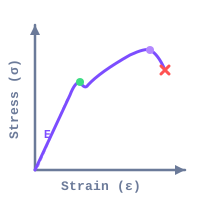
Understanding Strength of Materials: From Stress Analysis to Structural Design
Strength of materials, also known as mechanics of solids or mechanics of materials, is a foundational branch of engineering that studies how solid bodies respond to applied forces and displacements. Every structural component in the built world — from bridges and buildings to machine shafts and pressure vessels — must be designed to withstand loads without failure. This discipline provides the analytical tools to predict how materials deform, where they yield, and when they fracture, making it indispensable for mechanical, civil, and aerospace engineers.
Stress, Strain, and Hooke’s Law
At the heart of strength of materials lie the concepts of stress and strain. Stress (σ) is the internal resistance per unit area that a material develops when subjected to an external load, measured in pascals (Pa) or megapascals (MPa). Strain (ε) is the resulting deformation expressed as a ratio of change in dimension to the original dimension. In the elastic region, stress and strain are linearly proportional through Hooke’s Law: σ = Eε, where E is Young’s modulus. The Stress-Strain Diagram simulator lets students interactively trace a complete engineering stress-strain curve, identifying the proportional limit, yield point, ultimate tensile strength (UTS), and fracture point for different materials. Understanding these regions is critical for selecting materials and determining safe working loads.
Mohr’s Circle and Stress Transformation
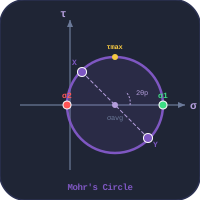
Real-world components rarely experience simple uniaxial loading. When a structural element is subjected to combined normal and shear stresses, engineers use Mohr’s circle to determine the principal stresses, maximum shear stress, and the orientation of the principal planes. This graphical method transforms a complex biaxial state of stress into an intuitive circular plot where principal stresses appear at the horizontal extremes and maximum shear stress equals the circle’s radius. The Mohr’s Circle simulator links the stress element and the Mohr’s circle in real time, allowing students to visualize how rotating the element changes the stress components. This visualization is essential for understanding failure criteria such as maximum shear stress (Tresca) and distortion energy (von Mises) theories.
Beam Bending, Shear Force, and Bending Moment Diagrams
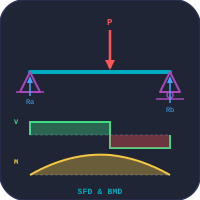
Beams are among the most common structural elements, and analysing them requires drawing shear force diagrams (SFD) and bending moment diagrams (BMD). Starting from equilibrium equations and support reactions, engineers determine how internal shear forces and bending moments vary along the beam length. These diagrams reveal critical sections where stresses are highest, guiding decisions about cross-section geometry and material selection. The bending stress formula σ = My/I connects bending moment (M), distance from the neutral axis (y), and the second moment of area (I). The Beam Bending SFD & BMD calculator lets students add point loads and uniformly distributed loads (UDL) to simply supported and cantilever beams, instantly generating both diagrams.
Torsion, Joints, and Pressure Vessels
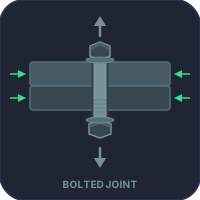
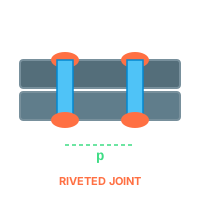
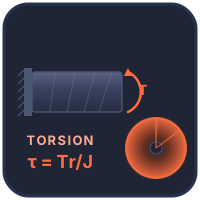
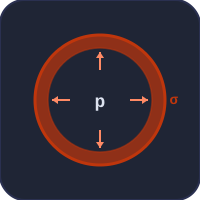
Shafts transmitting torque experience torsional shear stress governed by τ = Tr/J, where T is the torque, r is the radial distance, and J is the polar moment of inertia. The Shaft & Torsion simulator visualises the twist angle and stress distribution for solid and hollow circular shafts. Mechanical connections — including bolted joints and riveted joints — must be designed to resist tensile, shear, and bearing stresses while maintaining adequate factors of safety. Thin-walled pressure vessels, common in chemical plants and boiler systems, develop hoop (circumferential) stress that is twice the longitudinal stress, making them a classic application of stress analysis.
Material Testing: Tensile, Impact, and Fatigue
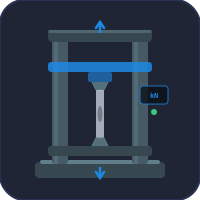
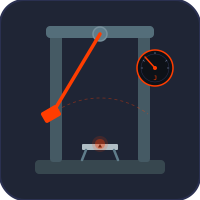
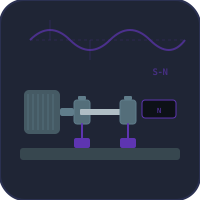
Laboratory testing validates theoretical predictions. The Universal Testing Machine (UTM) virtual lab simulates tensile and compression tests on multiple materials, producing real-time stress-strain curves. Impact testing using Charpy and Izod pendulums measures a material’s toughness and ductile-to-brittle transition temperature (DBTT), while fatigue testing with a rotating beam (R.R. Moore) machine generates S-N curves that define the endurance limit for cyclic loading. These tests are essential for certifying materials in safety-critical applications such as automotive, aerospace, and structural engineering.
Who Uses These Simulators?
These strength of materials simulators are designed for TVET students, undergraduate engineering students, mechanical design engineers, and educators seeking interactive teaching tools. Whether you are preparing for a university exam, reinforcing workshop concepts, or prototyping a structural design, these tools provide hands-on experience with the fundamental principles of solid mechanics — no physical lab equipment required.
Explore Related Simulators
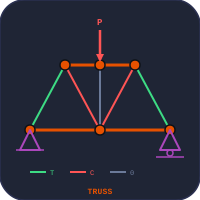
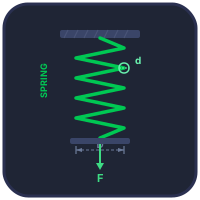
If you found these strength of materials simulators useful, explore our Truss Analysis simulator, Spring Design Calculator, Virtual Lab Testing tools, and Applied Mechanics simulators for more interactive engineering practice.