Thermal & Fluid Engineering Simulators
How much energy, how fast it moves, and how a fluid carries it. These tools cover thermodynamics, heat transfer and fluid mechanics — from the gas laws and the Carnot limit to engines, refrigerators, pipe networks, pumps and wings.
- 34 tools
- 6 topics
Thermodynamics & Gas Laws
Energy, work and the state of a substance: the gas laws, heat capacity, latent heat and the ideal cycles built from them.
Thermodynamic Cycles
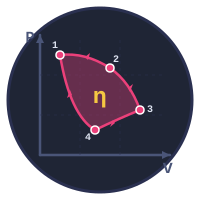
Carnot, Otto, Diesel and Brayton on a P-V diagram, stage by stage, with the efficiency of each.
Ideal Gas Law
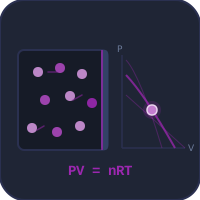
Solve PV = nRT for any variable, then see where a real gas departs from it through the compressibility factor Z.
Boyle’s Law
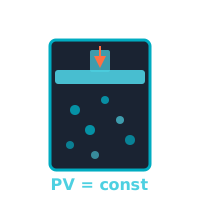
Compress a gas at constant temperature and straighten the curve by plotting P against 1/V.
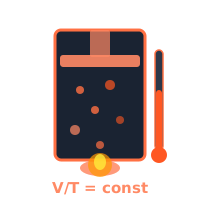
Charles’ Law
Heat a gas at constant pressure and extrapolate the V-T line back to absolute zero.
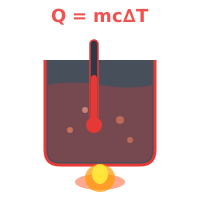
Specific Heat Capacity
Q = mcΔT for 58 materials in SI and US units, with a heating simulation.

Phase Change & Latent Heat
Heating and cooling curves, Q = mL, boiling point against pressure, sublimation and freeze-drying.
Engines, Power Plants & Refrigeration
The cycles running in real machines: steam plant, gas turbines and jet engines, piston engines, and the refrigeration and air-conditioning side of the same laws.
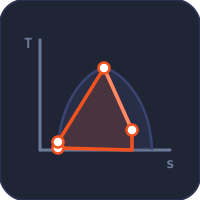
Rankine Cycle
A steam power plant on T-s and P-v diagrams from built-in steam tables; vary boiler pressure, superheat and condenser.
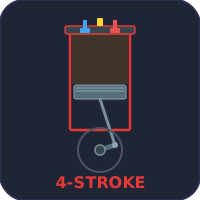
Four-Stroke Engine
Otto and Diesel cycles in a running engine, with P-V and T-s diagrams, power and torque.

Gas Turbine
The Brayton cycle in a power plant, a turbojet and a turbofan: regeneration, intercooling, reheat, thrust and TSFC, in a 2D cutaway and a 3D engine.
Steam Boiler
Fire-tube and water-tube boilers cut open and animated in 2D and 3D: Cochran, Lancashire, Babcock & Wilcox, Benson and more, with circulation and mountings.

Steam Engine
A double-acting slide-valve engine in 2D and 3D: indicator diagram, Zeuner valve diagram, cut-off, indicated power, steam use, compounding and the governor.
Hydroelectric Power Plant
Run-of-river, dam-toe, high-head and pumped-storage plants in 2D and 3D: dam, penstock, surge tank, Kaplan, Francis and Pelton turbines, water hammer and the governor.
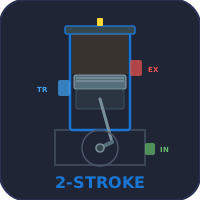
Two-Stroke Engine
Port timing, piston motion and a live P-V diagram through intake, compression, power and exhaust.

Morse Test — Multi-Cylinder Engine
Indicated power, friction power and mechanical efficiency by cutting out one cylinder at a time.
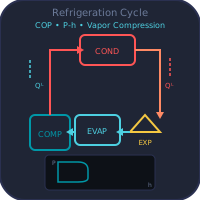
Vapour-Compression Refrigeration
COP and the P-h diagram for R-134a, R-410A and R-290.
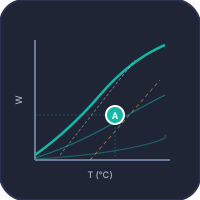
Psychrometric Chart
Dry and wet bulb, dew point, humidity ratio and enthalpy of moist air, altitude-corrected, SI or IP.
Heat Transfer
How fast energy moves: conduction through solids, convection to a fluid, radiation across space — and what the temperature change does to the part.
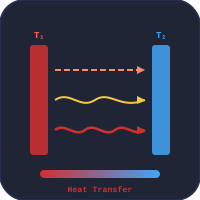
Conduction, Convection & Radiation
Fourier’s law, Newton’s law of cooling and the Stefan-Boltzmann law, side by side.
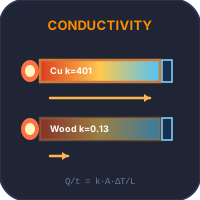
Thermal Conductivity
Fourier’s law with a table of k-values, comparing conductors and insulators.
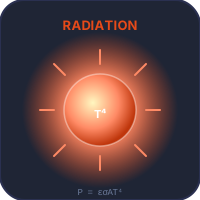
Stefan-Boltzmann Law
Radiated power P = εσAT⁴, the Planck spectrum and a planet’s equilibrium temperature.

Heat Exchanger — LMTD & NTU
Counter- and parallel-flow exchangers with live temperature profiles, effectiveness and outlet temperatures.
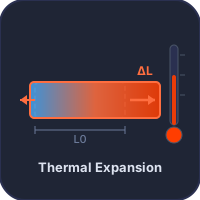
Thermal Expansion
Linear expansion, thermal stress, shrink fits and bimetallic strip deflection.

Thermocouple & Seebeck Effect
Heat one junction, read the thermo-EMF, and build a thermopile.
Fluid Properties & Statics
Fluids at rest and the properties that decide how they will flow: pressure transmission, buoyancy and viscosity.
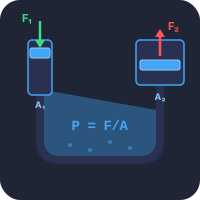
Pascal’s Law
Pressure transmitted through a hydraulic press: force multiplication from piston areas.
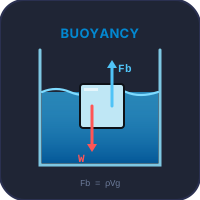
Buoyancy & Archimedes
Level rise in a tank and weighing over an overflow can: buoyant force and density.

Viscosity — Falling-Ball Viscometer
Time a sphere between two marks and find dynamic viscosity by Stokes’ law.
Fluid Flow
Fluids in motion through pipes and openings: conservation of mass and energy, flow regime, friction loss and discharge.
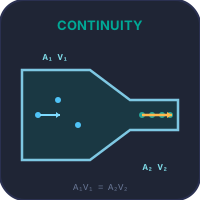
Continuity Equation
Flow speeds up through a narrowing: A₁V₁ = A₂V₂ with a live flow-rate check.
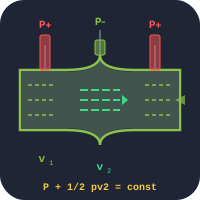
Bernoulli & the Venturi
Pressure head trades against velocity head along a converging–diverging pipe.
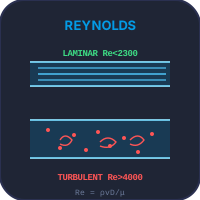
Reynolds Number
Osborne Reynolds’ dye experiment: laminar, transitional and turbulent flow.

Pipe Flow & Pressure Drop
Darcy-Weisbach head loss, friction factor and the Moody chart, with live velocity profiles.
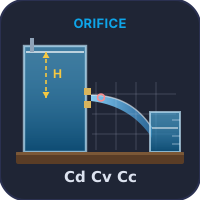
Orifice Discharge
Cd, Cv and Cc from the jet trajectory and a timed collection on a constant-head tank.
Aerodynamics & Turbomachines
Flow doing work on a body or a body doing work on a flow: lift and drag, pumps and hydraulic turbines.
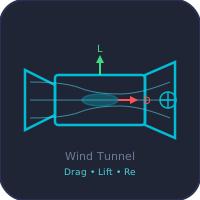
Wind Tunnel
Drag, lift and pressure distribution on airfoils and bluff bodies, with blockage correction.
Airfoil Analysis
Cl, Cd, Cm and Cp of NACA 4- and 5-digit sections from a viscous panel method.

Centrifugal Pump
Head, power and efficiency curves, best efficiency point, affinity laws and NPSH.

Hydraulic Turbines
Pelton, Francis and Kaplan runners: efficiency, unit quantities and specific speed.
Three Questions, One Subject
Thermal and fluid engineering — often taught together as thermofluids — answers three different questions about the same energy. Thermodynamics asks how much: how much energy a process exchanges as heat and work, and how much of the heat can ever become work. Heat transfer asks how fast: how quickly energy crosses a wall, a fluid film or empty space for a given temperature difference. Fluid mechanics asks how a liquid or gas moves and what pressure and force it exerts on the way. Every machine on this page — an engine, a refrigerator, a pump, a turbine — needs all three at once, which is why the collection keeps them together.
The Core Relation Behind Each Topic
Each group is built on a small number of equations. The table lists the one a student should recognise first in each, with the simulator that shows it.
| Idea | Relation | Where it appears |
|---|---|---|
| Thermodynamics | ||
| First law, closed system | ΔU = Q − W | Cycles, engines |
| Ideal gas | pV = nRT | Ideal gas, Boyle, Charles |
| Sensible and latent heat | Q = mcΔT · Q = mL | Specific heat, phase change |
| Best possible heat engine | η = 1 − TC/TH | Carnot, Rankine |
| Refrigerator performance | COPR = QL/Win | Refrigeration |
| Heat transfer | ||
| Conduction | q = −kA dT/dx | Conductivity |
| Convection | q = hA(Ts − T∞) | Three modes |
| Radiation | q = εσAT⁴ | Stefan-Boltzmann |
| Exchanger duty | q = UA·ΔTlm | LMTD & NTU |
| Fluid mechanics | ||
| Hydrostatics | p = ρgh · Fb = ρgV | Pascal, buoyancy |
| Conservation of mass | A₁V₁ = A₂V₂ | Continuity |
| Conservation of energy | p/ρg + V²/2g + z = const | Bernoulli, orifice |
| Flow regime | Re = ρVD/μ | Reynolds |
| Pipe friction | hf = f(L/D)V²/2g | Pipe flow |
A Sensible Order for a Thermofluids Course
- Properties and the gas laws — pressure, temperature, specific heat, latent heat, pV = nRT.
- The first and second laws — energy balances, then the Carnot limit on any cycle.
- Fluid statics — pressure with depth, Pascal’s law and buoyancy.
- Fluid flow — continuity, Bernoulli, then Reynolds number and pipe friction.
- Heat transfer — the three modes, then exchangers.
- Applied cycles and machines — steam plant, IC engines, refrigeration, pumps, turbines and aerodynamics.
Units That Trip Students Up
The equations in this subject are short; the errors are nearly always in the units. Temperature must be absolute — kelvin or rankine — in every gas law, in efficiency limits and in radiation, where getting it wrong by 273 changes the answer by orders of magnitude. Pressure must be absolute in the gas laws but is usually read as gauge pressure off an instrument. And the sign of work depends on the textbook: many engineering texts count work done by the system as positive, while many chemistry and physics texts count work done on it. Check which convention a problem uses before trusting a sign.
Frequently Asked Questions
What does thermal and fluid engineering cover?
It combines thermodynamics, heat transfer and fluid mechanics, often under the single course name thermofluids. Together they explain how engines, power plants, refrigerators, heat exchangers, pumps, turbines and aircraft work, from the gas laws and energy balances up to complete machines.
What is the difference between thermodynamics and heat transfer?
Thermodynamics tells you how much energy a process exchanges and what the end state will be; it says nothing about time. Heat transfer tells you how fast that energy moves through conduction, convection and radiation, which decides how big a heat exchanger or how thick an insulation layer has to be.
Why must temperature be in kelvin in gas law and radiation calculations?
Those relations are proportional to absolute temperature. In pV = nRT, or in radiated power, which goes as T to the fourth, a temperature in degrees Celsius measures from the wrong zero, so doubling it does not double anything physical and the answer is simply wrong.
Are any of these suitable for school physics?
Yes. The gas laws, specific heat capacity, latent heat, Pascal's law, buoyancy and Bernoulli's principle are all taught before university. They also appear in the Basic Science collection, which groups them with other school physics and chemistry experiments.
Explore Related Simulators
Updated