
Workshop & Manufacturing
Interactive simulators for machine tools, joining methods, metrology, and material testing
12 tools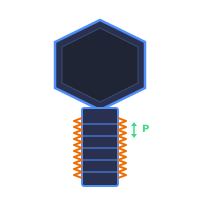

Workshop Technology and Manufacturing Processes: A Comprehensive Guide
Workshop technology is the backbone of mechanical engineering education. It brings together the practical skills and theoretical knowledge required to transform raw materials into finished components through machining, joining, and quality inspection. From the first turning cut on a centre lathe to the final hardness check on a heat-treated part, every step in a manufacturing workflow demands an understanding of machine tools, material behaviour, and dimensional control. MechSimulator offers twelve interactive workshop and manufacturing simulators that cover the core topics every TVET and engineering student must master before stepping onto a real production floor.
Machine Tools: Lathe, Drilling, Milling, and CNC
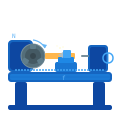
The lathe machine is often called the "mother of all machine tools" because it was one of the earliest power-driven devices and remains the most versatile. A centre lathe holds the workpiece between centres or in a chuck and rotates it against a single-point cutting tool. The principal operations include turning (reducing outside diameter), facing (generating flat end surfaces), boring (enlarging internal holes), threading (cutting helical grooves for screws and bolts), taper turning (producing conical surfaces), and knurling (impressing a diamond or straight-line pattern for grip). Cutting parameters such as spindle speed, feed rate, and depth of cut must be calculated from the workpiece material and tool geometry to achieve the desired surface finish without overheating the tool.
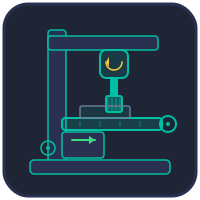
The drilling machine complements the lathe by creating and finishing holes. A column drill press drives a rotating twist drill into a stationary workpiece clamped to the machine table. Beyond basic drilling, the same machine performs reaming (finishing a drilled hole to a precise diameter), boring (enlarging an existing hole on-centre), countersinking (creating an angled seat for screw heads), and tapping (cutting internal threads). Selecting the correct spindle speed depends on the drill diameter, the material being cut, and the recommended cutting speed for the tool material, whether high-speed steel or carbide-tipped.
The milling machine uses multi-point rotary cutters to remove material from a workpiece. End mills, face mills, and slot drills each suit different operations, and cutting parameters — spindle speed, feed per tooth, depth of cut — must be calculated to optimise material removal rate (MRR) and surface finish. The CNC G-Code simulator takes machining a step further into computer numerical control, where tool paths are defined by G-code commands (G00 rapid traverse, G01 linear interpolation, G02/G03 circular arcs). Writing, visualising, and debugging G-code is an essential skill for modern manufacturing.
Hydraulic systems power everything from excavators to industrial presses. Our Hydraulic Circuit simulator lets you build circuits with pumps, directional control valves, cylinders, and relief valves, calculating flow rate, pressure, force, piston speed, and hydraulic power in real time.
Joining Methods: Welding, Bolting, and Riveting
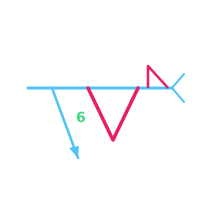
Permanent and semi-permanent joints hold structures together under static and dynamic loads. Welding is the primary permanent joining method, fusing base metals with or without filler material. Engineers communicate weld requirements on drawings using standardized symbols defined by AWS A2.4 and ISO 2553. A single welding symbol can specify the joint type (butt, lap, tee, corner), weld type (fillet, groove, plug, spot, seam), weld size, length, pitch, contour, and finishing requirements. Mastering these symbols is essential for anyone reading or creating fabrication drawings.
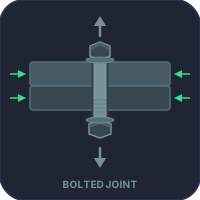
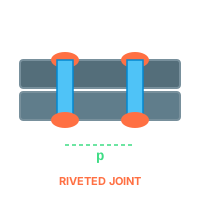
Bolted joints are the most common semi-permanent fastening method in mechanical assemblies. Designing a bolted connection requires calculating tensile stress in the bolt shank, shear stress across the shear plane, bearing stress on the connected plates, and applying appropriate safety factors based on load type and reliability requirements. Standard metric bolts from M6 to M24 cover the vast majority of engineering applications. Riveted joints, while largely replaced by welding and high-strength bolting in modern steel construction, remain important in aerospace (solid aluminium rivets) and in understanding historical structures such as boilers and bridges. Learning rivet head types (snap, pan, countersunk, flat) and joint configurations (single-lap, double-lap, single-strap butt, double-strap butt) builds foundational knowledge of fastener behaviour under shear and bearing loads.
Metrology in the Workshop: Threads and Tolerances
Dimensional accuracy is what separates a functional component from scrap. Thread nomenclature defines the geometry of screw threads using terms such as major diameter, minor diameter, pitch diameter, pitch, lead, thread depth, and helix angle. The ISO 261 metric thread standard specifies these dimensions for every standard thread size, and knowing how to read a thread designation like M10 x 1.5 is a fundamental skill. The tolerance and fits system governed by ISO 286 controls how mating parts interact. Every dimension on an engineering drawing carries a tolerance band that defines the acceptable range of sizes. When a shaft fits inside a hole, the relationship between their tolerance zones determines whether the assembly will be a clearance fit (free movement), a transition fit (possible slight interference), or an interference fit (requiring press-fitting). Selecting the correct fit is critical: too loose, and a bearing housing will vibrate and wear prematurely; too tight, and assembly becomes impossible without risking damage to the components.
Material Testing in the Workshop Context
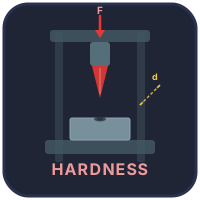
Before any component enters service, its mechanical properties must be verified through standardised tests. Hardness testing measures a material's resistance to permanent indentation. The three principal methods — Brinell (ball indenter, heavy load), Rockwell (cone or ball with direct-reading scale), and Vickers (diamond pyramid, micro to macro loads) — each suit different applications and material types. Hardness values correlate with tensile strength and wear resistance, making hardness testing one of the most frequently performed quality checks on the shop floor. Impact testing using the Charpy and Izod pendulum methods evaluates a material's toughness, specifically its ability to absorb energy during sudden fracture. The ductile-to-brittle transition temperature (DBTT) revealed by impact testing at varying temperatures is critical for selecting steels used in cold environments such as Arctic pipelines, LNG storage tanks, and offshore structures. Together, hardness and impact tests give workshop engineers a rapid, reliable picture of material suitability.
Who Uses These Simulators?
These workshop and manufacturing simulators serve a broad range of learners and professionals. TVET students and apprentices use them to familiarise themselves with machine tool controls, cutting operations, and workshop calculations before entering a physical workshop. Mechanical engineering undergraduates apply the simulators in manufacturing technology and machine design coursework. Workshop instructors use the explore and simulate modes during classroom demonstrations, projecting interactive diagrams of lathe parts, weld symbols, or tolerance zones on screen. Design engineers reference the bolted joint and tolerance fit calculators during preliminary design. Quality inspectors review hardness and impact testing procedures. Even experienced machinists benefit from refreshing their knowledge of thread standards and weld symbol interpretation.
Explore Other Categories
If you found these workshop and manufacturing simulators helpful, explore our other categories: Measuring Instruments Simulators for Vernier calipers, micrometers, and precision gauges, Mechanisms & Machines Simulators for cams, gears, and linkages, and Strength of Materials Simulators for beam bending, stress analysis, and structural design tools.