Potential and Kinetic Energy Simulator
Energy stores & Joule’s experiment in 2D and 3D — Simulate • Explore • Practice • Quiz

Display Controls
Σ Live equation — values from the moment on screen
1 Overview
A rider moves along a track while the simulator shows where its energy is at every moment: kinetic (green), gravitational potential (blue), elastic potential in a spring (purple), thermal from friction and bounces (orange) and the total (yellow). It has four modes: Simulate, Explore, Practice and Quiz.
2 Getting Started
Pick one of the eight scenes in card 1: Skate ramp, Coaster hills, Loop-the-loop, Pendulum, Drop & bounce, Spring launcher, Joule’s experiment and Build your own. The run starts at once. Drag the rider on the track to hold it anywhere, and let go to release it. Space pauses and plays; R restarts the run.
The page opens in the 3D view on a computer or tablet and in the 2D view on a phone. The 2D | 3D switch is at the left of the bar under the scene, and the page remembers your choice. Add ?view=2d or ?view=3d to a link to open a particular view.
3 Simulate Mode
- Rider & world (card 2): the mass (the energies scale, the motion does not), gravity on Earth, the Moon, Mars or Jupiter, friction μ and the speed the rider leaves at when you release it.
- Scene settings (card 3): the drop height and bounciness of the ball, the spring’s stiffness and compression, the pendulum’s length and the loop’s radius. On the skate ramp, the coaster hills, the spring launcher and Build your own, drag the white points to reshape the track, and add or remove points.
- Joule’s experiment: a falling weight turns paddles in a can of water. Card 3 sets the drop height and the mass of water; Wind up lifts the weight for another drop, and Do 20 drops repeats it automatically, as Joule did. The Inside the can panel shows the paddles turning and the thermometer rising.
- The energy-flow diagram (Sankey) shows where the energy came from on the left and where it is now on the right, joined through one gold total that never changes. Untick Energy flow in Display Controls to hide it.
- The bar chart shows each energy on a fixed scale, with the starting total as a dashed line the Total bar always touches. Tick Pie chart in Display Controls for the shares. Drag the blue PE = 0 line to move the zero of potential energy: PE and the total shift, the motion does not.
- The graph under the scene: Energy vs position draws PE along the track with the mechanical energy as a yellow line, so the green gap between them is the kinetic energy and the rider turns round where they meet; Energy vs time plots every energy over the last 12 seconds.
- Slow the run to ½× or ¼× with the speed buttons. In 3D, drag the rider to move it, drag elsewhere to orbit, and Ctrl + scroll (or pinch) to zoom; Ride follows the rider along the track.
4 Explore, Practice & Quiz
Explore has twenty cards in five groups: Forms of energy, Conservation, The law & Joule, Friction & the real world and Common mistakes, each with a worked example. Practice mixes thirteen kinds of problem: kinetic energy, potential energy, speed from a drop, height from a speed, speed at another height, the loop-the-loop, the spring launcher, energy lost to friction, the bouncing ball, Joule’s experiment, work into heat, efficiency and the pendulum. Quiz asks six questions drawn at random from a pool of twenty-four, with the options shuffled, and scores you with up to three stars.
5 Key Concepts
KE = ½mv², PE = mgh and EPE = ½kx². With no friction KE + PE stays constant, so a rider released from rest at height h reaches v = √(2gh) at the bottom: 9.9 m/s from 5 m on Earth, whatever its mass. Friction moves energy into the thermal store; the total of all four never changes. In Joule’s experiment the falling weight’s PE becomes heat in the water, ΔT = Q / (mwc). The simulator works in SI units (joules, metres, kilograms), as energy is taught in SI everywhere.
6 Tips & Other Features
Release the loop car from below 2.5r and watch the track force at the top go negative: a skater would fall off there. On the Drop & bounce scene each bounce reaches e² of the height before. Σ Calculations works through the numbers for the moment on screen; CSV downloads the energy-time data; PNG or a right-click (long-press) saves the view.
Potential and Kinetic Energy — an Interactive Simulation
Energy is never made or destroyed: it only moves from one store to another. This simulator makes that law of conservation of energy visible. A skater on a half-pipe, a coaster car, a pendulum bob, a bouncing ball and a spring-launched block move on tracks you can reshape, a falling weight warms water in Joule’s paddle-wheel experiment, and live energy bar charts, an energy-flow diagram, a pie chart and two energy graphs show kinetic, potential, elastic and thermal energy changing from moment to moment, in a flat 2D view or a true-size 3D scene.
Kinetic Energy and Potential Energy
Kinetic energy is the energy of motion, KE = ½mv². Because speed is squared, doubling the speed quadruples the kinetic energy. Gravitational potential energy is energy stored by height, PE = mgh, measured from a zero level you choose. A spring stores elastic potential energy, ½kx². As a rider goes down, PE becomes KE; going up, KE becomes PE again.
Conservation of Mechanical Energy
With no friction, the mechanical energy KE + PE is constant: ½mv₁² + mgh₁ = ½mv₂² + mgh₂. Released from rest, a rider that has dropped a height h moves at v = √(2gh). The mass cancels, so a heavy car and a light skater reach the same speed. These are the values the simulator gives on Earth (g = 9.81 m/s²) for a 60 kg skater:
| Height dropped h | 1 m | 2 m | 5 m | 10 m | 20 m |
|---|---|---|---|---|---|
| PE turned into KE (60 kg) | 589 J | 1 177 J | 2 943 J | 5 886 J | 11 772 J |
| Speed at the bottom, √(2gh) | 4.43 m/s | 6.26 m/s | 9.90 m/s | 14.01 m/s | 19.81 m/s |
Choose Skate ramp with friction at zero: the yellow Total bar never moves, and the skater rises to exactly the height she started from on every swing.
The Energy–Position Graph
Plot potential energy against position and you get the shape of the track. Draw the total energy as a flat line above it: the gap between the line and the curve is the kinetic energy, and where the curve reaches the line the speed is zero. Those turning points are as far as the rider can go. The Energy vs position graph under the scene draws exactly this, live, with the rider marked on it.
Friction and Thermal Energy
Turn friction up and the mechanical energy falls while thermal energy rises by the same amount: the wheels and track get warmer. KE + PE + Eth still equals the starting total, which is the full law of conservation of energy. A bouncing ball loses energy the same way: with a coefficient of restitution e, each bounce reaches e² of the height before.
The Law of Conservation of Energy
The law of conservation of energy says that energy cannot be created or destroyed: it can only be transferred from one store to another, and in a closed system the total stays the same. Energy gets in or out only as work (a force moving something) or as heat. The Energy flow panel in the simulator draws this as a Sankey diagram: every source of energy on the left (the starting PE, a spring, the work done winding a weight up) flows into one gold total, which splits into the stores the energy is in now. The two sides always add up to the same number, however the energy moves around.
Joule’s Experiment: Work Becomes Heat
Between 1845 and 1850 James Joule showed that heat is a form of energy. Falling weights turned paddles inside an insulated can of water; the paddles churned the water and it warmed slightly. In the Joule’s experiment scene the paddles’ drag grows with the square of the speed, so the weight soon falls at a steady terminal speed and almost all of its potential energy is stirred into the water. The little kinetic energy it still has when it lands becomes heat at the floor. The temperature rise follows from Q = mw c ΔT, with c = 4186 J/(kg·K) for water. Joule repeated the drop about twenty times to get a rise he could measure; the simulator gives these values for a 20 kg weight falling 2 m into 0.5 kg of water on Earth:
| Drops | Work done mgh × n | Heat in the water | Temperature rise |
|---|---|---|---|
| 1 | 392 J | 390 J | 0.186 °C |
| 5 | 1 962 J | 1 950 J | 0.932 °C |
| 10 | 3 924 J | 3 899 J | 1.863 °C |
| 20 | 7 848 J | 7 799 J | 3.726 °C |
The small gap between the work and the heat in the water is the weight’s kinetic energy at landing, about 2.5 J a drop. Winding the weight back up is work done on the system, so the total grows by mgh each time: energy in always equals energy now. The heat that warms 1 g of water by 1 °C, the old calorie, is 4.19 J, which is Joule’s mechanical equivalent of heat. For heating by a flame or an element, see the Specific Heat Capacity Simulator.
The Same Ramp on Other Planets
Potential energy depends on g. A 60 kg skater 5 m up stores very different amounts of energy on different worlds, and reaches the bottom at different speeds, but still rises back to 5 m on the far side:
| World | g (m/s²) | PE at 5 m (60 kg) | Speed after a 5 m drop |
|---|---|---|---|
| Earth | 9.81 | 2 943 J | 9.90 m/s |
| Moon | 1.62 | 486 J | 4.02 m/s |
| Mars | 3.71 | 1 113 J | 6.09 m/s |
| Jupiter | 24.79 | 7 437 J | 15.74 m/s |
Roller Coasters and the Loop-the-Loop
A coaster’s chain lift stores all the train’s energy as potential energy at the top of the first hill, so every later hill must be lower. To stay on the track at the top of a vertical loop of radius r the car needs v² ≥ gr there, which a drop from height h supplies only if h ≥ 2.5r. In the Loop-the-loop scene, drag the car up or down the first drop and watch the track force at the top: below 2.5r it goes negative, and only the coaster’s under-wheels hold the car on.
Who Uses This Simulator?
Students meeting energy in middle school science, GCSE and IGCSE physics, AP Physics 1, IB, CBSE and introductory college mechanics; teachers who want a free tool for energy bar charts, roller-coaster lessons and the work–energy theorem; and anyone revising for a question on kinetic and potential energy.
Frequently Asked Questions
What is the difference between potential and kinetic energy?
Kinetic energy is the energy of motion, KE = 1/2 m v^2: it depends on mass and on the square of speed. Gravitational potential energy is energy stored by height, PE = m g h, measured from a chosen zero level. A skater at the top of a ramp has the most potential energy and no kinetic energy; at the bottom the potential energy has turned into kinetic energy.
Is energy conserved on a roller coaster?
Total energy is always conserved. Without friction the mechanical energy, kinetic plus potential, stays constant, so the car can never rise above its starting height. With friction some mechanical energy becomes thermal energy in the wheels and track, so each hill must be lower than the one before, but kinetic plus potential plus thermal energy still adds up to the starting total.
Why does the speed at the bottom not depend on the mass?
Energy conservation gives m g h = 1/2 m v^2. The mass appears on both sides and cancels, leaving v = sqrt(2 g h). A heavier rider has more potential energy at the top and more kinetic energy at the bottom, in the same proportion, so it reaches the same speed. A drop of 5 m on Earth gives 9.9 m/s for any mass.
How high must a car start to get round a loop-the-loop?
At the top of a loop of radius r the car needs v^2 of at least g r so that gravity alone supplies the centripetal force. Energy from a start height h gives v^2 = 2 g (h - 2r) at the top, so the frictionless minimum is h = 2.5 r. A loop of radius 3 m needs a start at least 7.5 m above the bottom.
What is the law of conservation of energy?
Energy cannot be created or destroyed; it can only be transferred from one store to another, so the total energy of a closed system stays the same. When a weight falls and turns paddles in water, as in Joule's experiment, its potential energy is not lost: it becomes thermal energy in the water. A 20 kg weight falling 2 m twenty times puts about 7 800 J into 0.5 kg of water and warms it by about 3.7 °C.
Explore Related Simulators
- Free Fall & Gravity Simulator: a dropped object with and without air resistance.
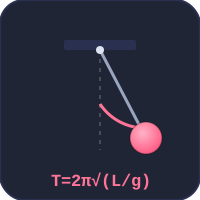
- Simple Pendulum Simulator: the period T = 2π√(L/g) and the energy of a swing.
- Collision & Momentum Simulator: kinetic energy lost in inelastic collisions.
- Hooke’s Law Simulator: springs, F = kx and the energy they store.
- Projectile Motion Simulator: kinetic and potential energy in flight.
- Specific Heat Capacity Simulator: Q = mcΔT for water, metals and oils.
Updated