
Magnetism Explained: An Interactive Magnet Simulator from Grade 3 to Grade 12
A magnet is an object that makes a magnetic field around itself. It attracts iron, nickel, cobalt and most steels, and it pushes or pulls other magnets without touching them. The Magnetic Playground lets you explore that idea on a magnet sandbox: a bench where you bring out real magnets, iron and compasses, push them together, turn them over and watch what happens, with six experiments beyond it that run from Earth’s field to electrons curving in a magnetic field. Everything draws the field and shows its numbers, so the same page works for a Grade 3 lesson on attraction and repulsion and for a Grade 12 problem on Faraday’s law.
Magnetic poles: attraction and repulsion
Every magnet has a north pole and a south pole, where its pull is strongest. Like poles repel and unlike poles attract. Plain iron is attracted by either pole, so the only sure test for a magnet is repulsion. Cut a bar magnet in half and each piece has its own north and south pole: a single isolated pole has never been found. On the sandbox bench the force between magnets is calculated from their poles, so two magnets placed far apart stay put (friction wins) and slide together only when they are close enough for the magnetic force to beat friction.
Learning polarity by playing: what to try on the bench
Put two bar magnets on the bench and push one slowly toward the other. At a few centimetres it jumps the last gap with a click: N has met S. Double-click it to flip it end for end and push again: now it slides away, because N faces N. Do the same with two flat disc magnets, side by side: with the same face up they push apart, and turning one over makes them pull together. That is the whole of polarity in two experiments. A paper clip behaves differently. It jumps to either end of a magnet, because the magnet turns the clip into a temporary magnet whose near end is always the opposite pole. And a compass is a small magnet too: its red, north-seeking tip is pushed away from a magnet’s north pole, which is how you can name the poles of a magnet with no paint on it.
Magnetic field lines, compasses and iron filings
Field lines show the direction a compass needle would point. Outside a magnet they run from N to S, inside it they continue from S to N, they never cross, and they crowd together where the field is strongest. Iron filings and plotting compasses make the pattern visible. Field strength is measured in tesla (T): Earth’s field is 25–65 μT, a fridge magnet a few millitesla, the surface of a neodymium magnet about half a tesla and an MRI scanner 1.5–3 T.
| Idea | Rule or formula | Where to try it |
|---|---|---|
| Poles | like repel, unlike attract | Sandbox: any two magnets |
| Field of a straight wire | B = μ0I / 2πr | Sandbox: current wire |
| Field inside a long solenoid | B = μ0nI | Sandbox: electromagnet |
| Force on a current | F = BIL sinθ | Motor Effect |
| Torque on a coil | τ = NBIA cosφ | DC Motor |
| Faraday’s law | ε = −NΔΦ/Δt | Sandbox: coil and meter |
| Generator EMF | ε = NBAω sinωt | Generator |
| Force on a moving charge | F = qvB sinθ, r = mv/qB | Charged Particles |
| Magnetic dip (dipole) | tan I = 2 tanλ | Earth’s Magnetism |
Which materials are magnetic?
Only ferromagnetic materials are strongly attracted: iron, nickel, cobalt and alloys made from them, including most steels. Most metals are not: copper, aluminium, gold, silver, brass and lead do not stick. That surprises many students, and the sandbox’s test objects are chosen around it, with a “tin” can that sticks (it is steel), an aluminium can that does not, a copper-coloured coin that sticks because it is copper-plated steel, and a US 5-cent coin that does not because its copper–nickel alloy is not magnetic. A steady magnetic field also passes straight through paper, plastic, glass, wood, aluminium and copper; only a magnetic material such as a steel sheet blocks it.
Magnetic domains and the Curie temperature
Inside iron, tiny regions called domains are each fully magnetised. In an ordinary iron bar they point every which way and cancel out; magnetising the bar lines them up. Stroking a steel bar with a magnet, or putting it in a coil carrying direct current, does this. Heating it above its Curie temperature (770 °C for iron, 354 °C for nickel) or hammering it scrambles the domains again. Soft iron loses its magnetism as soon as the field is removed, which is why it is used for electromagnets, while hard steel keeps it and makes permanent magnets.
Earth’s magnetic field
Earth behaves like a giant bar magnet tilted about 10° from its spin axis, with the imaginary magnet’s south pole in the Arctic. That is why the north pole of a compass points north. The field is made by electric currents in Earth’s liquid iron outer core. A dip needle shows that the field also points into the ground: level at the magnetic equator, straight down at the magnetic poles. For a dipole the angle of dip obeys tan I = 2 tan λ, so at magnetic latitude 45° the dip is 63.4°.
Electromagnetism: from Ørsted to the electric motor
In 1820 Hans Christian Ørsted saw a compass needle turn beside a wire carrying current: an electric current makes a magnetic field. Round a straight wire the field lines are circles, given by the right-hand grip rule, and B = μ0I/2πr: 10 A gives 40 μT at 5 cm, about the same as Earth’s field. Wind the wire into a coil around a soft iron core and you have an electromagnet, which is stronger with more current, more turns and an iron core. A wire carrying current across a magnetic field feels a force, F = BIL sinθ, whose direction is given by Fleming’s left-hand rule. A 5 cm wire carrying 3 A across a 0.2 T field feels 0.03 N. Put a coil on an axle between two poles, add a split-ring commutator to reverse the current every half turn, and you have a DC motor.
Electromagnetic induction and generators
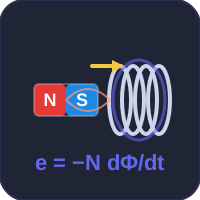
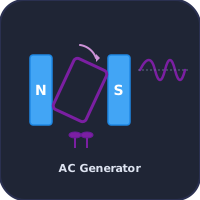
Michael Faraday found the reverse effect in 1831: a changing magnetic field makes a current. Push a magnet into a coil and a meter flicks one way; pull it out and it flicks the other way; hold it still and nothing happens. The induced EMF is ε = −NΔΦ/Δt, and by Lenz’s law the current always opposes the change that caused it, which is energy conservation at work. A generator spins a coil in a magnetic field: ε = NBAω sinωt. A 100-turn coil of area 0.01 m² spinning at 50 Hz in a 0.2 T field gives a peak of 62.8 V.
Charged particles in a magnetic field
A charge moving across a magnetic field feels a force F = qvB at right angles to its motion, so it moves in a circle of radius r = mv/|q|B without speeding up or slowing down. An electron at 2×10⁶ m/s in a 1 mT field circles with a radius of 1.14 cm, and a proton at the same speed circles 1836 times wider. The same force steers particles from the Sun toward the poles to make the aurora, and it is the working principle of mass spectrometers and cyclotrons.
Who uses this simulator?
Elementary students meeting magnets for the first time (NGSS 3-PS2-3), middle-school students learning about fields, electromagnets and Earth’s magnetism (MS-PS2-3, MS-PS2-5), high-school physics students working on electromagnetism and induction (HS-PS2-5, GCSE, IGCSE, CBSE Classes 10 and 12, AP Physics 2), and teachers who want a projector demonstration or a Chromebook activity for every grade from one page.
Frequently asked questions
Which materials are attracted to a magnet?
Only ferromagnetic materials are strongly attracted: iron, nickel, cobalt, most kinds of steel (steel is mostly iron) and some alloys and ceramics. Most metals are not attracted, including copper, aluminium, gold, silver, brass, lead and zinc, and neither are wood, plastic, glass, rubber or paper. A tin can sticks because it is steel with a thin coat of tin.
How can you find the north pole of an unmarked magnet?
Bring a compass close to one end. The compass needle is a magnet too, and its north (usually red) tip is pushed away from the magnet's north pole and pulled toward its south pole, because like poles repel and unlike poles attract. You can also hang the magnet from a thread: the end that swings round to point north is its north pole.
Why does a compass needle point north?
A compass needle is a small magnet that is free to turn. Earth's magnetic field, made by currents in its liquid iron outer core, acts like a huge bar magnet whose south pole lies in the Arctic. Unlike poles attract, so the needle's north pole turns toward the Arctic and points north.
How do you make an electromagnet stronger?
Increase the current, wind more turns of wire on the coil, or put a soft iron core inside it. Inside a long coil the field is B = μ0nI, so it grows with the turns per metre n and the current I, and an iron core multiplies it many times. Reversing the current swaps the poles but does not change the strength.
What is Fleming's left-hand rule?
It gives the direction of the force on a current-carrying wire in a magnetic field. Hold the thumb, first finger and second finger of your left hand at right angles: the First finger points along the Field (north to south), the seCond finger along the Current, and the thuMb gives the Motion (force). The size of the force is F = BIL sin θ.
How does a magnet produce electricity?
Moving a magnet into or out of a coil changes the magnetic flux through the coil, and a changing flux induces a voltage (Faraday's law): ε = −NΔΦ/Δt. The current only flows while the flux is changing, and it flows in the direction that opposes the change (Lenz's law). Generators do this continuously by spinning a coil in a magnetic field.
Explore Related Simulators
Go deeper into induction with the Faraday’s Law simulator, see a full machine in the AC Generator and the DC Motor, step voltages up and down with the Transformer, and build circuits with Ohm’s Law. For the atoms behind magnetism, try Build Your Atom.
Updated