Carburetor Simulator
Six carburettors in section — simple, fixed venturi, SU, slide, diaphragm, pressure — Animate • Learn • Practice • Quiz
Display Controls
⚙ Atmosphere & fine settings
The atmosphere is the ISA troposphere; the deviation changes temperature at each altitude, not pressure. Engine speed is held by a dynamometer, so throttle and speed can be set independently.
Σ Live equations — this carburettor with today’s numbers
▦ Pressures & settings — what each part sees
💡 What-if coach — what the carburettor is doing now
1 Overview
The Carburetor Simulator draws six kinds of carburettor in section and runs each one live on the engine it would feed. Pick a type with the tabs above the drawing: Fixed venturi (Holley, Rochester, Weber, Solex), Simple (the textbook carburettor), CV (SU) constant-depression, Slide (Mikuni VM, Amal), Diaphragm (Walbro, Zama chainsaw carburettors) and Pressure (Bendix-Stromberg aircraft). Every number comes from one model: ISA air, compressible flow through the throttle, a speed-density engine, and the orifice law for every fuel path.
Colours: light blue is air, pink is manifold vacuum (deeper pink is more vacuum), amber is fuel and pale amber is emulsion (fuel mixed with bleed air). Fuel dots move at a speed set by each circuit’s flow, and spray leaves each nozzle in proportion to it.
2 Controls
- Throttle and Engine speed are set separately: a dynamometer holds the speed. Drag the throttle lever (and the choke lever, where there is one) on the drawing.
- Each type has its own tuning parts: jet and venturi diameters and the lip height on the simple carburettor; main jet, air-correction jet, idle mixture screw, fuel level, power-valve rating and tilt on the fixed-venturi type; the jet adjusting nut, needle and damper on the SU; clip groove, main jet, pilot air screw and cutaway on the slide; H and L needles and tilt on the diaphragm; mixture, pump pressure and idle needle on the pressure carburettor.
- Snap throttle closes the throttle, waits a second and slams it open, switching to the Live trace. Lifting-pin test (SU only) raises the piston 0.8 mm for 2.5 s.
- Presets set a whole operating point; any change switches to Custom. Units switch SI and Imperial (kPa ↔ inHg/inH₂O/psi, kg/h ↔ lb/h, L/h ↔ gal/h, mm ↔ in, m ↔ ft, kW ↔ hp); slide cutaways stay in millimetres because that is their part number. The choice is remembered across the site.
3 Reading the Drawing
The banner at the top left names the circuit supplying most of the fuel. Numbered balloons match the key. Pressure tags show the suction where the fuel is drawn, the manifold pressure and, on the SU, the piston lift and the needle diameter in the jet. The fixed-venturi type shows the emulsion well level falling as the suction rises; once it uncovers the emulsion-tube holes, bubbles show the bleed air. Tilting the fixed-venturi or diaphragm carburettor turns the whole body while the fuel in the bowl stays level.
Beside the drawing: manifold pressure, engine speed, fuel flow and air-fuel ratio gauges (EGT for the aircraft carburettor), and a mixture bar where the triangle is the metered mixture and the dot is what the cylinders receive after wall wetting.
4 The Four Charts
- Circuits — air-fuel ratio against throttle opening at this speed, with each circuit’s share of the fuel stacked behind it: see the idle, transfer, main and power circuits hand over, or the slide carburettor’s pilot, needle and main jet.
- Mixture vs airflow — the classic textbook plot. On the simple carburettor it adds the incompressible formula; on the fixed-venturi type, the main jet alone with no air bleed.
- Altitude — the mixture richening as the air thins, with and without automatic mixture control on the pressure carburettor.
- Live trace — eight seconds of airflow, metered mixture and cylinder mixture. Compare Snap throttle with the accelerator pump on and off, or with the SU damper full and empty.
5 Explore, Practice and Quiz
Explore has concept cards for the principle and for each type, with worked examples. Practice generates problems on air-fuel ratio, venturi suction, jet flow and jet sizing, the lip head, the simple-carburettor formula, rejetting, altitude, SU piston depression and lift, needle annulus, jets in series, the air-bleed factor, engine airflow and power-valve ratings, plus pressure-carburettor problems. Quiz draws eight questions from a pool covering every type, with the options shuffled.
6 Model and Limits
Fuel flows are steady orifice flows with constant discharge coefficients. The emulsion well is a linear two-orifice model, the single-cylinder carburettors (slide and diaphragm) see a pulsation factor on their metering suction, and the manifold wall film follows Aquino’s model. The engine figures are representative, not a particular make. Two-stroke short-circuiting, fuel boiling and icing are not modelled.
How a Carburetor Works — Interactive Simulator for Six Types
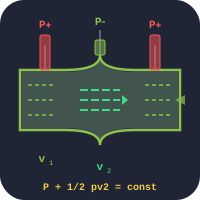
A carburetor (carburettor in British English) meters petrol into the air an engine breathes. The air speeds up through a narrow throat called the venturi, its pressure drops, and that suction draws fuel through a calibrated jet. Because both the air and the fuel follow a square-root law, the fuel flow follows the airflow and the mixture stays near the right ratio. This simulator runs that idea in six real designs, from the simple carburettor of every engineering textbook to the SU, slide, diaphragm and pressure carburettors.
The Six Types Compared
| Type | Examples | What meters the fuel | Typical use |
|---|---|---|---|
| Simple float | Textbook carburettor | One jet, venturi suction minus the lip head | University IC engine courses |
| Fixed venturi | Holley, Rochester, Weber, Solex | Idle, transfer, main with air bleed, power valve, pump | Classic cars, hot rods, small engines |
| Constant depression | SU, Zenith-Stromberg CD, Keihin CV | Tapered needle in a piston at constant depression | British classics, motorcycles |
| Slide | Mikuni VM, Amal, Dell’Orto | Pilot, cutaway, needle and clip, main jet | Two-strokes, racing motorcycles |
| Diaphragm | Walbro, Zama | H and L needles, metering chamber below atmosphere | Chainsaws, trimmers, blowers |
| Pressure (injection) | Bendix-Stromberg PS | Diaphragm servo holds the jet drop equal to the air signal | Piston aero engines |
The Simple Carburettor and Its Air-Fuel Ratio
Write the air through the throat and the fuel through the jet with the orifice law and divide them. The nozzle lip sits a height z above the fuel so that fuel does not dribble out, and the suction must first lift the fuel that far:
A/F = (CdaAt / CdfAj) · √(ρa/ρf) · √(Δp / (Δp − ρf g z))
For a 31 mm throat (Cd = 0.92), a 1.74 mm jet (Cd = 0.75), ρa = 1.225 kg/m³, ρf = 740 kg/m³ and z = 18 mm (a lip head of 131 Pa) the incompressible formula gives:
| Venturi suction | A/F |
|---|---|
| 0.1 kPa | no fuel |
| 0.25 kPa | 22.93 |
| 0.5 kPa | 18.43 |
| 1 kPa | 16.99 |
| 2 kPa | 16.39 |
| 4 kPa | 16.11 |
| 8 kPa | 15.97 |
So the simple carburettor gives no fuel at idle, a lean mixture at low airflow and a steadily richer one as the airflow rises; compressibility of the air at the throat makes it richer still. Every compensating device of a real carburettor exists to fix one of these faults.
The Circuits of a Fixed-Venturi Carburetor
- Float circuit — the float and needle valve hold the fuel level, which sets the lip head.
- Idle (slow-running) circuit — idle jet, idle air bleed and the idle port below the plate, set with the idle mixture screw.
- Transfer slot or progression holes — uncovered as the plate edge sweeps past, they bridge the gap to the main circuit and prevent a flat spot.
- Main circuit — main jet, emulsion tube (main well tube) and air-correction jet (high-speed air bleed). Air bleeding into the well flattens the mixture curve.
- Power valve (economiser, power enrichment) — held shut by manifold vacuum at cruise, it opens at wide throttle.
- Accelerator pump — squirts a shot of fuel when the throttle opens quickly, covering the lean moment while fuel wets the manifold.
- Choke — a plate above the venturi that adds its own suction for a rich cold start.
Constant-Depression (SU) and Slide Carburetors
An SU carburettor has no fixed venturi. A piston rises until the depression under it balances its weight and spring, so the depression stays nearly constant while the gap grows with airflow, and a tapered needle in the fixed jet meters the fuel. The jet adjusting nut lowers the jet for a richer mixture, the oil damper enriches a snap opening, and the lifting-pin test checks the mixture at idle. In a slide carburettor the throttle cable lifts the slide directly: pilot jet and air screw rule idle to ⅛ throttle, the cutaway ⅛ to ¼, the needle and its clip ¼ to ¾, and the main jet ¾ to full.
Diaphragm and Pressure Carburetors
A diaphragm carburettor replaces the float bowl with a sealed metering chamber held a fixed amount below atmospheric pressure by a spring-loaded diaphragm and inlet needle, fed by a pulse pump driven by crankcase pressure. It meters in any attitude; the H needle sets the full-throttle mixture and the L needle the idle. The aircraft pressure carburettor goes further: air and fuel diaphragms on one stem make a poppet valve hold the drop across the metering jets equal to the air signal, and the fuel is sprayed in under pressure downstream of the throttle.
Mixture and Altitude
Air mass flow through the venturi follows the square root of air density but fuel flow does not depend on it, so every carburettor runs richer as the air thins, as √σ:
| Altitude (ISA) | Density ratio σ | A/F if 13.5 at sea level |
|---|---|---|
| 0 m | 1.000 | 13.50 |
| 1,000 m | 0.907 | 12.86 |
| 2,000 m | 0.822 | 12.24 |
| 3,000 m | 0.742 | 11.63 |
| 4,000 m | 0.669 | 11.04 |
Who Uses This Simulator?
Automotive technician students (ASE A8 engine performance, IMI light vehicle, Kfz-Mechatroniker), motorcycle and small-engine technicians tuning slide, CV and diaphragm carburettors, aviation maintenance students learning float and pressure carburettors, classic-car owners setting up SUs and Webers, and mechanical engineering students deriving the simple carburettor in an internal combustion engines course.
Frequently Asked Questions
How does a carburetor work?
Air flowing into the engine speeds up through a narrow throat called the venturi, and its pressure drops. That suction pulls petrol out of a calibrated jet fed from a float bowl, so more air means more suction and more fuel. Separate circuits take over where the venturi alone cannot meter: the idle and transfer circuits at small throttle openings, the main circuit with its air bleed through the middle, the power valve at full throttle, the accelerator pump on a sudden opening and the choke for a cold start.
What are the circuits of a carburetor?
A fixed-venturi carburettor such as a Holley, Rochester, Weber or Solex has a float circuit that holds the fuel level, an idle (slow-running) circuit that feeds below the throttle plate, a transfer slot or progression holes that bridge to the main circuit, a main circuit with an emulsion tube and air-correction jet, a power valve or economiser for full throttle, an accelerator pump for sudden openings and a choke for cold starts.
How do you calculate the air-fuel ratio of a simple carburetor?
Write the air flow through the venturi throat and the fuel flow through the jet with the orifice law and divide them: A/F = (Cda At / Cdf Aj) times the square root of (air density / fuel density) times the square root of (venturi suction / (venturi suction minus fuel density times g times z)), where z is the height of the nozzle lip above the fuel. With a 31 mm throat, a 1.74 mm jet and z = 18 mm the ratio is 16.99 at 1 kPa of suction and 16.11 at 4 kPa.
What is the difference between a CV carburetor and a slide carburetor?
In a slide carburettor the throttle cable lifts the slide directly, so the slide is the throttle and the suction on the needle jet changes with the opening. In a constant-velocity or constant-depression carburettor, such as an SU or a motorcycle CV carb, a separate butterfly is the throttle and the piston is lifted by the depression itself, rising until its weight and spring balance a nearly constant depression. A tapered needle in the piston then meters the fuel.
Why can a chainsaw carburetor run upside down?
A chainsaw uses a diaphragm carburettor. Instead of a float bowl with a free fuel surface, it has a small sealed metering chamber closed by a flexible diaphragm. The diaphragm opens the inlet needle whenever the chamber falls a fixed amount below atmospheric pressure, so the fuel is held at that pressure in any attitude. A float carburettor tilted about 20 degrees can flood.
Why does a carburetor run rich at altitude?
Air mass flow through the venturi follows the square root of the air density, but the fuel flow through the jet does not depend on air density at all. So the air-fuel ratio falls in proportion to the square root of the density ratio. A carburettor set to 13.5 at sea level gives about 11.6 at 3,000 m, where the density ratio is 0.742. Aircraft pilots lean the mixture, and pressure carburettors can carry an automatic mixture control.
Explore Related Simulators
- Four Stroke Engine Simulator: the engine a carburettor feeds, with its Otto cycle and valve timing.
- Two Stroke Engine Simulator: the crankcase-scavenged engine behind slide and diaphragm carburettors.
- Bernoulli’s Principle Simulator: the venturi that makes the suction.
- Orifice Lab: the square-root law that governs every jet.
- Turbocharger Simulator: forced induction, and why boost and carburettors are tricky partners.
- Radial Engine Simulator: the aero engines that used pressure carburettors.
Updated