Pressure Carburetor Simulator
Bendix-Stromberg injection carburetor in section — Animate • Learn • Practice • Quiz
Display Controls
⚙ Atmosphere & fuel supply
The atmosphere is the ISA troposphere; the deviation changes temperature at each altitude, not pressure. The fuel pump pressure is the gauge pressure at the carburetor inlet (chamber E). The idle mixture needle sets the idle valve: richer than 1.0 opens it.
Σ Live equations — the force balance with today’s numbers
▦ Chamber pressures — A to E, the nozzle and the manifold
💡 What-if coach — what the carburetor is doing now
1 Overview
The Pressure Carburetor Simulator draws a Bendix-Stromberg PS-type pressure (injection) carburetor in section, on a 360 in³ (5.9 L) four-cylinder aero engine, and runs it live. Intake air rises through the venturi and past the throttle plate; the regulator on the right compares the air metering force (chamber A impact air against chamber B venturi suction) with the fuel metering force (chamber D unmetered fuel against chamber C metered fuel) and moves the poppet valve until the two balance. Every pressure, flow and valve position on the drawing is computed, not animated by hand.
The colours follow the FAA handbook’s figure: light blue impact air, slate venturi suction, red unmetered fuel, rose metered fuel, purple inlet fuel and pink manifold air above the throttle.
2 Controls
- Throttle and Engine speed set the airflow (a constant-speed propeller holds the rpm). You can also drag the throttle lever on the drawing.
- Mixture runs from Idle cut-off (0 %) through lean to Full rich (100 %). It opens a needle in parallel with the main metering jet; idle cut-off shuts the poppet valve.
- Altitude is pressure altitude in the ISA atmosphere. Higher means thinner air, so a fixed mixture runs richer.
- Accelerating pump, Automatic mixture control and Carburettor heat switch those systems in and out.
- Atmosphere & fuel supply holds the ISA temperature deviation, the fuel pump pressure and the idle mixture needle.
- Presets set a whole flight condition; any change switches to Custom. Units switch SI and Imperial (kPa ↔ psi/inHg, kg/h ↔ lb/h, °C ↔ °F, m ↔ ft, kW ↔ hp); the choice is remembered across the site.
3 Reading the Drawing
The arrows on the two diaphragms are the air force (blue, opening) and the fuel force (red, closing), drawn to the same scale: when the carburetor is regulating they are equal. The poppet moves with the stem; at idle it sits wide open because the idle valve on the throttle shaft is doing the metering. Fuel dots move at a speed set by the flow, the nozzle sprays in proportion to it, and the pump diaphragm moves with manifold vacuum. Pressure tags show each chamber relative to ambient.
The cockpit gauges show manifold pressure, rpm, fuel flow and EGT; the bar beside them is the cylinder mixture, from rich to lean, with best power and peak EGT marked.
4 The Four Charts
- Fuel schedule — F/A against airflow from idle to full throttle at the current rpm, mixture and altitude: rich at idle, flat through cruise, a step up when the enrichment valve opens.
- Mixture curve — power and EGT against the mixture setting at the current throttle: find peak EGT and best power.
- Altitude — F/A against altitude at the current settings with and without automatic mixture control.
- Live trace — the last eight seconds of airflow, fuel flow and the F/A the cylinders actually receive. Press Snap throttle with the accelerating pump on, then off, and compare.
Right-click (long-press on touch) the canvas to save an image, copy the readings, export CSV or reset.
5 Calculations and Learning Panels
The calculator icon works the operating point through step by step: atmosphere, airflow, the air signal, the regulator balance, the jet flow, the fuel-air ratio and the engine output. The learning panels show the live equations, a table of every chamber pressure and a coach that explains what the carburetor is doing.
6 Explore, Practice and Quiz
Explore has sixteen cards in four groups: Fundamentals, Metering, Systems and Operation. Practice generates ten kinds of problem (F/A, lambda, jet flow, venturi suction, altitude richening, ISA pressure, BSFC, fuel volume, engine airflow and diaphragm force), worked in SI. Quiz draws six questions from a pool of twenty and shuffles the options.
7 What the Model Assumes
Air through the venturi is treated as incompressible (throat Mach below 0.25); the throttle is a compressible orifice that chokes. Fuel passes a series of sharp orifices (poppet, jets, idle valve) and a spring-loaded nozzle that opens at 5 psi. The diaphragms have equal areas and the poppet servo is taken to settle instantly (its moving parts weigh a few grams). The 3 L manifold fills and empties by the throttle and engine flows; part of the fuel wets its walls and evaporates over 0.7 s (Aquino’s model), and the cylinders breathe the manifold’s own mixture of air and fuel vapour, so a snapped throttle runs them lean for a moment unless the accelerating pump fills the gap. Engine power uses a constant indicated efficiency shaped by the mixture, with friction and pumping losses; EGT is an empirical curve that peaks at stoichiometric. The automatic mixture control is ideal (signal × σ). The numbers are typical of a PS-5C on a 180 hp engine, not a calibration sheet.
How a Pressure Carburetor Works — Interactive Simulator
A pressure carburetor, also called an injection carburetor, meters fuel for a piston aero engine without a float bowl. Fuel arrives from the engine-driven pump under pressure and stays in closed chambers. A regulator weighs the air flowing through the venturi against the fuel flowing through the metering jets, and a spring-loaded nozzle sprays the metered fuel into the air downstream of the throttle. Bendix-Stromberg built them as the PS, PD, PT and PR series, and the same servo-regulator idea lives on in the Bendix RSA fuel injection system. This pressure carburetor simulator draws a PS-type unit in section and computes every pressure in it live.
The Five Chambers and the Two Forces
- Chamber A — impact air. Impact tubes face the incoming air and carry its total pressure, slightly above ambient.
- Chamber B — venturi suction. A port at the venturi throat carries the lowest air pressure in the carburetor.
- Chamber D — unmetered fuel. Fuel that has passed the poppet valve but not the jets.
- Chamber C — metered fuel. Fuel downstream of the main metering jet and the mixture needle, on its way to the nozzle.
- Chamber E — fuel inlet. Pump pressure, through the strainer, with a vapour vent back to the tank.
The air diaphragm between A and B and the fuel diaphragm between C and D are fixed to one stem that carries the poppet valve. The air metering force, (pA − pB)·S, pushes the poppet open. The fuel metering force, (pD − pC)·S, pushes it closed. With equal areas the stem settles where the drop across the jets equals the air signal.
Why Fuel Flow Follows Airflow
The air signal is the impact pressure plus the venturi suction, and both grow with the square of airflow: pA − pB = ṁa²/(2ρ)·[1/(CdAv)² + 1/Ab²]. Fuel through a jet follows ṁf = CdAj√(2ρfΔp). Set the jet drop equal to the air signal and the airflow cancels: the fuel-air ratio is the same at every throttle setting and depends only on the jet area and on √(ρf/ρa). That last term is why a fixed mixture richens with altitude by 1/√σ, and why the pilot leans in the climb or an automatic mixture control bleeds chamber A into chamber B.
| Altitude (ISA) | Density ratio σ | F/A if 0.080 at sea level |
|---|---|---|
| 0 ft | 1.000 | 0.080 |
| 4,000 ft | 0.888 | 0.085 |
| 8,000 ft | 0.786 | 0.090 |
| 12,000 ft | 0.693 | 0.096 |
Idle, Enrichment, Acceleration and Shut-down
At idle the air signal is almost zero, so an idle spring holds the poppet open and an idle valve on the throttle shaft limits the fuel; the idle mixture needle sets it. Near full power an enrichment valve opens beside the main jet and lifts the mixture from about 0.080 to about 0.095 to cool the cylinders. When the throttle is snapped open the air arrives at once but the fuel lags, partly because some of it wets the manifold walls, so an accelerating pump held back by manifold vacuum squirts an extra charge into the nozzle line. Moving the mixture to idle cut-off shuts the poppet, so the engine stops cleanly with no fuel dribbling from the nozzle.
Pressure Carburetor vs Float Carburetor
A float carburetor is simpler, but it needs gravity to hold its fuel level, it stops in negative g and its fuel evaporates in the venturi, chilling the throttle body and making carburettor ice. A pressure carburetor works in any attitude, resists vapour lock because its fuel is pressurised, and evaporates its fuel downstream of the throttle. Its price is complexity: diaphragms that age, seals, and a flow bench to calibrate it.
Who Uses This Simulator?
Aviation maintenance (A&P / B1) students learning the powerplant fuel metering syllabus, pilots who want to understand what the mixture lever and the EGT gauge are telling them, and mechanical engineering students studying venturi metering and orifice flow.
Explore Related Simulators
- Four Stroke Engine Simulator: the engine this carburetor feeds, with its Otto cycle and valve timing.
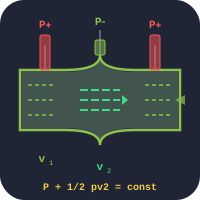
- Bernoulli’s Principle Simulator: the venturi that makes the air metering signal.
- Orifice Lab: the square-root law that governs every metering jet.
- Gas Turbine Simulator: the jet engines that replaced piston aero engines.
Updated